


use factory resistor wire to trigger relay for HEI


Thread Starter
Registered User
Joined: Aug 2012
Posts: 314
From: Bel Air, MD
use factory resistor wire to trigger relay for HEI
Can I use the factory resistor wire to activate a relay and just send 12v directly to my HEI from the battery? If not, what is a good spot to tap into to get 12v keyed?
Found this diagram, however it is for a GTO and I dont not know if they used the same points setup as the olds.

Found this diagram, however it is for a GTO and I dont not know if they used the same points setup as the olds.

Registered User
Joined: Feb 2010
Posts: 1,585
From: Modesto CA
X2 on running a new wire off the IGN spade on the fuse block. You will have to run a 12v wire to that relay anyways. Why not do less work and use less money/parts.
I actually have a M&H engine harness set up with the proper wiring and connectors for an HEI distributor and internally regulated alternator. Mine needed to be replaced and I was able to order to my specs. It looks identical the factory harness except for the mods.
I actually have a M&H engine harness set up with the proper wiring and connectors for an HEI distributor and internally regulated alternator. Mine needed to be replaced and I was able to order to my specs. It looks identical the factory harness except for the mods.
Registered User
Joined: Oct 2010
Posts: 1,275
From: Boise ID
Can I use the factory resistor wire to activate a relay and just send 12v directly to my HEI from the battery? If not, what is a good spot to tap into to get 12v keyed?
Found this diagram, however it is for a GTO and I dont not know if they used the same points setup as the olds.
Found this diagram, however it is for a GTO and I dont not know if they used the same points setup as the olds.
Registered User
Joined: Oct 2010
Posts: 1,275
From: Boise ID
Yes I do carry an extra in my tool box right beside the replacement HEI module.
azure blue 442
Joined: Sep 2013
Posts: 103
From: Mount Forest,Ontario, Canada
horn relay stand off
Your relay idea will work fine. I've had a similar set up on my 70 442 for years.
However, if you are sourcing power from the horn relay stand off, use 10 gauge wire to the relay and from the relay to the coil/module connection.
I suggest a 25 or 30 amp fuse.
14 gauge wire will lose some voltage ,while #10 won't at these current levels and wire lengths.
Also, be sure to buy a minimum 30 amp relay of reputable quality. It will last longer, and have less voltage drop across the internal contacts.
Happy wiring.
However, if you are sourcing power from the horn relay stand off, use 10 gauge wire to the relay and from the relay to the coil/module connection.
I suggest a 25 or 30 amp fuse.
14 gauge wire will lose some voltage ,while #10 won't at these current levels and wire lengths.
Also, be sure to buy a minimum 30 amp relay of reputable quality. It will last longer, and have less voltage drop across the internal contacts.
Happy wiring.
Last edited by dmullin; Mar 26, 2014 at 05:05 PM.
azure blue 442
Joined: Sep 2013
Posts: 103
From: Mount Forest,Ontario, Canada
There isn't anything wrong tapping off the battery if you fuse it close by.
But the horn relay stand off is intended for branching from, and its closer, neater and also comes from a fusible link source.
But the horn relay stand off is intended for branching from, and its closer, neater and also comes from a fusible link source.
Administrator
Joined: Oct 2009
Posts: 42,496
From: Poteau, Ok
What determines 12v during cranking are the 2 wires that used to be on the coil positive terminal of your original wiring. There is the resistor wire and the wire provided for the bypass circuit from the starter. In your drawing they are connected to terminal 86 on the new relay.
Ben
Joined: Mar 2009
Posts: 1,851
From: Snohomish, WA
This is what I've done on several cars- just cut it back to the minimum length you can safely work with by the connector- strip, then solder on a new wire, cover with heat shrink. Always gotten the full 12 volts afterwords.
Thread Starter
Registered User
Joined: Aug 2012
Posts: 314
From: Bel Air, MD
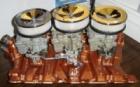
I took the carb off last night, might swap my HEI while I have easy access to the dist.
Registered User
Joined: Feb 2013
Posts: 15,409
From: Phoenix, AZ
I measured mine several yeas ago using a Fluke 189 multimeter in Fast Min/Max mode and the highest reading was just over 5 Amps. I am not 100% certain I was able to capture the peak values with this method, though.
Registered User
Joined: Oct 2010
Posts: 1,275
From: Boise ID
What I mean is you are driving at night with the air on, blower motor on high headlights on high beam and stereo running full blast, that's when that old fuse box is being seriously overtaxed. When you have a stand alone ignition system it has a better chance of not having a voltage drop that could harm something.
Am I making any sense?
Registered User
Joined: Feb 2013
Posts: 15,409
From: Phoenix, AZ
You guys are still missing the point of the relay, it has nothing to do with what amperage the ignition is pulling and has everything to do with how much amperage everything else added together is using.
What I mean is you are driving at night with the air on, blower motor on high headlights on high beam and stereo running full blast, that's when that old fuse box is being seriously overtaxed. When you have a stand alone ignition system it has a better chance of not having a voltage drop that could harm something.
Am I making any sense?
What I mean is you are driving at night with the air on, blower motor on high headlights on high beam and stereo running full blast, that's when that old fuse box is being seriously overtaxed. When you have a stand alone ignition system it has a better chance of not having a voltage drop that could harm something.
Am I making any sense?
And are you certain that the fuse box is being "seriously overtaxed" in that situation? I have been there many times and nothing catastrophic happened.
Last edited by Fun71; Mar 28, 2014 at 03:07 PM.
azure blue 442
Joined: Sep 2013
Posts: 103
From: Mount Forest,Ontario, Canada
40 year old electrical system
Hei ignition systems are designed to run at full electrical system voltage.
The electrical system designed for the original ignition will make the hei operate, but at what level?
Electrical loads don't really pull current. A given voltage will push a given current through a given resistance.
Therefore, if extra resistance is added to the primary ignition circuit by factors such as switch contacts, fusebox and bulkhead connections, in many cases 16 gauge wire and corrosion, you will have an operating voltage drop that induces less secondary current. Less spark.
My point is that by installing a higher output ignition you are requiring more out of the supply circuit than was originally designed for, that's before we account for all the aged parts.
The electrical system designed for the original ignition will make the hei operate, but at what level?
Electrical loads don't really pull current. A given voltage will push a given current through a given resistance.
Therefore, if extra resistance is added to the primary ignition circuit by factors such as switch contacts, fusebox and bulkhead connections, in many cases 16 gauge wire and corrosion, you will have an operating voltage drop that induces less secondary current. Less spark.
My point is that by installing a higher output ignition you are requiring more out of the supply circuit than was originally designed for, that's before we account for all the aged parts.

Thread
Thread Starter
Forum
Replies
Last Post
joepenoso
General Questions
28
Jun 4, 2014 01:56 PM


