


HEI ignition system


Thread Starter
Registered User
Joined: May 2014
Posts: 29
From: SoCal and Northern Cal in winter.
HEI ignition system
Since my wires have been burned out and the firewall chared beyond recognition can anyone tell me where the 3 wires plug into for a new HEI ignition system. I am working on a 1978 GMC Royale, motorhome, and cannot locate any electrical block or connection. The only thing I am sure of is the wire from the ignition switch. Am a newbee.
Thread Starter
Registered User
Joined: May 2014
Posts: 29
From: SoCal and Northern Cal in winter.
OK, there were 3 wires to the distributor that were fried and some kind of plastic part that melted away. The new ones show 3 wires leaving so there isn't some kind of control module they plug into? Originally the ignition system used HEI but someone converted it so they could use an Acell super coil. What a bastardized piece of work! I am not sure how to install a new HEI system now. The fire burned the vacuum lines to the power brakes and something else behind the firewall. As well as the cruise control diaphragm, water hoses, speedometer cable and throtle cable. Wish I I could Blame it on a defective alternator but fair is fair.
Registered User
Joined: Feb 2013
Posts: 15,394
From: Phoenix, AZ
It's the electronic control circuitry for the HEI; it is located inside the distributor underneath the rotor.
http://rmcavoy.freeshell.org/diagrams/HEI.jpg
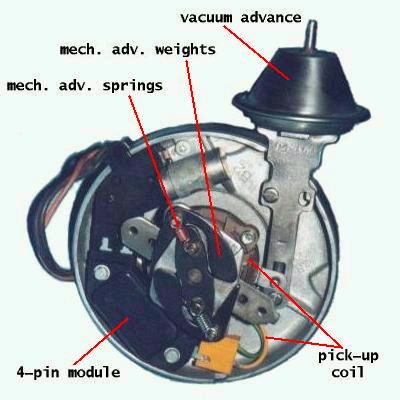
Is that the wiring harness on the distributor as shown on the left upper side of the image above? Or are you referring to a wiring harness coming from somewhere in the engine compartment?
This site has some good info on the HEI and its wiring: http://www.crankshaftcoalition.com/w...EI_distributor
Actually, the remote coil is a very good modification to the HEI: it replaces the in-cap epoxy coil with a remote oil-filled coil. Getting rid of the epoxy coil above the electronic module removes a lot of heat from the under-cap area, so the module runs cooler and as we all know, cooler electronics perform better. The oil-filled coil also runs cooler than the epoxy coil, so it doesn't run the same risk of insulation breakdown as the epoxy coil and it should last longer and perform better.
http://rmcavoy.freeshell.org/diagrams/HEI.jpg
This site has some good info on the HEI and its wiring: http://www.crankshaftcoalition.com/w...EI_distributor
Actually, the remote coil is a very good modification to the HEI: it replaces the in-cap epoxy coil with a remote oil-filled coil. Getting rid of the epoxy coil above the electronic module removes a lot of heat from the under-cap area, so the module runs cooler and as we all know, cooler electronics perform better. The oil-filled coil also runs cooler than the epoxy coil, so it doesn't run the same risk of insulation breakdown as the epoxy coil and it should last longer and perform better.
Last edited by Fun71; Apr 20, 2015 at 12:37 AM.
Thread Starter
Registered User
Joined: May 2014
Posts: 29
From: SoCal and Northern Cal in winter.
Yes there are three wires on the distributor that must plug in somewhere. On my RV the end where those wires attached is a piece of plastic melted over the wire, which is where it went to. Because it is so fried I can't tell what it is.

Old(s) Fart
Joined: Mar 2007
Posts: 50,770
From: Northern VA
From the photo posted above, you can see that the three wires come from the distributor base and plug into the cap. These are the wires that control the coil in the cap. There is a single pink wire from the firewall harness that plugs into the BATT terminal on the cap. If you have a tach, that wire plugs into the TACH terminal on the cap. That's all there is to the HEI wiring.

Administrator
Joined: Oct 2009
Posts: 42,475
From: Poteau, Ok
There are 2 connectors on a GM HEI, the outside 2 female connector is the Batt+ (switched power) the other female spade is for a tach hookup. The inside connector goes from the cap to the module. Red wire to B terminal on the module, green wire to the C terminal, and the black is ground. See attached:

Connoisseur d'Junque
Joined: Sep 2010
Posts: 21,183
From: The Hudson Valley
Sounds like you need a new cap, rotor, wires, pickup, and module.
That being said, it would probably be cheaper to buy a complete replacement HEI distributor.
In your case (late-'70's GMC motorhome), an aftermarket unit would probably not adversely affect your performance (the way it might on a higher-compression, earlier engine).
- Eric
That being said, it would probably be cheaper to buy a complete replacement HEI distributor.
In your case (late-'70's GMC motorhome), an aftermarket unit would probably not adversely affect your performance (the way it might on a higher-compression, earlier engine).
- Eric

Registered User
Joined: Mar 2012
Posts: 548
From: Hickory, North Carolina
From the photo posted above, you can see that the three wires come from the distributor base and plug into the cap. These are the wires that control the coil in the cap. There is a single pink wire from the firewall harness that plugs into the BATT terminal on the cap. If you have a tach, that wire plugs into the TACH terminal on the cap. That's all there is to the HEI wiring.
Is the yellow wire previously used with a non HEI distributor from the coil to the starter solenoid eliminated ? The harness I am using had two wires one yellow one black running to the positive side of the coil. I'm guessing that the black is my power supply and it should run to Bat on the HEI in place of the pink power wire.
Which side of the starter solenoid does the purple wire attach R or S ?
I have read conflicting advise on this.
BTW the car is a 69 Cutlass with a 69 455.
Last edited by Bitburger; May 27, 2015 at 01:39 PM.
Old(s) Fart
Joined: Mar 2007
Posts: 50,770
From: Northern VA
Is the yellow wire previously used with a non HEI distributor from the coil to the starter solenoid eliminated ? The harness I am using had two wires one yellow one black running to the positive side of the coil. I'm guessing that the black is my power supply and it should run to Bat on the HEI in place of the pink power wire.
Which side of the starter solenoid does the purple wire attach R or S ?
I have read conflicting advise on this.
BTW the car is a 69 Cutlass with a 69 455.
Which side of the starter solenoid does the purple wire attach R or S ?
I have read conflicting advise on this.
BTW the car is a 69 Cutlass with a 69 455.
Your HEI needs a full 13.8V in both the START and RUN positions. The easiest way to do this is to 1) replace the black/orange resistor wire with a regular copper wire and 2) connect BOTH the yellow wire and this replacement for the black/orange wire to the BATT terminal of the HEI cap.
Now your HEI gets 13.8V in START from the yellow wire and in RUN from the replaced black/orange wire.
And for those who are wondering, the reason why newer cars only need one wire to the HEI is because the ignition switch on those cars is designed so that one wire gets power in both the START and RUN positions.
Administrator
Joined: Oct 2009
Posts: 42,475
From: Poteau, Ok
The purple wire goes to the S terminal. Your car may or may not need the yellow resistance bypass wire depending on whether your coil wire has power in both the run and on positions of the ignition switch.
Registered User
Joined: Mar 2012
Posts: 548
From: Hickory, North Carolina
Joe,
So when i am done I will still have a yellow wire to the solenoid R side and the purple wire to the S side.
On the HEI I will now have three wires to the Bat side.
Where does the replacement copper wire originate and what guage do you suggest ?
Thanks
So when i am done I will still have a yellow wire to the solenoid R side and the purple wire to the S side.
On the HEI I will now have three wires to the Bat side.
Where does the replacement copper wire originate and what guage do you suggest ?
Thanks
Old(s) Fart
Joined: Mar 2007
Posts: 50,770
From: Northern VA
On the HEI I will now have three wires to the Bat side.
Where does the replacement copper wire originate and what guage do you suggest ?

Thread
Thread Starter
Forum
Replies
Last Post
joepenoso
General Questions
28
Jun 4, 2014 01:56 PM
atkinsom
Big Blocks
12
Nov 21, 2011 09:40 AM


