When you click on links to various merchants on this site and make a purchase, this can result in this site earning a commission. Affiliate programs and affiliations include, but are not limited to, the eBay Partner Network.
I'm currently building a 461 bracket motor for a customer. This motor was designed with long term reliability as the main focus over maximum HP. He wants to put hundreds of runs on it with minimal maintenance. I just finished up the short block and hope to have it finished up and dynoed in the next month. Estimated power will be in the 625-650 hp range.
Specs:
'67 425 .921 lifter block
4.155 x 4.250
Mondello steel main girdle (fitted by me)
13:1 compression
Scat billet 8 cw crank
Molnar 7.00" BBC "power adder" rods.
Diamond 61000-8 Pontiac pistons
268/274 @.050 .735/.735 lift 111 LSA Bullet solid roller cam (mild lobes for lower spring pressure and long life)
Edelbrock Gen 1 heads with 2.100 int. and 1.71 ex. valves mildly ported by Joe Mondello many years ago
Jesel 1.75 ratio shaft rockers
.937 Morel Ultra Pro lifters
Edelbrock Victor intake (4150 that I converted to a 4500 flange)
Moroso single stage belt drive oil pump
1050 APD carburetor
As my name say, NEW TO OLDS. So can some explain this mod? Why and when needed?
The customer wanted more oil pump capacity. Not really necessary at this level but he wants to go overkill on anything to help increase longevity and reliability. An external belt drive pump gives you easy oil pressure adjustment and the ability to prime the oiling system each time you start the engine after sitting for any length of time.
The customer wanted more oil pump capacity. Not really necessary at this level but he wants to go overkill on anything to help increase longevity and reliability. An external belt drive pump gives you easy oil pressure adjustment and the ability to prime the oiling system each time you start the engine after sitting for any length of time.
Ok thanks, I get that. I was asking because I wanted to find out that with say 650 or less Hp, do these OLDS have an oiling issue where something like a Mellings pump isn't enough? Just looking for info to learn these a bit more.
I have crewed for a few guys that used belt-driven, eternal wet-sump SB. And as far as I was told, they did it for high RPM oiling when your over 9000 RPM's. ANd rules had weight adder penalty for dry sumps oiling.
So, the belt driven pump is in addition to the pump in the pan? Just trying to get my head around it.. where's the suction side pull from?
NO the pump in the pan is eliminated. Oil is still fully contained in the pan as normal, along with a manufactured pick-up. Then line run from suction side of pump to pick-up, through pump, and line back to blocks oil passage.
At that point, why not just pull from the pan like a dry sump? Seems overly complicated to me.
It's actually quite simple, works well and is far less expensive than a dry sump set up. A good friend of mine runs this same set up on his 1150 hp 8200 rpm 560 cid Buick.
At that point, why not just pull from the pan like a dry sump? Seems overly complicated to me.
"Oil is still fully contained in the pan as normal, along with a manufactured pick-up". So think of it this was, 1 stage oil system like 1 stage of a dry sump set up. BUT instead of an external tank holding the oil, it stays in the oil pan. Plus some places don't allow dry sumps or have a weight adder. My 6 stage pumps are $2,000+ just for the pump. No lines, fittings tank nothing other then pump, and I have 2 of them. Single external is around $600.
I get that it's basically a 1 stage dry setup. My point was more about what goes on at the bearing cap, why you need a special pickup, and why it can't just pull from a bung in the bottom of the pan. Is the factory filter setup used, or does it do away with that and use a remote?
Here is a pic of the pickup in the pan. Very simple. There is a -12 bung on the outside of the pan. That goes to the suction side of the pump. The pressure side of the pump goes to a remote filter and then back to the inlet fitting at the back of the block I posted above. Also see above the block off plate where the pump originally was. I also put pipe plugs where the original filter housing was but you could just as easily use a block off plate.
Very nice work Chad. Should be a great build!
What's it going in?
What do you think the extra compression is worth?
Say you built the same engine at 11:1?
Always makes me curious why guys want such compression when that engine would make great power a few points lower.
What's your take on it?
I made the fitting. It has a -12 AN top with a .531 inside diameter.
Thanks, the fitting didn't look that big for the .531 passage. That should work out nice. Did you plug the passage on the in block or just block it with the plug?
Thanks, the fitting didn't look that big for the .531 passage. That should work out nice. Did you plug the passage on the in block or just block it with the plug?
Just the block off plate at the cap. To be honest it's really only there to simulate the torque stress of the oil pump. That passage is essentially "dead" so to speak.
Very nice work Chad. Should be a great build!
What's it going in?
What do you think the extra compression is worth?
Say you built the same engine at 11:1?
Always makes me curious why guys want such compression when that engine would make great power a few points lower.
What's your take on it?
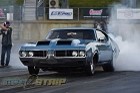
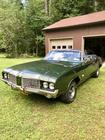
It's going in a 71 Cutlass bracket car. Car is around 3250 lbs with driver. It's a fairly well known car from the old ROP days.
I'd say the compression is worth 20-25hp over an 11:1 pump gas deal. There is more to it though. Higher compression enables you to run more cam duration and still have cylinder pressure thus raising the rpm range. 600hp at 6500 rpm is better than 600hp at 6000 rpm if you goal is to get down the track faster. This is going in a race only car so being able to run pump gas is of no concern.
Its really nice to see dyno testing backed up by supporting data! 593 observed HP makes sense tested in Ohio? in the summer. Is it possible you can supply the flow numbers so we can plug in that component as well? Nice build!
Nice results & power is still maintaining at 6500, looking like it would still make power at 250-500 higher.
I have a question regarding main bearings. With large diameter mains & high bearing speeds, it can limit the max safe RPM.
How successful is reducing the main bearing size to something closer to 2.5"?
Not sure what it would take to find a suitable thrust bearing??? Has anyone experimented with this?
You obviously have the skills to undertake a project like this.