When you click on links to various merchants on this site and make a purchase, this can result in this site earning a commission. Affiliate programs and affiliations include, but are not limited to, the eBay Partner Network.
1964 B body floor brackets, seats, floors, complete interior
Here we go.
This might not be a "major" project to the asylum men, but for me, this is a big deal. And- I hope my efforts are helpful to the next noobie who decides to take on this work. This is my seat mount bracket.
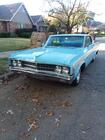
I don't have crazy ideas this car is going to be worth lots of money. I just love this car, and these are my seat mounts. I only discovered they were this bad when I pulled the seats and set them out to the upholsterer. As the Dude says, "This aggression will not stand man".... Or simply, I can't live with this- but what am I going to do?
Well let me tell you... I never rebuilt an engine before, well.. once- with help from my cousin
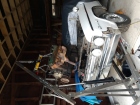
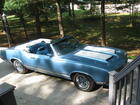
But I rebuilt this engine... and I never did a convertible top, not before now... but I did it.
I don't think that's half bad...
So now I have some real work to do- but I got a barn, and winter is coming.
I ordered floor pans for a 64 Impala, and they're not perfect, but I think they'll do. And I have a hammer and some dollys, and a stump of wood, so I think I can make some shapes with metal. I have a grinder, and a cutting tool, and a few files and a drill... and some time on my hands. I'm thinking I can teach myself to weld, I can patch up these floors, fab some support brackets as needed, replace the carpets, undercoat this car... my wife thinks I'm crazy, but that's nothing new. She's probably right. No sane man ever tried to do anything that everyone else told him he can't do. That's why it takes a little bit of crazy to achieve anything.
Major project? Not by some standards, but by mine, yeah. I'm going to start by buying a wire feed welding tool- I don't even know what it's called! That, and some gloves and a hood with one of those self darkening lenses, so I don't burn my eyes out. And then, I'm going to practice marrying pieces of metal together.
I'm going to fix this. Don't tell me I can't. That only steadies my resolve- I'm stubborn, and when I get it in my head I'm going to do something, I do it. Or, a flame out in the most spectacular fashion. Either way, it'll fun to watch, so stay tuned.
Today I learned a 1964 Impala floor is a poor match for a 1964 Dynamic 88. It might still be easier than starting from sheet steel, and I really just need a couple patches (maybe sheet steel would have been a better choice, considering what these floor pans cost). The biggest difference I see is at the edge, where the flat floor turns upwards at the rocker and the sill. The perimeter frame requires a sharp turn up and the Impala floor turns up more gradually, so I think I'll have to bend it a bit. I just want to get it close enough that I can see it fitting- I'm not there yet. The hole in my floor keeps getting bigger, and this Chevy floor pan keeps getting smaller. Ideally, when they become the same size, the floor pan will fit in the hole. There's not a lot to photograph at this time, but I felt it was worth noting for those who care- Chevy floor isn't a great match for a '64 Olds.
Dam that's too bad, I feel for you. But knowing you you'll get it figured out and resolved. Wish I could help you out but I don't have a clue when it comes to doing this kind of repair work. On the positive you'll be saving a bunch of money by doing it yourself and the money you save will pay for the tools you'll need.
I finished shaping one of the patches... lots of measuring, trimming, grinding and filing, but the Impala floor is a reasonable place to start for the repairs. Here's a couple pictures, that's just a mock up. I want to paint the supports inside with rust inhibitor, clean up all the scaling and such, then I'll weld the new panels in place. That's a pretty good fit I think... That's the Impala floor pan, I had to do a bit of tin knocking but it fits. That's my cat. How did he get in here?
The drivers side floors are moving along! I cut the last patch and fitted it today- it looks great (I think so anyway)> Then I descaled all the supports with a wire brush on my drill and hit it all with rust inhibitor primer and paint. I'll have to grind the paint off some places before I weld the floor patches in, but I couldn't see leaving the metal unprotected. I'm sure it's going to rust eventually, but I believe this will help slow the process.
Great job! Floor panels were what I started with on my 56 Ford pickup. It is the best place to start- learn etc. I started the same as you- no experience with body work- mig welding sheet metal ,etc. I'm sure with your motivation and attitude you will do a fine job. Continue keeping us posted!
SO the passenger side seat support has me a bit worried. As bad as the driver's side was, it was solid. I could give it a swift blow with a hammer without it bending, so I chose to just try to seal the rust and weld in a new floor pan. The other side though, is a bit softer.
the whole center section is rusted away. It's nearly all the way through here.
I busted out a piece of 16 gauge and decided I could beat it into shape, but that didn't work. 16 gauge, I found, is too strong to be beaten into complex shapes with a hammer and dolly. I suppose it could be done, but how long would a person have to beat on it before it yields? Instead, I decided to attempt a little welding project, as much for fun as anything else.... so I grabbed up my 16 gauge sheet and a 1/4" bar stock I had laying around, and tried to fab up a bracket
My next concern is, can I weld this bracket to the old cross members? They're pretty rusty, and my welder is supposedly rated only up to 3/16". Maybe I can drill a hole in each of the bars and do a spot weld, or I can try to just weld the 16 gauge webbing to the cross member. Or, I'll call it a little project I made for fun, leave the bracket as is except to paint it with rustoleum and rely on the new floor pan for most of the seat support. Or I drill a couple little holes in the cross member where I want to weld the bracket and do it from underneath... I'm not sure at this point. Once I cut out the old bracket, I can't put it back in, and I can't buy one.
I think it's Miller time, and this is a question to be answered another day.
Over the years dirt and gravel would accumulate inside of the frames through the holes that run along them from the rain. During the winters the sand would be mixed with salt and no one would bother to rinse all the channels out during the seasons. The first thing I did to my car after I got it was flush all of those spots out with a garden hose. I must of have gotten five gallons of debris when I finished. Haven't done it yet but I'd like to spray all of the inside of the frame areas with one of those products that film coat it. I'm not too concerned about it right now until I get to it because everything is solid and I try not to drive it in the rain and definitely won't be driving it during the winters.
I'm mentioning this because you might want to check your's and do the same and ward off any further rotting problems going forward.
Over the years dirt and gravel would accumulate inside of the frames through the holes that run along them from the rain. During the winters the sand would be mixed with salt and no one would bother to rinse all the channels out during the seasons. The first thing I did to my car after I got it was flush all of those spots out with a garden hose. I must of have gotten five gallons of debris when I finished. Haven't done it yet but I'd like to spray all of the inside of the frame areas with one of those products that film coat it. I'm not too concerned about it right now until I get to it because everything is solid and I try not to drive it in the rain and definitely won't be driving it during the winters.
I'm mentioning this because you might want to check your's and do the same and ward off any further rotting problems going forward.
That's what I'm finding. It's why I opened up as much of the floor as I did, so I can clean out the debris that has collected inside the supports. Then I sealed it as best I could with rustoleum primer and then paint.
Welding sheet metal (without burning through) requires practice and skill.
Is there a local Tech school that offers evening welding courses?
A small 110 volt welder is all you need to weld sheet metal.
Get a MIG welder with a gas bottle.
Stay away from " flux core wire " welders.
Dude, you are of course correct. I had to dial back the voltage, and set the wire feed pretty low too. I still burned through quite a bit, but I was able to get enough really solid welds that I feel good about the job. It's not pretty by any stretch, but it's solid. I used seam sealer to fill it (like bondo over anyone's sloppy metalwork). What surprised me was that the new pans were easier to weld than the old floors. I thought the old floors would be a thicker metal, but I found burn through happened on the old floor, not on the new metal. And I settled for lots of small tack welds. There was no way I would have been able to run a long clean bead with my equipment and limited experience.
I would have liked to have done better. I had to settle for best I could do, and honestly, I think it's solid but not pretty. I'll try again on the passenger side.
Dude, you are of course correct. I had to dial back the voltage, and set the wire feed pretty low too. I still burned through quite a bit, but I was able to get enough really solid welds that I feel good about the job. It's not pretty by any stretch, but it's solid. I used seam sealer to fill it (like bondo over anyone's sloppy metalwork). What surprised me was that the new pans were easier to weld than the old floors. I thought the old floors would be a thicker metal, but I found burn through happened on the old floor, not on the new metal. And I settled for lots of small tack welds. There was no way I would have been able to run a long clean bead with my equipment and limited experience.
I would have liked to have done better. I had to settle for best I could do, and honestly, I think it's solid but not pretty. I'll try again on the passenger side.
You're catching on fast Dave.
Yes, for welding sheet metal you need low heat and a slow wire feed.
Probably the only successful way to weld sheet metal is by using short "stitch welds" of an inch or two at the most.
Go around the welded area with short welds in different locations so that each weld has time to cool before welding near it again.
I'm not sure, Charlie. I decided to clean up the bracket the best I could. I managed to get it shiny both top and bottom. I cut away some of the really rusted pieces and I welded a couple pieces of 16 gauge steel in where the bracket needed support. Then I wire brushed it and whacked it good and hard to make sure it didn't break loose. It ain't pretty but it's in there...