


Whiff of oil


Thread Starter
Registered User
Joined: Nov 2020
Posts: 426
From: Washington State
Or as in my case, your hands get too fat to fit.

Running On Empty
Joined: Jul 2018
Posts: 26,053
From: Earth
Yes, I would expect to see some blowby - generally in the form of light blue smoke out the A$$ end - most of the time. Yet, there's the possibility you won't see any blue smoke, not even light blue smoke. I'd say I've done 40 to 50 compression tests, a dozen ring jobs on several different cars - in my own personal experience I generally see "some" light blue smoke - generally, But, often you have to look awfully hard. These are from my own personal experiences working on my cars & friends cars. Now, I can tell you you'll see significant blowby if you've scorched a cylinder wall. But, hey - if you're confident you're getting 150psi +/- 10% chances are very slim you have a ring issue. You may have valve stem seals issue.
Thread Starter
Registered User
Joined: Nov 2020
Posts: 426
From: Washington State
I've not had a car with bad rings before and it sounds like you have a lot more experience. Would the car run well with a ring issue? Smooth acceleration and idle? I have smelled oil more than once in the cabin with the windows closed when I took my foot off the gas after accelerating. I watched the PCV grommet for about 10 minutes this morning while idling and revving the motor and saw no smoke. I guess most cars don't have blowby as bad as Derick experiences in his rescues on VGG.
Thread Starter
Registered User
Joined: Nov 2020
Posts: 426
From: Washington State
Yes rock steady and 21 inches. A quick snap after revving and releasing the throttle just as dicribed. I will check it again tomorrow. It's been a while, but the car has always consumed oil.

Proud Viet Nam Veteran
Joined: Dec 2006
Posts: 10,817
From: Rowlett, TX
A piston typically has three rings on it. The top two are compression rings and the bottom one is an oil ring. Not likely but it could be a bad oil ring. I am just kind of guessing now. But if that were the case, it should be showing up on your plugs. If it burned two quarts between 3,000 oil changes, I would not worry about it. You could buy a lot of oil for the price of a rebuild. I probably would not worry about a quart every 1,000 miles either but that is me.
Running On Empty
Joined: Jul 2018
Posts: 26,053
From: Earth
The engine can & often runs fairly good with bad rings, but it's highly relative. If it's general wearing of the rings (which would happen to the majority of engines over a period of time) - the engine can & often runs rather well - you simply begin to gradually burn more oil than you normally would. Sometimes there might be a little hesitation, yet a little hesitation isn't a hallmark of any issue with bad rings & let's face it, your issue as you initially described it is not (most likely) a case of a broken/cracked rings (IMO) or scorched cylinder walls etc. I honestly can't put a handle on where that much oil would exiting, other than via the combustion route based on the info you've provided. I guess my next logical choice would be a leak-down test for valve seals? Generally, you'll see the vacuum gauge needle make rapid (sometimes nearly negligible) movements ~1" Hg to maybe 2"Hg or 3"Hg - if you have a rock solid vacuum gauge needle I most likely don't have any other suggestions; and, others w/ more experience will need to chime in.
Running On Empty
Joined: Jul 2018
Posts: 26,053
From: Earth
A piston typically has three rings on it. The top two are compression rings and the bottom one is an oil ring. Not likely but it could be a bad oil ring. I am just kind of guessing now. But if that were the case, it should be showing up on your plugs. If it burned two quarts between 3,000 oil changes, I would not worry about it. You could buy a lot of oil for the price of a rebuild. I probably would not worry about a quart every 1,000 miles either but that is me.


Registered User
Joined: Jan 2010
Posts: 6,105
From: central Indiana
That would work just as well if it's available. I have a 2/10 Amp charger that I don't think would keep up with cranking the 455 in my 71 for very long. Last time I did a compression test I did it dry then tried to do it wet. The battery didn't last through the wet compression test so MAW keep the battery healthy if you can.
The textbook method is to remove all the plugs, disable the ignition, and mechanically hold the throttle wide open. Crank each cylinder an equal number of puffs, the first puff should read at least half the final reading, and no more than 20% variance between the highest and lowest cylinder.
Thread Starter
Registered User
Joined: Nov 2020
Posts: 426
From: Washington State
I hooked up the vacuum gauge this morning. Warmed at idle, it pulls 20 inches and is steady. At approximately 1/3 throttle, it pulls 18 inches and is steady. At as high as I am comfortable revving my car in neutral, maybe 1/2 to 2/3 throttle, it pulls about 16 inches and has a slight quiver, about 1/2 inch fluctuation. When I popped the throttle open and released, it dropped to 0 inches and snapped back to 24 inches before settling back in at a steady 20 inches.
CH3NO2 LEARN IT BURN IT
Joined: Jul 2010
Posts: 5,635
From: Land of Taxes
I hooked up the vacuum gauge this morning. Warmed at idle, it pulls 20 inches and is steady. At approximately 1/3 throttle, it pulls 18 inches and is steady. At as high as I am comfortable revving my car in neutral, maybe 1/2 to 2/3 throttle, it pulls about 16 inches and has a slight quiver, about 1/2 inch fluctuation. When I popped the throttle open and released, it dropped to 0 inches and snapped back to 24 inches before settling back in at a steady 20 inches.
If you have good compression good leak-down rates, no visible blow-by, it's not leaking and you can't see it on the plugs or out the exhaust, simply keep an eye on it to see if consumption goes up. Keep an eye on the plugs and exhaust pipes too
All it takes is one cracked oil control ring. You won't always see it as smoke or a loaded-up plug. It will only rear its ugly head with an increase in oil consumption. Valve seals cause this as well. You will see that on the plugs or the back side of the valves. Definitely would see it by 35K. miles
The fact you can smell it leads me to think you have an oil control problem to some level. Pull that passenger side #8 plug. It could very well be one cylinder causing this.
If the consumption rate increases or you are not satisfied with its current rate of consumption it's time for total disassembly/inspection to see whats causing the elevated consumption.
Thread Starter
Registered User
Joined: Nov 2020
Posts: 426
From: Washington State
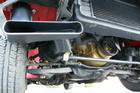
The only other thing I can think of is a slow leak out of the lower passenger rear valve cover bolt burning on the exhaust. I had to tighten the rest of the bolts because they were leaking. I couldn't tighten that one because I used the 350 covers which don't have a notch. The Pac-a-Jet 455 covers from the jet boat the motor came out of didn't have the notch either. A leaking valve cover may not show up on the floor if the oil burns on the exhaust while running down the road. Maybe I can try to reach the bolt now that I have a better tool kit.

Thread
Thread Starter
Forum
Replies
Last Post


