When you click on links to various merchants on this site and make a purchase, this can result in this site earning a commission. Affiliate programs and affiliations include, but are not limited to, the eBay Partner Network.
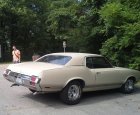
Hey folks, long time! It's Mac with the '71 Supreme 🙂
I'm installing a 100 amp Summit brand internally regulated alternator and just have a couple of quick questions, mostly to give me emotional security 🙄
1. The instructions call for at least an 8 awg wire from the Batt terminal to the battery (or for us, to the horn relay), which means an 8 awg from the relay to the battery for a 4 foot run, or under. I'm routing the wire as the stock wire was run; along the intake/head, back behind the block / brake booster area, turn, up over the wheel-well to the relay. So I've made my wires out of 6 awg, but it just looks overkill. I realize it won't hurt anything to go bigger but 10 awg to 6 is a big jump. Opinions?
2. I used my multimeter to verify the original Batt wire at both the alternator and the horn relay, but just to verify, it is not the red wire with the fusible link, correct? That one goes to the instrument panel?
I have the wiring diagram from the CSM and the diagrams of the necessary alterations for a 1-wire, and I've made my jumpers for the voltage regulator plug, so I'm pretty set. And just FYI, I'm not buying into the 1-wire alt is better, it's just the only chrome unit I could get from Summit before September.
Edit: that is NOT the terminal I am using for the 6 awg wire. I got lazy for a second but ran out and grabbed some copper lugs and soldered them to the ends,
10 awg vs 6
I hope everyone is doing well....or well enough. That goes for Eric, Joe, and the "other" Eric.
-Mac
One wire alternators don't compensate for voltage drop in the alternator-to-distribution post wire. Large (low resistance) wire gives full voltage at the distribution point.
@oldcutlassThanks Eric, good to know you're still here. I'm doing "okay". The lockdown left me with a rather annoying case of temperature intolerance. Other than that, I'm still kicking. Is Gary correct? Did you mean stress the stud physically or electrically? My guess is both 😁
@VC455 Thanks for the explanation, Gary. I didn't know that about the one-wires, but I figured there had to be a catch.
@Olds64 Didn't mean to imply that I wanted to cut corners. I already have the 6 awg wire. I just needed verification that I wasn't insane putting in that large of a wire.
Lastly, logic suggests that I should use 6 awg wire for the battery-to-horn relay connection (which I've already made), otherwise it would be a bottleneck. Thanks for the help, and good to know this site is still bustling!
@oldcutlassThanks Eric, good to know you're still here. I'm doing "okay". The lockdown left me with a rather annoying case of temperature intolerance. Other than that, I'm still kicking. Is Gary correct? Did you mean stress the stud physically or electrically? My guess is both 😁...
Don't put physical stress on the stud. 6awg will carry 100A on lengths of up to 20'.
Ima throw my ante in the pot. First, 4ga charge line off an 100a alternator. Second, they sell the 2 pin connector that plugs into that 1 wire alternator. They usually put a rubber plug over the pins. I sleep better with the ignition turning the regulator on.
Ima throw my ante in the pot. First, 4ga charge line off an 100a alternator. Second, they sell the 2 pin connector that plugs into that 1 wire alternator. They usually put a rubber plug over the pins. I sleep better with the ignition turning the regulator on.
Yeah, I never understood the attraction of the one-wire alternator, especially since the car is already wired for three wires.
Ima throw my ante in the pot. First, 4ga charge line off an 100a alternator. Second, they sell the 2 pin connector that plugs into that 1 wire alternator. They usually put a rubber plug over the pins. I sleep better with the ignition turning the regulator on.
Originally Posted by joe_padavano
Yeah, I never understood the attraction of the one-wire alternator, especially since the car is already wired for three wires.
Well huh, I hadn't thought about the the order of operations, thanks. It makes sense for the VR to come on first. Glad I'm making this easily reversible. Just pull the jumpers and install a solid state regulator. But I'm kind of committed with the one-wire for now. @joe_padavano I've seen in other posts that you refer to a junction block on the firewall. I don't seem to have that in my '71. I have the voltage regulator and the high-speed fan relay, the wiper motor and the AC stuff, but that's all. Is it another year that has the junction block? Just curious.
Yeah, I never understood the attraction of the one-wire alternator, especially since the car is already wired for three wires.
Because it’s far easier for people to spend money on aftermarket crap than learn how the system is suppose to work, and make it work correctly. These same people have a car full of cheap crimp butt connectors and wire nuts, and wonder why the car isn’t reliable.
But the aftermarket is willing to fix thier problem on your dime. I noticed several companies offer a module to turn on a warning lamp if the charging system fails. You know, the feature OEM alternates have.
But the aftermarket is willing to fix thier problem on your dime. I noticed several companies offer a module to turn on a warning lamp if the charging system fails. You know, the feature OEM alternates have.
That module is like $25 or $30. To replace a function that the car had from the factory. I have no problem separating idiots from their money.
The one wire alternator works great on street rods and cars that came with a generator.
I converted my 62 from generator to CS130. The wire for the GEN light is already in the harness. The only new wire I had to run was the sense wire to the junction block.
I converted my 62 from generator to CS130. The wire for the GEN light is already in the harness. The only new wire I had to run was the sense wire to the junction block.
Glad I'm making this easily reversible. Just pull the jumpers and install a solid state regulator. But I'm kind of committed with the one-wire for now.
No problem with your going one wire or three wire. Much of this post is concerned with understanding the difference between the two.
Here's a diagram that illustrates the function of the two wires that are missing from a one-wire alternator. Follow the wires from the tabs marked 1 and 2 at the center of the diagram.
The wire from Tab 1 has two functions. It signals the alternator to turn on when you turn the key on. And it lights the dash warning lamp if the alternator fails.
--One wire alternators turn on at a minimum speed and can't shine the warning light.
The wire from Tab 2 senses the voltage at the Junction Block. The internal voltage regulator adjusts voltage at Bat so that it delivers full voltage to the junction block.
--One wire alternators only deliver full voltage at the Bat terminal. You compensated by putting a fat wire between Bat and Junction Block to minimize voltage drop.
The Diagram also shows the wire I mentioned before...
The wire from Junction Block to Energizer (Battery) was factory-sized to include enough resistance to prevent 100% alternator output going into a low battery. Full alternator output to the battery would boil the acid and spray it on your carefully painted surfaces. That's why I mentioned that you don't want to "upgrade" that wire.
Whichever way you go, there is no need to ever go back to an external regulator, either mechanical or solid state.
The junction block is the threaded post on the horn relay. On most Cutlii it's on the driver side inner fender, but on some cars it's on the firewall.
Ahh, I didn't know the horn relay was located on the firewall of some cars. Thanks for clearing that up, Joe.
Originally Posted by VC455
No problem with your going one wire or three wire. Much of this post is concerned with understanding the difference between the two.
Here's a diagram that illustrates the function of the two wires that are missing from a one-wire alternator. Follow the wires from the tabs marked 1 and 2 at the center of the diagram.
The wire from Tab 1 has two functions. It signals the alternator to turn on when you turn the key on. And it lights the dash warning lamp if the alternator fails.
--One wire alternators turn on at a minimum speed and can't shine the warning light.
The wire from Tab 2 senses the voltage at the Junction Block. The internal voltage regulator adjusts voltage at Bat so that it delivers full voltage to the junction block.
--One wire alternators only deliver full voltage at the Bat terminal. You compensated by putting a fat wire between Bat and Junction Block to minimize voltage drop.
The Diagram also shows the wire I mentioned before...
The wire from Junction Block to Energizer (Battery) was factory-sized to include enough resistance to prevent 100% alternator output going into a low battery. Full alternator output to the battery would boil the acid and spray it on your carefully painted surfaces. That's why I mentioned that you don't want to "upgrade" that wire.
Whichever way you go, there is no need to ever go back to an external regulator, either mechanical or solid state.
I didn't realize wires were sometimes used for their resistance. That must have been carefully calculated 😲 So the engineers were counting on a certain amount of electricity being blead-off by the car's accessories from the junction box so that not all of it was being shunted through the smaller wire to the battery? That seems hard to predict.
So the engineers were counting on a certain amount of electricity being blead-off by the car's accessories from the junction box so that not all of it was being shunted through the smaller wire to the battery? That seems hard to predict.
More accurately, the engineers were counting on a certain I*R (voltage drop from the max charge current thru an easily calculated wire resistance) to limit the charge current into the battery to a value less than the alternator's output capability, leaving a known amount of current capacity left over the car's accessories. If for whatever reason the alternator can't supply enough current under these predicted worst-case conditions, some voltage drop will occur and the lights (and other accessories) dim a bit. Since the point of regulation is at the junction block (and not the alternator's terminal on a 1-wire alt), a varying charge current will have no effect on the voltage supplied to all other accessories - as long as the alternator's current capacity is not exceeded (not so for a 1-wire setup....which is why they recommend a beefier wire between the alt and terminal block).
Now there's a handy chart. Saving this in my files. But, as stated above, if the battery-to-relay wire is supposed to act as a resistor (protecting the battery from overheating), then I can't go by this chart, can I?
Originally Posted by oldcutlass
My question is what other electrical accy's are wired into the car and where did you pickup the connection point?
Oh boy, here we go. Uhh....
1. CD player and amp - amp hooks right to the battery, fused of course
2. 200-4r trans lockup - hooked at an adjunct fuse block I put on the inner fender (with circuit breaker and relay)
3. AFR gauge - hooked to same
4. Gauge lights - tapped into fuse box under dash.
5. AC, headlights, etc.
6. HEI - ran 12 awg non-resist wire
The one-wire is reading 13.7 volts at idle with AC on, fan on high, and headlights on. But the alternator gets very hot. I can only touch it lightly and just for a split second. Is this normal? The internet says it is....but....? I don't think I ever tested my 100 amp, externally regulated alt for temp.
Now there's a handy chart. Saving this in my files. But, as stated above, if the battery-to-relay wire is supposed to act as a resistor (protecting the battery from overheating), then I can't go by this chart, can I?
I don't know where you got that, but the wire is supposed to be the exact opposite of a resistor. You want the minimum resistance possible on that wire. Any added resistance increases voltage drop, which is why this chart has both current and length.
I don't know where you got that, but the wire is supposed to be the exact opposite of a resistor. You want the minimum resistance possible on that wire. Any added resistance increases voltage drop, which is why this chart has both current and length.
It's stated here in this thread.
I'm running 6 gauge from the battery to the relay, and from the relay to the alt. Heading to a car show, fire extinguisher in the back seat, as always.
Modern sealed batteries aren't going to spray any acid. On my 1962, the junction block on the horn relay is where the large gauge battery cable attaches, so there's no resistance there. The alternator to junction block wire I installed was 8 gauge for the 105A CS130 I used and the short length of wire. Resistance there is negligible as well.
It's stated here in this thread.
I'm running 6 gauge from the battery to the relay, and from the relay to the alt. Heading to a car show, fire extinguisher in the back seat, as always.
I wouldn't do that. The starter feed is off that relay junction point, is it not? You're on borrowed time spinning a starter on 6ga.
I wouldn't do that. The starter feed is off that relay junction point, is it not?
No, it is not. That ended with the 1967 cars. The OP's 71 runs the battery cable directly to the starter solenoid. The older relay (left) has a much larger junction block stud than does the newer one (right).
I didn't realize wires were sometimes used for their resistance. That must have been carefully calculated 😲 So the engineers were counting on a certain amount of electricity being bled-off by the car's accessories from the junction box so that not all of it was being shunted through the smaller wire to the battery? That seems hard to predict.
Mac, it's more straight-forward than that.
The alternator puts, say, 14 V at the junction block. For example, a flat battery might safely take 30 amps without boiling and that might occur at a battery terminal voltage of 13.5 V. They would size the wire to have a half-volt drop when it carries 30 amps.
If the accessories took all the output of the alternator, the voltage at the junction would fall and the battery wouldn't charge.
The wire puts only a maximum value on the charge current.
And, as Joe and I said previously, if you always use a modern AGM battery, you can upsize that wire without much risk.
In case it helps, when I did this on my ‘66’s, I ran 2 wires to the junction block - 1 sense wire and 1 field wire on the idea that the output wire (maybe i used 8-10 gauge) for a higher amperage alternator needed to be physically larger over the length (let’s say 6-7’). On later GM 10SI and 12SI you’ll eventually see that 1 terminal is the “S” terminal, 1 is the “F” terminal.
I’m with Joe P on the 1 wire alternators, they just don’t measure system load accurately enough to be useful. Sure they’ll work fine unless you have an edge case electrical system, but you don’t really have a good sense of the draw of all of your electrical accessories. Short run? 1 wire will work just fine. For a few months or a year, don’t sweat it.
Anyway, you might want to run 2 wires to the junction block and just terminate the 14 ga (non-output) wire on both ends when / as / if you pick up that later alternator. Then you just terminate both ends properly and you have a solid remote input about system draw to the ALT, but only have to get into the harness once. Suggest Red color for the big old output wire. I think my remote sense wire is purple, but can’t recall.
My figuring 5-10 years ago was that the number of electrical systems will go up, not down, so getting formal about the voltage draw/drop to the let the alternator compensate was a good move. This has proved true.
The only other recommendation I can make is to separate out some/all of the latter day high amperage draws like amps, 02 sensors and so on off to a separate relay triggered by the key switch. That way, you don’t put unplanned-for high amperage draws on 50+ year old wiring it was never designed to handle.
Somewhere on CO I have a post on how to cleanly install such a relay and it wasn’t too long ago maybe a year or 2, but I feel good about hiving off latter day improvements.
Thanks for all input, fellas.
Joe is correct, my starter wire comes directly off the battery, not the junction block. That would have been a red flag right away. My battery is a new Napa Gold, 800 cranking amps, if memory serves. Again, I'm not thrilled with the one-wire but it seems to be working fine and since I already had a volt meter installed, the "idiot light" not working isn't really an issue. @cfair When I installed the stereo and amp (which I NEVER use, sigh...) the fuse block under the dash started looking a little scary so I followed an online article and installed another fuse block on the inner fender, complete with relays and a breaker, which is fed by the battery.
We drove a good 80 miles last night and everything seemed okay. The wires weren't hot, or even warm, at the battery.
I think it’s pretty cheesy the way GM stole Doc Brown’s invention of the flux capacitor, probably got away with it because he was distracted by time travel. Does seem that the bean counters squashed further development so it never evolved for the at large public.
I think it’s pretty cheesy the way GM stole Doc Brown’s invention of the flux capacitor, probably got away with it because he was distracted by time travel. Does seem that the bean counters squashed further development so it never evolved for the at large public.