


What's that in the frame rail???


Thread Starter
Moderator
Joined: Jun 2006
Posts: 514
What's that in the frame rail???
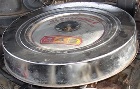
This afternoon I removed the front bumper from a 1970 Delta 88 parts car. Then I noticed something that didn't look right inside the frame rail. How do you think this got there? Looking at the weathering, how long do you think it rode around in there? 
DSCN8347.jpg
DSCN8348.jpg
DSCN8350.jpg
DSCN8351.jpg
DSCN8347.jpg
DSCN8348.jpg
DSCN8350.jpg
DSCN8351.jpg


Connoisseur d'Junque
Joined: Sep 2010
Posts: 21,183
From: The Hudson Valley
I'd look at the base with a loupe to see whether there is anything there that looks like a date code - was that light bulb made in 1969?
I see no way for something that size to accidentally find its way into the frame, so the question in my mind is: Was that bulb one of the no-cost "extras" installed on the assembly line by a bored or annoyed GM worker?
- Eric
I see no way for something that size to accidentally find its way into the frame, so the question in my mind is: Was that bulb one of the no-cost "extras" installed on the assembly line by a bored or annoyed GM worker?
- Eric


Thread Starter
Moderator
Joined: Jun 2006
Posts: 514

 Watts that???



Registered User
Joined: Jun 2009
Posts: 15,192
From: southeastern Michigan
What's weird, though, is where would a line worker get a light bulb unless he brought it from home? Given that the factory was probably lit by fluorescent lights mounted on the ceiling way up high, there would not likely have been any incandescent bulbs laying around. Would a line worker really go through the bother to bring in a light bulb just to hide it in a car going down the assembly line? Why a light bulb and not something that will make a little more noise? If he's a disgruntled worker trying to get back at GM, why not hide something a little more critical to GM's operations, like a tool or an extra car part or something like that?
Connoisseur d'Junque
Joined: Sep 2010
Posts: 21,183
From: The Hudson Valley
Likely they had drop lights with incandescent bulbs for use in certain areas for inspection.
If a drop light bulb burned out (as they do all the time), a worker may have grabbed a replacement, swapped out the bulbs, had the old bulb in his hand, looked around, noted a trash can twenty feet away (or not around at all), and just stuffed it in the frame to keep the line moving.
- Eric
Thread Starter
Moderator
Joined: Jun 2006
Posts: 514
Well, I looked for a date stamp and didn't find anything. The ink on the top of the blub is really faint, but it looks like a Sylvania 60 watt. The gunk on it looks like its been there a while. So however it got there I had a chuckle when I spotted it!

Registered User
Joined: Jan 2017
Posts: 252
From: North Haven CT
I worked at a Ford dealer in the 80's as a mechanic and during a strike talk time we'd find all kinds of strike paperwork jammed in trunks, under seats. I had a 87 Ford Escort GT that had a crank/no start then and it had no comp. I thought, well, check spark, good, fuel, good, then cam timing, good. Ran a comp check, almost 0. Pulled the engine apart, not a one ring on any piston.

Registered User
Joined: Feb 2009
Posts: 11,900
From: Brazil Indiana
I wouldn't be so sure.
Likely they had drop lights with incandescent bulbs for use in certain areas for inspection.
If a drop light bulb burned out (as they do all the time), a worker may have grabbed a replacement, swapped out the bulbs, had the old bulb in his hand, looked around, noted a trash can twenty feet away (or not around at all), and just stuffed it in the frame to keep the line moving.
- Eric
Likely they had drop lights with incandescent bulbs for use in certain areas for inspection.
If a drop light bulb burned out (as they do all the time), a worker may have grabbed a replacement, swapped out the bulbs, had the old bulb in his hand, looked around, noted a trash can twenty feet away (or not around at all), and just stuffed it in the frame to keep the line moving.
- Eric


Registered User
Joined: Aug 2013
Posts: 12,798
From: Evansville, IN
Couple cents from a current auto industry employee, the aboves are right in that equipment sometimes has its own lighting, and back then definitely would have been lightbulbs. Your typical "assembly line" has a conveyor that moves the car down it, and that's either overhead conveyor holding the car on a carrier frame, or a moving floor slat or skillet line holding the car up by posts. Then, you have about 2 feet on either side that is walkway, then flowracks of parts and equipment control panels outside of that. Above those flowracks and the walkway are utilities that my company calls the task equipment, and those things include "star line" (which is a bus of 220/110), air manifolds for 100 psi or so plant air, all the wiring for communications, and, lastly, relevant to this conversation, a continual bank of one or two tube fluorescent lights tilted down at a 45 degree angle on both sides of the line, running the entire length.
The overhead lighting for general lighting of the conveyance aisles between the lines does not do much, and many of the plants of my company don't even have it.
My bet is an underbody inspection or work light burned out and the dude just stashed it there thinking someone on final would pull it before putting the bumper on.
The overhead lighting for general lighting of the conveyance aisles between the lines does not do much, and many of the plants of my company don't even have it.
My bet is an underbody inspection or work light burned out and the dude just stashed it there thinking someone on final would pull it before putting the bumper on.

Registered User
Joined: Mar 2013
Posts: 1,914
From: St. Clair, MI
At the dealer, the customer complained of a metallic rattle in the passenger door of his brand new Pontiac. I pulled the panel out and found someones lunch, 2 tallboy cans of Bud.
Nuts,bolts, screws, were all common finds in doors and other tight areas of cars, the assembly line speed doesn't give enough time to finish your job correctly and fish for lost parts. The current assembly line process requires the assembler to check off on every job, either the job is done to spec, or there is some error that must be checked by repair or inspector. Its part of the drive to error proof the build process. But even with this, defects get thru.

Thread
Thread Starter
Forum
Replies
Last Post


