When you click on links to various merchants on this site and make a purchase, this can result in this site earning a commission. Affiliate programs and affiliations include, but are not limited to, the eBay Partner Network.
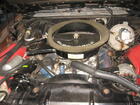
We are currently in uncharted waters with this 455. My dad once had a 1970 442. The engine was rebuilt stock in the 90's, and hadn't accrued many miles before being pulled. I've been inspired lately, and took it on as a project. I was forbidden from taking off the heads, but I cleaned the carburetor and spark plugs, replaced gaskets for the oil pan, valve covers, and water pump. I also replaced the valley pan under the intake manifold.
I got it spinning by hand 2 weeks ago, got it running off the gas bottle 5 days ago, and got it to run off a gas can 2 days ago. I have video of it running if that's useful, but it seemed pretty healthy to me. To tune the carburetor and reign in the timing, we tried to set up a constant loss coolant system.
The first iteration of coolant system was able to hold hose pressure, but didn't have any sort of outlet, so we didn't start the engine. The second iteration ran the hose through the heater valve at the back left of the manifold, which to my understanding, is open during a condition of no vacuum.
Water didn't come out of the low port on the water pump like we expected, and we tried to start the engine to see if vacuum actually opened the heater valve. It cranked and let out one puff of white out of the exhaust. Stomach dropped and we turned off the water. We poured some gas in the carb and it started a little slower than usual. It required a much higher throttle input than usual to keep running, and it died when I let off. When we tried to start again, it ran, but started shooting white vapour and liquid from the carburetor, and kept going until I switched off the ignition. This vapor was in the manifold, carburetor, and cylinders for at least 5 minutes, but did not come out of the exhaust.
I suspect water is getting in the wrong places from the water pump bolts and from a bad RTV seal on the valley pan, because of a milky oil dipstick and the fact that hours elapsed between RTV application and proper torquing of the intake manifold. My father suspects the head gaskets.
I'm looking for advice on what diagnostic steps to take, and what lessons we might take away from this.
Cap the heater ports. Be sure the thermostat is removed. Now run the garden hose to the water pump inlet. The outlet is the thermostat housing. This is how the coolant flows when the engine is running. With an open loop cooling system, the thermostat will never get warm enough to open.
If you suspect coolant in the oil then a compression test is in order. If it has poor compression you can always do a cylinder leak down test.
I dumped the oil today and it was milky. Once we get a new stud I’ll look into getting a compression tester. Using a fuel pressure gauge, two cylinders seem to have a bigger dead spot than others between compression and vacuum, but I’m hoping that it goes away. If it doesn’t, my first thoughts would be a burnt head gasket or a warped head.



 Refresh roadblock