When you click on links to various merchants on this site and make a purchase, this can result in this site earning a commission. Affiliate programs and affiliations include, but are not limited to, the eBay Partner Network.
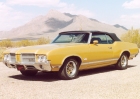
i recently bought a 1971 442 its has a 1969 date coded 455 with Ca heads. ill be pulling the motor soon and separating the body and chassis. id like some opinions on the Ca heads Thanks John
Congratulations on your purchase, beautiful car! Sorry I can't help you on the heads, I own a 67 with the 400ci in it. Good luck with the resto/rebuild.
Ca heads are essentially the same thing as regular C heads and are correct for a 1967-1969 big block. They come in small valve and large valve styles, depending upon the original application. They are a good head for a performance build.
I can't remember what the small A means, maybe the A.I.R. ports are drilled for California emissions? Whatever it is, it's a very minor change from the regular C head.
I always thought the lower case "a" represented the small design change to signify the case hardened seats?
1971 G and 7 heads (sans "A") have hardened seats. So do J and 8 heads. It's not a lower case "A", it's a small capital A. Ironically, in the case of the CA heads, both letters are the same size and smaller than normal.
I guess I still have a question though, which maybe you answered by default?
The "reasons" for the additional "A" was to "signify" a design change of which was the transitioning to case hardened valve seats during this time frame? That's what I recalled during this period of time, but I'm not completely certain, perhaps you know for sure?
It was a change of some sort, but as the 1971 heads show, the hardened seats aren't that change.
For 71-72, was the A to signify the addition of valve rotators? I thought I had read that one year had rotators on the exhaust valve only, and the other year had rotators on both intake and exhaust? That would require a slight change to the valve pocket depth.
Guys - I'm still a newbie in learning about these cars, but the OP stated this motor is a date coded 1969 455. To me, that doesn’t even jive with coming out of a 1969 442. Would the motor have to have come out of of another Olds large car model, perhaps a Toronado???
Guys - I'm still a newbie in learning about these cars, but the OP stated this motor is a date coded 1969 455. To me, that doesn’t even jive with coming out of a 1969 442. Would the motor have to have come out of of another Olds large car model, perhaps a Toronado???
Yes, it is a transplanted engine as the only A-Body to get a 455 in those years was the Hurst/Olds. The 442s got the 400-G block engines, which some folks equate to a boat anchor, so installing a 455 is the logical approach to rectify GM's glaring mistake with what was supposed to be a performance car.
The 442s got the 400-G block engines, which some folks equate to a boat anchor, so installing a 455 is the logical approach to rectify GM's glaring mistake with what was supposed to be a performance car.
69442ragtop - I will state again, I am relatively new to these cars, only owning my 1967 442 for about a year now so excuse me if this is a dumb question. Are you saying that only a 455 out of an A body can go into another A body? The OP is stating he has a 1969 date coded 455 in the 71 442 he recently purchased. If the OP is correct and it truly is a 1969 455, and if it could only come from another A body, then he'd have his hands on a 69 H/O motor in his car, wouldn't that be something!
69442ragtop - I will state again, I am relatively new to these cars, only owning my 1967 442 for about a year now so excuse me if this is a dumb question. Are you saying that only a 455 out of an A body can go into another A body? The OP is stating he has a 1969 date coded 455 in the 71 442 he recently purchased. If the OP is correct and it truly is a 1969 455, and if it could only come from another A body, then he'd have his hands on a 69 H/O motor in his car, wouldn't that be something!
All Olds engines are interchangeable, as in you can easily swap the 260, 307, 330, 350, 400, 403, 425, and 455 engines.
The OP is saying the VIN stamping on his engine shows that it is a 1969 manufactured engine, which would have come from the factory with C, or in his case, CA heads.
Since only the big cars (88, 98, Toronado) and H/Os came with 455 engines that year, his engine most likely started its life in a big car and was transplanted into the 442 in place of the original 400-G block. Dropping a 455 in place of a smaller engine was a very common thing to do back in the days when performance was prized above "originality".
My apologies, I meant no disrespect, but you know what I mean.
I was kidding. I'm used to it by now. Thanks for your post clarifying engine availability -- I could sense that we were about to disappear down a rabbit hole there if not for your intervention.
All - The point I was trying to get across, and was doing a poor job doing so, is if the OP's motor has come out of a 69 Toronado (375 hp), 69 H/O (390 hp), or a 69 Toronado GT (400 hp), he has what I would consider a "special" motor. If it were me, I would want to know if my motor came from one of those 3 models, and what markings/stamps/components of the motor would allow me to make that determination. If I had one of those 3 iconic high output motors, it would make me think twice about replacing OEM spec components of the motor with something different during the motor rebuild, unless your end game is a racing motor.
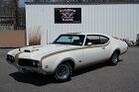
Chris - Hmmmm, that's interesting you bring this up. "If" it were really from a 1969 442, I believe the only 1969 442 with the 455 was the Hurst/Olds 380 hp.
All - The point I was trying to get across, and was doing a poor job doing so, is if the OP's motor has come out of a 69 Toronado (375 hp), 69 H/O (390 hp), or a 69 Toronado GT (400 hp), he has what I would consider a "special" motor. If it were me, I would want to know if my motor came from one of those 3 models, and what markings/stamps/components of the motor would allow me to make that determination. If I had one of those 3 iconic high output motors, it would make me think twice about replacing OEM spec components of the motor with something different during the motor rebuild, unless your end game is a racing motor.
Technology has come a long way since 1969. The car that engine was born in is long gone, so maintaining the OEM parts is a moot point. And frankly, don't believe advertised HP and torque numbers - why would Olds waste the money developing a 370 HP W30 with unique parts when they could have just bolted in a 400 HP Toronado motor that was nearly identical to the base 442 motor in 1970? And if the motor needs to be rebuilt, those OEM parts will be gone anyway.