


Fuel lines, where does return line go?


Thread Starter
Registered User
Joined: Jan 2008
Posts: 238
From: London, Ontario, Canada
Fuel lines, where does return line go?
Hi everyone,
I was hoping to get an answer to my issue with my fuel lines.
I have a 1969 Cutlass Supreme. Putting in a 1970 Olds 350 I acquired. The car has two fuel lines (I believe one would be a return?) from the tank to the front engine area. My fuel pump only has two "ports" one inlet, and one outlet. I also have an Edelbrock 1406 carb with Electric Choke.
Where would the return fuel line get hooked up?
Other questions I have related to this topic:
Is it possible to "flood" the carb if the fuel pump is too strong?
I've run the engine for short times, but it seems like it is going through a lot of fuel when it runs. The carb seems to be set up correctly as far as the adjustments go. I am not sure if this may be related to not having the return line connected somehow.
Can the fuel somehow keep "siphoning" into the carb/engine after the engine is shut off?
This is almost what it seems is happening.
Anyone care to chime in on this?
Thanks
Duane
I was hoping to get an answer to my issue with my fuel lines.
I have a 1969 Cutlass Supreme. Putting in a 1970 Olds 350 I acquired. The car has two fuel lines (I believe one would be a return?) from the tank to the front engine area. My fuel pump only has two "ports" one inlet, and one outlet. I also have an Edelbrock 1406 carb with Electric Choke.
Where would the return fuel line get hooked up?
Other questions I have related to this topic:
Is it possible to "flood" the carb if the fuel pump is too strong?
I've run the engine for short times, but it seems like it is going through a lot of fuel when it runs. The carb seems to be set up correctly as far as the adjustments go. I am not sure if this may be related to not having the return line connected somehow.
Can the fuel somehow keep "siphoning" into the carb/engine after the engine is shut off?
This is almost what it seems is happening.
Anyone care to chime in on this?
Thanks
Duane

Registered User
Joined: Sep 2009
Posts: 1,489
From: KY
They make a fuel pump with three ports one is for a return line to the tank. A stock mechanical pump shouldn't flood the engine due to the fact the engine control the pump. When the rpm increase it pumps more fuel. At idle it pumps less fuel. The needle valve and float control the amount of gas in the fuel bowl. If you have a with the needle valve and seat, dirt could cause the valve to hang up either causing not enough fuel or to much fuel in the bowl. If the float is set wrong same thing too much or not enough. If a float has a hole in it you would have a problem with not enough fuel. A lot of times with aftermarket Carbs. You have to adjust them or change part to make them work on your engine. Metering rods, setup springs, or the primary jets. Sometimes the Edelbrock have problems with dirt getting in between the metering rod and the primary. Keeping the metering rod from working letting too much fuel going into the primary at lower rpm. A good fuel filter and driving with air cleaner on will prevent this. If it is a new carb it could be stuff left over from the box it came in.
Last edited by 70 cutlass s; Dec 17, 2009 at 03:31 AM. Reason: I left off the n't on shouldn't sorry know it makes more sence.
Registered User
Joined: Dec 2007
Posts: 369
From: Nuremberg, GERMANY
Hi Duane
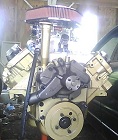
Here i attached an image from my 350 where the lines were hooked on....
if you hook on the return lines correctly, normally the carburator should not be flooted at anytime, thats what i would say....
Do you have a original fuel pump????
Hope that helps....
Torsten
Here i attached an image from my 350 where the lines were hooked on....
if you hook on the return lines correctly, normally the carburator should not be flooted at anytime, thats what i would say....
Do you have a original fuel pump????
Hope that helps....
Torsten
Thread Starter
Registered User
Joined: Jan 2008
Posts: 238
From: London, Ontario, Canada
Awesome pic man!
Thanks a bunch.
That is exactly what I thought. I have the wrong fuel pump.
According to my manual, all V8 with A/C in '69 should have the pump like in your pic, WITH a return line outlet.
I have two pumps here, of course, both are wrong.
I found one on e-pay, for 19.99
I may just order it.
Thanks guys!
Duane
Thanks a bunch.
That is exactly what I thought. I have the wrong fuel pump.
According to my manual, all V8 with A/C in '69 should have the pump like in your pic, WITH a return line outlet.
I have two pumps here, of course, both are wrong.
I found one on e-pay, for 19.99
I may just order it.
Thanks guys!
Duane


Old(s) Fart
Joined: Mar 2007
Posts: 50,770
From: Northern VA
Just to clarify this thread, the reason for fuel return is to reduce the chance of vapor lock. That's why it was factory installed on those cars that ran a risk of high underhood temperatures - A/C cars and high perf cars. It's a good thing to keep.
The return line recirculates fuel from the pump back to the tank. Since the return line is a smaller diameter than the other lines, it has more resistance. This causes the pump to send fuel to the carb first, but as soon as the needle closed, the fuel goes back to the tank. This constant circulation of the hot fuel back to the cool tank keeps fuel temps under control and thus helps reduce vapor lock.
The return line recirculates fuel from the pump back to the tank. Since the return line is a smaller diameter than the other lines, it has more resistance. This causes the pump to send fuel to the carb first, but as soon as the needle closed, the fuel goes back to the tank. This constant circulation of the hot fuel back to the cool tank keeps fuel temps under control and thus helps reduce vapor lock.
Registered User
Joined: Jan 2009
Posts: 171
From: North FL
Not to high jack 69rman's thread but when not using the return line and keeping the original fuel tank sending unit what would you use to block that port off? Would it be as simple as installing a rubber cap like on a carb or would it need to be filled with soder?
Registered User
Joined: Sep 2009
Posts: 1,489
From: KY
If your talking about the line returning to the tank. Then yes you can just cap it off. Using a rubber "cap".
That would be if you where using a fuel pump that didn't have a return port. Its best to use the right fuel pump for your set up.
Registered User
Joined: Jan 2009
Posts: 171
From: North FL
well i'm using a electric pump (blue holley) and from reading on other sites i read over an article that was covering what joe was speaking about the vapor lock. I was wondering if i would need to order a bypass regulator or would the one that comes with the pump cut it. the car will be street/strip and the fact that i'll be idling at stop lights had me considering this.
Registered User
Joined: Sep 2009
Posts: 1,489
From: KY
I do recommend using a regulator with a electric fuel pump. The regulator that comes with the blue Holley. Will keep your pressure from going over 8psi keeping the engine from flooding at idle. If you want to buy a bypass regulator its up to you. I don't think it needs it as long as you use the regulator that came with the pump.

Thread
Thread Starter
Forum
Replies
Last Post


