


1971 Cutlass Supreme Convertible (#'s Matching)


Thread Starter
Registered User
Joined: Jul 2012
Posts: 12
1971 Cutlass Supreme Convertible (#'s Matching)
Hey guys,
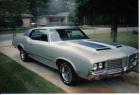
A couple weeks ago, my father and I purchased a cutlass supreme at a car show. With little time to verify authenticity, we made the purchase because of the almost complete body work, original interior in great shape, and the fact that it was a running car that sounded pretty good. We were planning on restoring this car to an enjoyable condition until....... we found out that it was numbers matching. Being the people we are, we can't restore an all original car and not make it look like the day it left the factory. Therefor we are going to follow our instinct and do a full restoration of the car.
I wanted to start this thread because I will have many questions for olds guru's (which I am not) and because I wanted to share this project with everyone. I will post pictures soon!
-Eric T
A couple weeks ago, my father and I purchased a cutlass supreme at a car show. With little time to verify authenticity, we made the purchase because of the almost complete body work, original interior in great shape, and the fact that it was a running car that sounded pretty good. We were planning on restoring this car to an enjoyable condition until....... we found out that it was numbers matching. Being the people we are, we can't restore an all original car and not make it look like the day it left the factory. Therefor we are going to follow our instinct and do a full restoration of the car.
I wanted to start this thread because I will have many questions for olds guru's (which I am not) and because I wanted to share this project with everyone. I will post pictures soon!
-Eric T
Last edited by '71Supreme; Aug 20, 2012 at 04:46 PM.

Thread Starter
Registered User
Joined: Jul 2012
Posts: 12
Transmission #
I went looking for the transmission stamp yesterday and found a number that doesn't match with the car  . Since the motor and body and interior and trim etc.. are all matching and original, I am a little confused as to how in depth of a resto I will be doing based on the value of the car.
Please offer any opinions as to whether I should do an all out factory original resto, or if I shouldnt waste my time without the original tranny.
. Since the motor and body and interior and trim etc.. are all matching and original, I am a little confused as to how in depth of a resto I will be doing based on the value of the car. Please offer any opinions as to whether I should do an all out factory original resto, or if I shouldnt waste my time without the original tranny.

Just an Olds Guy
Joined: Jul 2008
Posts: 24,528
From: Edmonton, AB. And "I am Can 'eh' jun - eh"
Hi Eric, welcome to C.O.
What engine/tranny does this car have? Is it 455/400 or 350/350?
Here is a link to FAQ about olds transmissions. http://www.442.com/oldsfaq/oftrn.htm
I don't know if the OG 71 #### is supposed to match the cars VIN. Most VIN derivatives match the last 6###### on the VIN plate.
If it's a TH350, there should be a stamping on one of the flanged areas with id stamped onto it. Something like this example:
What engine/tranny does this car have? Is it 455/400 or 350/350?
Here is a link to FAQ about olds transmissions. http://www.442.com/oldsfaq/oftrn.htm
I don't know if the OG 71 #### is supposed to match the cars VIN. Most VIN derivatives match the last 6###### on the VIN plate.
If it's a TH350, there should be a stamping on one of the flanged areas with id stamped onto it. Something like this example:
Thread Starter
Registered User
Joined: Jul 2012
Posts: 12
Allan,
The car is a 350/350, I'm still working on figuring out the tramission #'s. The number I took off of it was just above the pan on the drivers side. It had a format of ###N######. The N made me stop and think for a while that it wasn't original because the car was built in Michigan (LAN) but that might be the stamp just for the tranny saying where it was built??
Also, I am wondering about the fuel line pressure because I've heard many things about being careful with a pressurized fuel line when disassembling the carb but I dont know where the pressure relief valve or switch might be. any ideas??
The car is a 350/350, I'm still working on figuring out the tramission #'s. The number I took off of it was just above the pan on the drivers side. It had a format of ###N######. The N made me stop and think for a while that it wasn't original because the car was built in Michigan (LAN) but that might be the stamp just for the tranny saying where it was built??
Also, I am wondering about the fuel line pressure because I've heard many things about being careful with a pressurized fuel line when disassembling the carb but I dont know where the pressure relief valve or switch might be. any ideas??
"Car"mudgeon
Joined: Feb 2011
Posts: 5,191
From: Perry, GA
There will be very little if any pressure when taking the fuel line loose from a '71 350 carb. Unless there has been a fuel pump change to an electric one and then the only pressure will be if the fuel pump is on except for the residual pressure in the line.
Unlike today's fuel injected vehicles that require considerably more pressure and stay pressurized until you relieve the pressure at the port or pull the fuel pump fuse while the engine is running and waiting until it "runs out of gas" and the engine dies on it's own. The carbureted engine with a mechanical fuel pump will actually lose it's pressure (only around 5 psi) when sitting for a good bit and will only build up pressure as you crank the engine over.
So if it's stock with one of these mechanical fuel pumps bolted to the block. (Follow the gas line)

You should be fine to loosen the fuel line from the carb. Make sure you have a few rags to catch the residual gas and I always stick a bolt in it to keep gravity from siphoning gas out of the tank or kink the line over and clamp it to keep that from happening. I hope this helps
Unlike today's fuel injected vehicles that require considerably more pressure and stay pressurized until you relieve the pressure at the port or pull the fuel pump fuse while the engine is running and waiting until it "runs out of gas" and the engine dies on it's own. The carbureted engine with a mechanical fuel pump will actually lose it's pressure (only around 5 psi) when sitting for a good bit and will only build up pressure as you crank the engine over.
So if it's stock with one of these mechanical fuel pumps bolted to the block. (Follow the gas line)
You should be fine to loosen the fuel line from the carb. Make sure you have a few rags to catch the residual gas and I always stick a bolt in it to keep gravity from siphoning gas out of the tank or kink the line over and clamp it to keep that from happening. I hope this helps
Just an Olds Guy
Joined: Jul 2008
Posts: 24,528
From: Edmonton, AB. And "I am Can 'eh' jun - eh"
The car is a 350/350, I'm still working on figuring out the tramission #'s. The number I took off of it was just above the pan on the drivers side. It had a format of ###N######. The N made me stop and think for a while that it wasn't original because the car was built in Michigan (LAN) but that might be the stamp just for the tranny saying where it was built??
Now for the tranny, here's some better info for you to look for. The pic I posted earlier was more for Chevy. Here's where to look for Olds. This is from the 71 CSM:

Thread Starter
Registered User
Joined: Jul 2012
Posts: 12
Thanks guys,
Allan, thats initially where I checked because the service manual had said it was there but our servo seems to be either worn down or there is just no stamps on it... I'm confused by this a little. I found more numbers towards the front of the bell housing drivers side that have "73" in two different places. I'm starting to believe that this is a 73 tranny.
Allan, thats initially where I checked because the service manual had said it was there but our servo seems to be either worn down or there is just no stamps on it... I'm confused by this a little. I found more numbers towards the front of the bell housing drivers side that have "73" in two different places. I'm starting to believe that this is a 73 tranny.
Thread Starter
Registered User
Joined: Jul 2012
Posts: 12
One other thing, we pulled the motor w/o the tranny so the tranny is propped up by a jack stand right now. Do you guys have any little tricks for being able to keep the tranny up w/o a stand so we can move the car around a little?
Thanks
Thanks
Just an Olds Guy
Joined: Jul 2008
Posts: 24,528
From: Edmonton, AB. And "I am Can 'eh' jun - eh"
thats initially where I checked because the service manual had said it was there but our servo seems to be either worn down or there is just no stamps on it... I'm confused by this a little. I found more numbers towards the front of the bell housing drivers side that have "73" in two different places. I'm starting to believe that this is a 73 tranny.
 Well one good thing! You know that car has an Olds 350 that was built in 1971 at Lansing. That's what 31M means. The last 6 digits are vin derivative. They should match your VIN last 6 numbers. By the VIN number (which would be the sequence of production, I'm going to guess your car was built around the first or second week of April 1971. What does your cowl tag say?
Just an Olds Guy
Joined: Jul 2008
Posts: 24,528
From: Edmonton, AB. And "I am Can 'eh' jun - eh"
I should have done some more homework before I posted that ^^^. Apparently GM DID have a tool for exactly what you were asking about. It's shown on page 6B-5 of the 71 CSM (toro application).
It LOOKS like you could make the same bracket out of spare steel to make a cradle that would bolt to the bell housing and be supported by the frame.
It LOOKS like you could make the same bracket out of spare steel to make a cradle that would bolt to the bell housing and be supported by the frame.


Thread
Thread Starter
Forum
Replies
Last Post
Johnd
General Discussion
7
Nov 28, 2013 08:31 AM


