


head light install




Registered User
Joined: Jun 2009
Posts: 15,194
From: southeastern Michigan
Watch this video. He's talking about spark plug wires specifically, but what he says applies generally to electrical connections. Note where he puts the dielectric grease. He puts it on the rubber part of the inside of the spark plug boot, not on the metal connector that attaches to the tip of the spark plug.
"dielectric" = insulator
You do not want to put an insulating material onto a metal electrical connector.

Connoisseur d'Junque
Joined: Sep 2010
Posts: 21,183
From: The Hudson Valley
Yeah.
Dielectric grease probably won't hurt anything, as there is always a thin strip or two of direct metal to metal contact between the connectors of the plug, which won't have grease in between, but, yes, the dielectric grease is designed to be an electrical insulator.
I use Vaseline, myself, but pretty much any grease is probably fine.
- Eric
Dielectric grease probably won't hurt anything, as there is always a thin strip or two of direct metal to metal contact between the connectors of the plug, which won't have grease in between, but, yes, the dielectric grease is designed to be an electrical insulator.
I use Vaseline, myself, but pretty much any grease is probably fine.
- Eric
Registered User
Joined: Jun 2009
Posts: 15,194
From: southeastern Michigan
I think it IS dielectric grease, but they don't put it on the metal terminals. It's put onto the inside plastic part of the socket so that when you go to try to remove the bulb five years from now when it burns out, it comes out easily and is not stuck in there. It also works to prevent corrosion should the socket ever get wet.
It also can be applied to the bulb's sides. A bulb makes electrical contact with the socket at only two or three particular locations.
In the image below, look at the bulb on the right. There is a little nub sticking up from the silver part of the bulb just above the bottom and pointing right at us. That's where one contact is made, usually the ground. The other side of the electrical connection is made at the bottom of the bulb. That's the hot side. You don't want dielectric grease on either of these two points, but it's ok if you get it on the large, flat, silver part of the bulb's side.

As far as making electrical connection to your T-3 headlights, you have female spade plugs that fit over the male spade lugs on the headlight's back side, and the plug side usually is encased in plastic. See below.
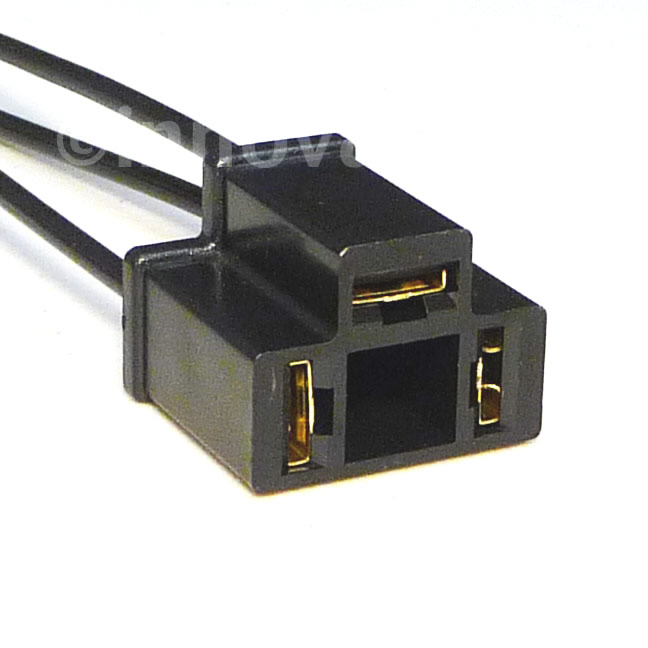
You could put dielectric grease on the bottom, plastic areas of the plug around the openings where the metal contacts are, which will make it a little easier to pull the plug off at some later date as well as prevent arcing, but you don't want to put the grease on the metal itself either in the plug or on the headlight.
It also can be applied to the bulb's sides. A bulb makes electrical contact with the socket at only two or three particular locations.
In the image below, look at the bulb on the right. There is a little nub sticking up from the silver part of the bulb just above the bottom and pointing right at us. That's where one contact is made, usually the ground. The other side of the electrical connection is made at the bottom of the bulb. That's the hot side. You don't want dielectric grease on either of these two points, but it's ok if you get it on the large, flat, silver part of the bulb's side.
As far as making electrical connection to your T-3 headlights, you have female spade plugs that fit over the male spade lugs on the headlight's back side, and the plug side usually is encased in plastic. See below.
You could put dielectric grease on the bottom, plastic areas of the plug around the openings where the metal contacts are, which will make it a little easier to pull the plug off at some later date as well as prevent arcing, but you don't want to put the grease on the metal itself either in the plug or on the headlight.
Registered User
Joined: Jun 2009
Posts: 15,194
From: southeastern Michigan
I would be a little concerned about this. Vaseline is a petroleum grease, which means it's made of hydrocarbons. Plastics are hydrocarbons, so Vaseline can attack plastics, such as the plastic parts of a bulb socket or headlight connector.
I've read, for instance, where people have used Vaseline to lubricate the plastic gears in their computer printers only to have the gear teeth soften and fail.
Safer to use one of the dielectric greases on the market as these are generally silicone-based and won't attack plastic.

I've read, for instance, where people have used Vaseline to lubricate the plastic gears in their computer printers only to have the gear teeth soften and fail.
Safer to use one of the dielectric greases on the market as these are generally silicone-based and won't attack plastic.
Connoisseur d'Junque
Joined: Sep 2010
Posts: 21,183
From: The Hudson Valley
- Eric
Registered User
Joined: Jun 2009
Posts: 15,194
From: southeastern Michigan
I'm just sayin'.
Here's an interesting page where they use petroleum jelly to shine up old plastic pieces where plain soap and water didn't work. How does the petroleum jelly make the plastic shine? Because it removes the topmost layer of plastic, because it dissolves the plastic, at least slightly.
The plastic they're talking about here is faded and discolored not because it's dirty but because the plastic pieces after so many years of exposure to air and light have degraded chemically somewhat, at least on their external surfaces. This layer is removed by the petroleum jelly, leaving behind a fresh, not-expose-to-air surface. Of course, over time, this surface will fade as well.
http://lifehacker.com/5902793/restor...using-vaseline
So, as I say, I'm just sayin'.
Here's an interesting page where they use petroleum jelly to shine up old plastic pieces where plain soap and water didn't work. How does the petroleum jelly make the plastic shine? Because it removes the topmost layer of plastic, because it dissolves the plastic, at least slightly.
The plastic they're talking about here is faded and discolored not because it's dirty but because the plastic pieces after so many years of exposure to air and light have degraded chemically somewhat, at least on their external surfaces. This layer is removed by the petroleum jelly, leaving behind a fresh, not-expose-to-air surface. Of course, over time, this surface will fade as well.
http://lifehacker.com/5902793/restor...using-vaseline
So, as I say, I'm just sayin'.
Registered User
Joined: Jun 2009
Posts: 15,194
From: southeastern Michigan
Another issue with Vaseline is that it has a pretty low melting temperature, around human body temperature, which is about 98 F. That's not all that hot, and I certainly wouldn't use it on anything that comes into contact with the engine. Even anywhere under the hood is suspect where, on a hot summer day, temperatures could get above 100 F.
When it melts, it flows away, and whatever lubricating or insulating effects it had are lost.
When it melts, it flows away, and whatever lubricating or insulating effects it had are lost.

Registered User
Joined: Dec 2011
Posts: 7,286
I have put silicone "dielectric" grease on all manner of electrical connections for years with great results. They come apart later easily and they WORK RIGHT because corrosion does not build up. There is always metal to metal contact on the terminals, especially the flat blade terminals like headlights. I pack the cavity full and put some on the tangs. NO PROBLEM.
The grease does not interfere with the conduction of electricity, but corrosion does.
The grease does not interfere with the conduction of electricity, but corrosion does.
Registered User
Joined: Jun 2009
Posts: 15,194
From: southeastern Michigan
Yes, it does interfere with the conduction of electricity. That's what "dielectric" means. You can't change the laws of physics. The reason you don't have electrical problems is that you have metal-to-metal contact where the various connections are made, which is the way connectors work.
It's a two-edged sword. The grease does protect the metal contacts from corrosion, but it can also attract dust and eventually dirty the connection.
As the video I cited above shows, I would use the grease where it is meant to be used, as an insulator around electrical connections to prevent arcing and to make pulling connectors apart and spark plug wires off of spark plugs easier. I would not put it on a metal surface that I want electricity to pass in and out of.
It's a two-edged sword. The grease does protect the metal contacts from corrosion, but it can also attract dust and eventually dirty the connection.
As the video I cited above shows, I would use the grease where it is meant to be used, as an insulator around electrical connections to prevent arcing and to make pulling connectors apart and spark plug wires off of spark plugs easier. I would not put it on a metal surface that I want electricity to pass in and out of.
Registered User
Joined: Jun 2009
Posts: 15,194
From: southeastern Michigan


Registered User
Joined: Jun 2009
Posts: 15,194
From: southeastern Michigan
But I'm like you on the use of these greases. I've used it on spark plug wires and that's it. There are times when I've gone to replace a taillight bulb or turn signal bulb, only to find it kind of stuck in there and me wishing I had put some grease on it before installing it however many years ago. But when I finally do get the bulb out, I never have any grease on hand, anyway, and I just put the new bulb back in without any. It's a vicious circle!
Registered User
Joined: Dec 2011
Posts: 7,286
Somehow the electricity has always found its way thru/ around the godawful layers of non-conducting grease I have used lo these many moons.
Whereas, I have seen, due to NO lube used:
melted plastic terminals from heated connection due to loose/ CORRODED metal. Headlamps and ign switches.
broken off gage package pins due to being stuck together tighter than the mechanical connection at the board can resist.
Bulbs that break off rather than come right out. Typically ruins the socket by the time you are done. What should be a 2m bulb replace becomes a 3 day refurbish of the entire fixture.
The ill effects:
None whatsoever.
So, you pays your money and you takes your choice.
This has been my experience.
Whereas, I have seen, due to NO lube used:
melted plastic terminals from heated connection due to loose/ CORRODED metal. Headlamps and ign switches.
broken off gage package pins due to being stuck together tighter than the mechanical connection at the board can resist.
Bulbs that break off rather than come right out. Typically ruins the socket by the time you are done. What should be a 2m bulb replace becomes a 3 day refurbish of the entire fixture.
The ill effects:
None whatsoever.
So, you pays your money and you takes your choice.
This has been my experience.

Just an Olds Guy
Joined: Jul 2008
Posts: 24,528
From: Edmonton, AB. And "I am Can 'eh' jun - eh"
My opinion. Seeing as this is likely going to the be only thing I'll post in this thread. I found dialetric grease in my tail light sockets and signal light sockets. I've never added anything grease there and we've had the car since it was 2 years old. It seems that if GM uses dialectric grease, it's for a reason. And if it's a non conductor I guess it comes down to weighing in on:
1. How much conductivity is lost?
2. What's the purpose of using it in the first place?
Just based on experience with numerous GM products, I don't think enough conductivity is lost to be concerned about anything. I also don't think Vaseline is a significant issue in the tail light or signal light sockets.
My opinion of why it's there? Simple - prevent corrosion as Chris and Eric have said.
1. How much conductivity is lost?
2. What's the purpose of using it in the first place?
Just based on experience with numerous GM products, I don't think enough conductivity is lost to be concerned about anything. I also don't think Vaseline is a significant issue in the tail light or signal light sockets.
My opinion of why it's there? Simple - prevent corrosion as Chris and Eric have said.
Registered User
Joined: Nov 2006
Posts: 1,918
From: SE Wisconsin
di·e·lec·tric [dahy-i-lek-trik]
noun
1. a nonconducting substance; insulator.
2. a substance in which an electric field can be maintained with a minimum loss of power.
adjective
3. of or pertaining to a dielectric substance.
I think the official definition confounds more than it elucidates?
noun
1. a nonconducting substance; insulator.
2. a substance in which an electric field can be maintained with a minimum loss of power.
adjective
3. of or pertaining to a dielectric substance.
I think the official definition confounds more than it elucidates?

Old(s) Fart
Joined: Mar 2007
Posts: 50,803
From: Northern VA
What the anti-grease crowd here seems to be missing is the fact that if the metal contacts are tight, they will displace the grease in the area of contact. Yes, obviously dielectric grease is a non-conductor, but you DON'T have a solid mass of grease between the terminals. What happens is that the terminals displace the grease as they slide together. The grease then forms around this metal-to-metal contact, sealing out moisture and oxygen that forms corrosion.
Once again, this assumes tight contacts. I've had cases where grease in a loose-fitting tail light socket prevented the bulb from making contact, but squeezing the socket (along with cleaning out the hardened old grease and re-lubricating) fixed the problem.
Also, NEVER use petroleum-based products on plastics, as they will dissolve or at least soften. Always use silicone grease on plastics.
Once again, this assumes tight contacts. I've had cases where grease in a loose-fitting tail light socket prevented the bulb from making contact, but squeezing the socket (along with cleaning out the hardened old grease and re-lubricating) fixed the problem.
Also, NEVER use petroleum-based products on plastics, as they will dissolve or at least soften. Always use silicone grease on plastics.
Registered User
Joined: Jun 2009
Posts: 15,194
From: southeastern Michigan
Not really.
Under "noun," definition 1 says it's an insulator, which is what we've said all along.
Definition 2 is just another way of stating that it's an insulator in that it is a material that can maintain a separation of charge. It does that because it is non-conducting, or, an insulator.
Signed,
Jaunty75
card-carrying member of the "anti-grease" crowd
Under "noun," definition 1 says it's an insulator, which is what we've said all along.
Definition 2 is just another way of stating that it's an insulator in that it is a material that can maintain a separation of charge. It does that because it is non-conducting, or, an insulator.
Signed,
Jaunty75
card-carrying member of the "anti-grease" crowd
Old(s) Fart
Joined: Mar 2007
Posts: 50,803
From: Northern VA
Let me add, by the way, that the grease really applies to Packard 56/59 style unsealed connectors. The Weatherpack and Metripack connectors use little silicone boots at every terminal, eliminating the need for grease to seal out the environment.

Old(s) Fart
Joined: Mar 2007
Posts: 50,803
From: Northern VA
Better invest in wire brushes then.
This whole discussion is like the difference between scientists and engineers. Scientists worry about theoretical crap, like the fact that a dielectric grease won't conduct. Engineers know that in the real world, there will ALWAYS be sufficient metal-to-metal contact.
This whole discussion is like the difference between scientists and engineers. Scientists worry about theoretical crap, like the fact that a dielectric grease won't conduct. Engineers know that in the real world, there will ALWAYS be sufficient metal-to-metal contact.
Registered User
Joined: Dec 2011
Posts: 7,286
Touche'
Jaunty, your card is missing a couple details.
On the car, you need one light out due to corrosion, and another flaming due to the melted plastic from the corroded connection that a tad of silicone grease would have prevented.
Jaunty, your card is missing a couple details.
On the car, you need one light out due to corrosion, and another flaming due to the melted plastic from the corroded connection that a tad of silicone grease would have prevented.
Registered User
Joined: Jun 2009
Posts: 15,194
From: southeastern Michigan
Registered User
Joined: Dec 2011
Posts: 7,286
Funny thing happened the other day. I had an extra minute in the auto parts store and perused the tube o' lube section. So, hey, what is this? [got a photo too]
DIELECTRIC GREASE
"FOR USE ON ELECTRICAL TERMINALS"
Ugh.
I forgot to mention the melted ignition switch terminal cases from overheated terminals also. Damn near a fire.
And the ill effects of using silicone grease on all such things.... oh yeah, NONE.
Imaginary, perhaps.
If folks need to see the pic I will go thru the steps needed to get it from phone to here.
DIELECTRIC GREASE
"FOR USE ON ELECTRICAL TERMINALS"
Ugh.
I forgot to mention the melted ignition switch terminal cases from overheated terminals also. Damn near a fire.
And the ill effects of using silicone grease on all such things.... oh yeah, NONE.
Imaginary, perhaps.
If folks need to see the pic I will go thru the steps needed to get it from phone to here.

Thread
Thread Starter
Forum
Replies
Last Post


