


Is this true?

Thread Starter
1972 U code Supreme
Joined: Jul 2018
Posts: 4,100
From: Chesapeake, VA
Is this true?
On our cruise home from work today, my buddy took a snap of me in my 72 Supreme sitting at a light in the left turn lane. When he sent me the pic, I noticed my left brake lights weren't lit up. I assumed it was an electrical issue that I would have to diagnose (ugh!), but he said that when the turn signal is on, the brake light goes inactive. As a quick diagnosis, I checked my brake lights after dinner tonight, and sure enough, both sides lit up.
I just always assumed that the brake light stays on as long as you're on the brakes, but apparently that's not the case.
Is he right?
Thanks,
Dave
I just always assumed that the brake light stays on as long as you're on the brakes, but apparently that's not the case.
Is he right?
Thanks,
Dave
Thread Starter
1972 U code Supreme
Joined: Jul 2018
Posts: 4,100
From: Chesapeake, VA
Oh boy...here we go. So why would they go out when the turn signal is on? As I said, I checked the brake lights after I got home as well as the turn signals, and everything works as it should.

Registered User
Joined: Aug 2011
Posts: 4,110
The two filament 1157 bulb is so that the dimmer filament illuminates with the tailights. The brighter filament works both the turn signal and brake light. Turn signal off all brake lights work, emergency flasher on turn signal/brake filaments blink all four corners, turn signal on one side brake light becomes the turn signal on that same side only. Check the other side it should act the same way.
Unless I'm misunderstanding the explanation, it sounds normal.
If the brake light on the opposite side goes out, that isn't normal. Then I'd be looking for a bad ground or turn signal switch.
Good luck!!!
Unless I'm misunderstanding the explanation, it sounds normal.
If the brake light on the opposite side goes out, that isn't normal. Then I'd be looking for a bad ground or turn signal switch.
Good luck!!!
Last edited by Sugar Bear; May 30, 2019 at 08:47 PM.
Registered User
Joined: Feb 2013
Posts: 15,411
From: Phoenix, AZ
Arright, so Sugar Bear got me to wondering and I went out and checked my car. Sugar Bear is correct, your lights are working as they should. With the brakes on, the side with the turn signal activated goes completely dark as the signal blinks.
Apparently I was remembering how the lights work when the headlights are on, the brakes are pressed, and the turn signals are activated. In that situation the turn signal side goes dim but not dark when the signal blinks.
I edited my reply above so that future readers are not led astray by my incorrect post.
Apparently I was remembering how the lights work when the headlights are on, the brakes are pressed, and the turn signals are activated. In that situation the turn signal side goes dim but not dark when the signal blinks.
I edited my reply above so that future readers are not led astray by my incorrect post.
Last edited by Fun71; May 30, 2019 at 10:01 PM.
Just an Olds Guy
Joined: Jul 2008
Posts: 24,528
From: Edmonton, AB. And "I am Can 'eh' jun - eh"
Ummm, ok let's take this to a logical conclusion. IF the signal was on when the brakes were applied, how would you know if the signal light was on if the brake lights were on all the time??? That's why eventually GM went to a red/yellow tail light. Even the new cars today the signal light over rides the brake light on lenses that are just red. There's absolutely nothing wrong with Dave's 72 tail lights/brake lights.
Dave, you will notice however that when the park lights or headlights are on, the front signal lights will alternate between front bumper and front side market light.
Dave, you will notice however that when the park lights or headlights are on, the front signal lights will alternate between front bumper and front side market light.
Thread Starter
1972 U code Supreme
Joined: Jul 2018
Posts: 4,100
From: Chesapeake, VA
Ummm, ok let's take this to a logical conclusion. IF the signal was on when the brakes were applied, how would you know if the signal light was on if the brake lights were on all the time??? That's why eventually GM went to a red/yellow tail light. Even the new cars today the signal light over rides the brake light on lenses that are just red. There's absolutely nothing wrong with Dave's 72 tail lights/brake lights.
Dave, you will notice however that when the park lights or headlights are on, the front signal lights will alternate between front bumper and front side market light.
Dave, you will notice however that when the park lights or headlights are on, the front signal lights will alternate between front bumper and front side market light.

Registered User
Joined: Feb 2009
Posts: 2,057
From: Poconos, Pennsylvania
Like Allen mentioned, unlike most older cars, almost all newer cars now have rear turn signals, either red or amber, that are separate from the brake lights. This newer USDOT requirement is so brake lights are lit on each side of the vehicle in addition to the center brake light - whether or not the turn signal is activated.
USDOT used to require front turn signals to be as far away from the headlamps as possible for obvious reasons. Nowadays the turn signals are routinely found near or next to the headlamps, making an activated front turn signal very hard to see - especially when the vehicle has either factory or aftermarket LED or HID headlamps.
On cars so equipped, it is confusing when drivers forget to turn off the rear fog lights when not needed as they are as bright as the brake lights. Not unlike the high beam indicator, it seems drivers either disregard, fail to notice, or not know what the indicator means.
USDOT used to require front turn signals to be as far away from the headlamps as possible for obvious reasons. Nowadays the turn signals are routinely found near or next to the headlamps, making an activated front turn signal very hard to see - especially when the vehicle has either factory or aftermarket LED or HID headlamps.
On cars so equipped, it is confusing when drivers forget to turn off the rear fog lights when not needed as they are as bright as the brake lights. Not unlike the high beam indicator, it seems drivers either disregard, fail to notice, or not know what the indicator means.
'87 Delta 88 Royale
Joined: Dec 2010
Posts: 2,514
From: Margate, England
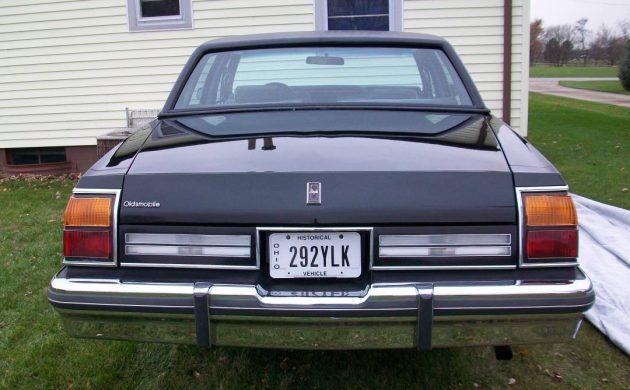
Amber turn signals independent of all other lights are required on all vehicles built after September 1st 1965. A good think IMO.
However many UK American car fans don't trouble to do anything, mostly the traffic police turn a blind eye to this, partly because they have better things to do, and partly because they might not be aware of the precise regulations.
It has led to several ingenious ways round this law, from amber bulbs in the reversing lamps to fitting blue or green lamps inside the red lens. My 1987 Oldsmobile has amber rear indicators anyway so no problem there.
Roger.
However many UK American car fans don't trouble to do anything, mostly the traffic police turn a blind eye to this, partly because they have better things to do, and partly because they might not be aware of the precise regulations.
It has led to several ingenious ways round this law, from amber bulbs in the reversing lamps to fitting blue or green lamps inside the red lens. My 1987 Oldsmobile has amber rear indicators anyway so no problem there.
Roger.
Just an Olds Guy
Joined: Jul 2008
Posts: 24,528
From: Edmonton, AB. And "I am Can 'eh' jun - eh"
'87 Delta 88 Royale
Joined: Dec 2010
Posts: 2,514
From: Margate, England
You are quite right Allan, my bad, I should have said it was a UK regulation. Other European countries have slight differences from UK laws, however on the whole they are rather more stringent than most US states, with the notable exception of emissions laws. Newer cars have to comply with close to US standards, but older cars are mostly exempt.
Roger.
Roger.
Registered User
Joined: Feb 2009
Posts: 2,057
From: Poconos, Pennsylvania
Amber turn signals independent of all other lights are required on all vehicles built after September 1st 1965. A good think IMO.
However many UK American car fans don't trouble to do anything, mostly the traffic police turn a blind eye to this, partly because they have better things to do, and partly because they might not be aware of the precise regulations.
It has led to several ingenious ways round this law, from amber bulbs in the reversing lamps to fitting blue or green lamps inside the red lens. My 1987 Oldsmobile has amber rear indicators anyway so no problem there.
Roger.
However many UK American car fans don't trouble to do anything, mostly the traffic police turn a blind eye to this, partly because they have better things to do, and partly because they might not be aware of the precise regulations.
It has led to several ingenious ways round this law, from amber bulbs in the reversing lamps to fitting blue or green lamps inside the red lens. My 1987 Oldsmobile has amber rear indicators anyway so no problem there.
Roger.

Thread
Thread Starter
Forum
Replies
Last Post


