


External to Internally Regulated Alternator Conversion


Registered User
Joined: Nov 2008
Posts: 3,345
From: Redmond, Oregon
What's your charging voltage?
Is your battery in good condition (does it hold a charge well? what's its resting voltage after the car hasn't run for a day?)?
Is the voltage to the Battery (-) terminal different from the output post on the alternator and from the terminal on the horn relay?
- Eric
I will check on all of this. But, yes the battery holds a charge well. I will check these perameters in a few days. Then see what that tells us.
Thanks
Larry
Is your battery in good condition (does it hold a charge well? what's its resting voltage after the car hasn't run for a day?)?
Is the voltage to the Battery (-) terminal different from the output post on the alternator and from the terminal on the horn relay?
- Eric
I will check on all of this. But, yes the battery holds a charge well. I will check these perameters in a few days. Then see what that tells us.
Thanks
Larry

Thread Starter
Registered User
Joined: Mar 2011
Posts: 558
Connoisseur d'Junque
Joined: Sep 2010
Posts: 21,183
From: The Hudson Valley
The alternator output should definitely be connected to the main power stud on the horn relay.
- Eric
Administrator
Joined: Oct 2009
Posts: 42,513
From: Poteau, Ok
How did you eventually hook yours up?


Administrator
Joined: Oct 2009
Posts: 42,513
From: Poteau, Ok
Sorry, but this picture clearly shows that your going through the battery power bus terminal on the horn relay just as in the schematic above.
Thread Starter
Registered User
Joined: Mar 2011
Posts: 558
I previously had it literally going to the prong on the horn relay like shown on the schematic, not to the hot lug where it is now. The schematic shows to tie into the PRONGS of the horn relay. Not the lug.
Thread Starter
Registered User
Joined: Mar 2011
Posts: 558
Connoisseur d'Junque
Joined: Sep 2010
Posts: 21,183
From: The Hudson Valley
So you connected it to one of the horn terminals.
I must say, I never noticed that the diagram could be interpreted like that, which is why I said that the mistake just didn't compute.
I believe that most of us have, at some time in the past, lived in the Chev-o-centric world, and the problem here is that the picture is a picture of a Chebby horn relay. If you've ever dealt with these, you know what it is and what the terminals are without even thinking of it, or being aware that it is different, so much so, that the idea of advising someone else of that fact would never occur to you.
If you hadn't pointed that out to me, and someone else had asked, I would have said that the picture in the diagram is of an Olds horn relay, just because my brain automatically "converted" the image without my realizing it, as I think everyone else's did, as well.
Here is the Chebby horn relay:


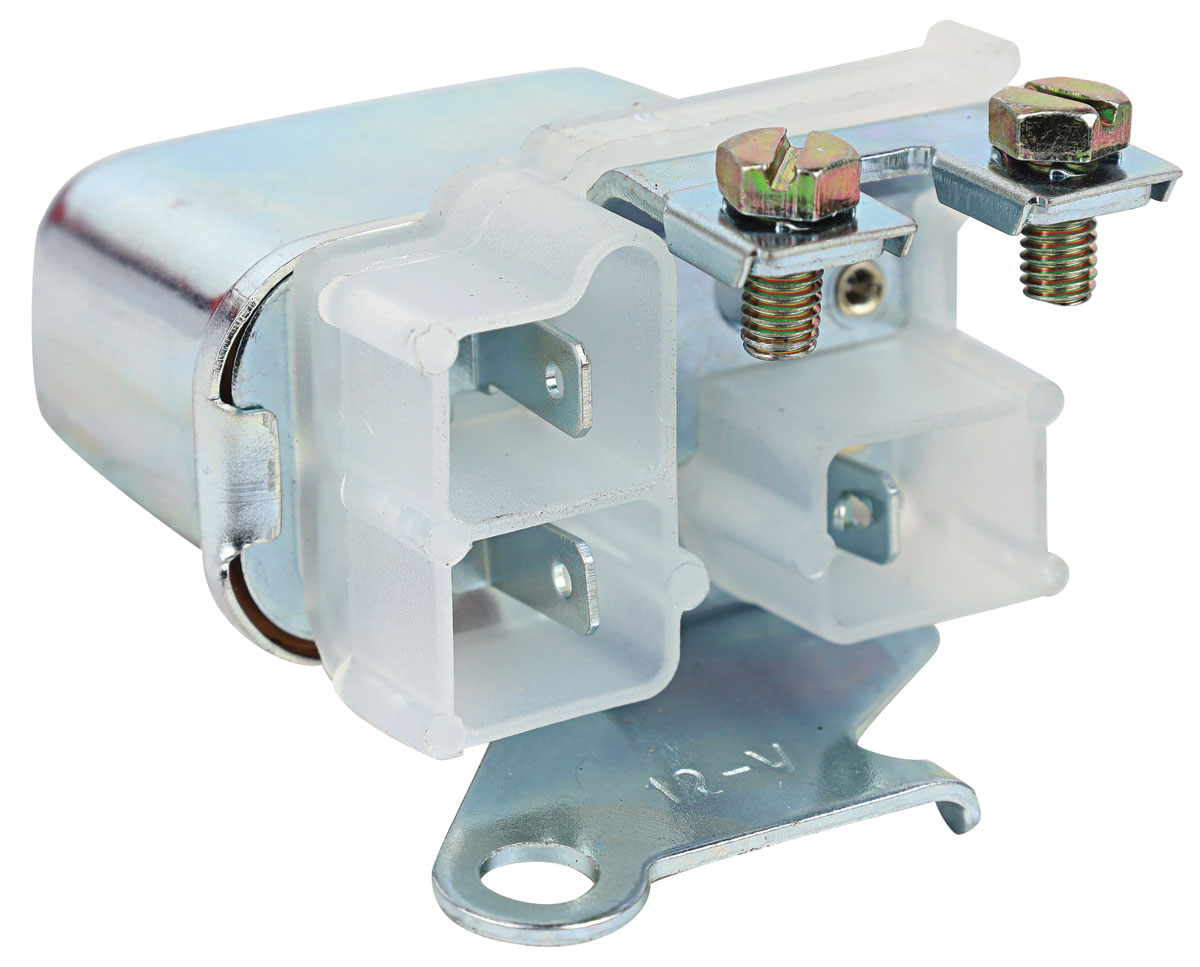
And here is the picture:

Notice that the words "BUS BAR" are clearly written between the two screws to indicate that you are connecting to the bus, and not to anything else.
I guess we will need to modify that diagram to avoid future problems, or perhaps to always link to it with a warning...
I'm sorry that happened.
- Eric
Thread Starter
Registered User
Joined: Mar 2011
Posts: 558
Thanks I'm just not in the know. No I haven't owned an old Chevy with a horn relay like that. I was wondering what "Bus Bar" meant and couldn't figure it out at the time.
I also tied the sense wire straight to the positive lug on the alternator. I heard that may not be the best and it might be better to tie into somewhere further away since its blasting out a bunch of power there and it may not be a true indication of what charging condition are like in most other places in the charging system. Not sure if it matters...
I also tied the sense wire straight to the positive lug on the alternator. I heard that may not be the best and it might be better to tie into somewhere further away since its blasting out a bunch of power there and it may not be a true indication of what charging condition are like in most other places in the charging system. Not sure if it matters...
Last edited by VinMichael; Oct 19, 2016 at 11:27 AM.
Connoisseur d'Junque
Joined: Sep 2010
Posts: 21,183
From: The Hudson Valley
I also tied the sense wire straight to the positive lug on the alternator. I heard that may not be the best and it might be better to tie into somewhere further away since its blasting out a bunch of power there and it may not be a true indication of what charging condition are like in most other places in the charging system. Not sure if it matters...
- Eric

Registered User
Joined: Mar 2014
Posts: 719
Power/amps usually fail at idle on old cars or not driven often, and the cheapest and easiest way to get more is a smaller alternator pulley. This gets more amps sooner even idling. For cheap and easiest to work on, plus amps galore there is this.
http://highperformanceolds.com/phpbb...hp?f=19&t=5036
To wire it into an external regulator circuit I just wired the 2 alternator wires off the 3G into the external regulator connectors on a Ford with spade connectors, that plugs in normally to the external regulator but now is disconnect from the harness.
http://highperformanceolds.com/phpbb...hp?f=19&t=5036
To wire it into an external regulator circuit I just wired the 2 alternator wires off the 3G into the external regulator connectors on a Ford with spade connectors, that plugs in normally to the external regulator but now is disconnect from the harness.
Thread Starter
Registered User
Joined: Mar 2011
Posts: 558
Power/amps usually fail at idle on old cars or not driven often, and the cheapest and easiest way to get more is a smaller alternator pulley. This gets more amps sooner even idling. For cheap and easiest to work on, plus amps galore there is this.
http://highperformanceolds.com/phpbb...hp?f=19&t=5036
To wire it into an external regulator circuit I just wired the 2 alternator wires off the 3G into the external regulator connectors on a Ford with spade connectors, that plugs in normally to the external regulator but now is disconnect from the harness.
http://highperformanceolds.com/phpbb...hp?f=19&t=5036
To wire it into an external regulator circuit I just wired the 2 alternator wires off the 3G into the external regulator connectors on a Ford with spade connectors, that plugs in normally to the external regulator but now is disconnect from the harness.
Registered User
Joined: Mar 2014
Posts: 719
There are two basic problems on charging shortages. One just takes a smaller pulley so lights and batteries stay bright in normal driving, assuming everything else like connections are good.
The second problem is for cars not so daily driven, that lose battery power over days or weeks or longer, and then usually see little actual running time when they are driven. In this case, a bigger amp idle is needed more by the later high amp at idle alternators like the 3G or the CS133. They will pump out a lot more amps fast, even at idle, recharging the depleted battery and covering the amps drawn while running at the same time.
Most just need a smaller alternator pulley when driven often. An easy test is to fully charge the battery up, then start the car and turn lights on and heater blower and radio and then check the idling voltage, with all on, at the battery. I don't like anything under 14, but some think 13 or 13.5 is fine.
Thread Starter
Registered User
Joined: Mar 2011
Posts: 558
No problem at all and glad to help. The smaller pulleys are common and cheap, and take little to change.
There are two basic problems on charging shortages. One just takes a smaller pulley so lights and batteries stay bright in normal driving, assuming everything else like connections are good.
The second problem is for cars not so daily driven, that lose battery power over days or weeks or longer, and then usually see little actual running time when they are driven. In this case, a bigger amp idle is needed more by the later high amp at idle alternators like the 3G or the CS133. They will pump out a lot more amps fast, even at idle, recharging the depleted battery and covering the amps drawn while running at the same time.
Most just need a smaller alternator pulley when driven often. An easy test is to fully charge the battery up, then start the car and turn lights on and heater blower and radio and then check the idling voltage, with all on, at the battery. I don't like anything under 14, but some think 13 or 13.5 is fine.
There are two basic problems on charging shortages. One just takes a smaller pulley so lights and batteries stay bright in normal driving, assuming everything else like connections are good.
The second problem is for cars not so daily driven, that lose battery power over days or weeks or longer, and then usually see little actual running time when they are driven. In this case, a bigger amp idle is needed more by the later high amp at idle alternators like the 3G or the CS133. They will pump out a lot more amps fast, even at idle, recharging the depleted battery and covering the amps drawn while running at the same time.
Most just need a smaller alternator pulley when driven often. An easy test is to fully charge the battery up, then start the car and turn lights on and heater blower and radio and then check the idling voltage, with all on, at the battery. I don't like anything under 14, but some think 13 or 13.5 is fine.
My alternator is a 94 amp 12SI from a huge 80s Caddy, so I think it's an improvement over the 63 amp externally regulated piece of junk that was on the car when I used to daily drive it.
I will have to turn on all the accessories and see how many volts I'm getting at idle, good tip.
I'd be inclined to switch over to a different alternator when I hook up multiport EFI which I will be installing sometime next year. I want to make the electrical system/charging system perfect at that time
Last edited by VinMichael; Oct 20, 2016 at 05:44 AM.
Registered User
Joined: Mar 2014
Posts: 719
My car falls in the second problem category as well. That's why even after I drive it, I like to throw a 2 amp trickle charge on it to keep the voltage up on the battery for when it sits.
My alternator is supposedly a 120 amp 12SI, so I think it's an improvement over the 63 amp externally regulated piece of junk that was on the car when I used to daily drive it.
I will have to turn on all the accessories and see how many volts I'm getting at idle, good tip.
I'd be inclined to switch over to a different alternator when I hook up multiport EFI which I will be installing sometime next year. I want to make the electrical system/charging system perfect at that time
My alternator is supposedly a 120 amp 12SI, so I think it's an improvement over the 63 amp externally regulated piece of junk that was on the car when I used to daily drive it.
I will have to turn on all the accessories and see how many volts I'm getting at idle, good tip.
I'd be inclined to switch over to a different alternator when I hook up multiport EFI which I will be installing sometime next year. I want to make the electrical system/charging system perfect at that time
Another thing is all amps and alternators are not created equal. The difference in the 63 and the 94 is more than total output capability. The 12SI puts out a lot more amps at idle and hits its peak faster.
Not driving it the battery is losing power sitting, and when you start it up the alternator is trying to replace power in the battery, and run the car at the same time, so more amps required.
If your cables are right, and with a smaller pulley, you should get plenty of amps even with injection at idle. And since you're not driving it a lot putting the battery charger on it 3 or 4 times a year is also a good idea.

Registered User
Joined: Nov 2008
Posts: 3,345
From: Redmond, Oregon
I had some time to work on mine today. The battery was 4 years old and I have kept it on a solar trickle charger pretty much forever. Today I bought a fresh 700 CCA battery and replaced the alternator with a 61 amp internal regulated unit. at resting with key off by the gauge (underdash voltmeter) it reads just about 12.5 volts. Starts right up and stays there until I bring the RPMs over about 1400. Then it jumps right up to 14.5 or so volts by the same gauge and stays there while driving and even when back to idle. It has a small pulley on it now and don't picture on any smaller then what is on it. It works great once the rpms are brought up. It is my belief it needs that to get "excited" and then works fine.
Cables are like new and connections are solid and tight.
not sure why or if it is correct but just what it does.
Larry
Cables are like new and connections are solid and tight.
not sure why or if it is correct but just what it does.
Larry
Registered User
Joined: Mar 2014
Posts: 719
I had some time to work on mine today. The battery was 4 years old and I have kept it on a solar trickle charger pretty much forever. Today I bought a fresh 700 CCA battery and replaced the alternator with a 61 amp internal regulated unit. at resting with key off by the gauge (underdash voltmeter) it reads just about 12.5 volts. Starts right up and stays there until I bring the RPMs over about 1400. Then it jumps right up to 14.5 or so volts by the same gauge and stays there while driving and even when back to idle. It has a small pulley on it now and don't picture on any smaller then what is on it. It works great once the rpms are brought up. It is my belief it needs that to get "excited" and then works fine.
Cables are like new and connections are solid and tight.
not sure why or if it is correct but just what it does.
Larry
Cables are like new and connections are solid and tight.
not sure why or if it is correct but just what it does.
Larry
Two common problems with a newer style alternator. One is not shutting off the engine when the you turn the ignition off and it keeps running, and the other is having to rev them to get the voltage/charging to start. I had both when I went to the 12 SI.
Connoisseur d'Junque
Joined: Sep 2010
Posts: 21,183
From: The Hudson Valley
I take nothing for granted in these discussions - in some of them I'm tempted to make sure that the car is upside-right, or has an engine in it.
- Eric
Connoisseur d'Junque
Joined: Sep 2010
Posts: 21,183
From: The Hudson Valley
Your does, but if I recall, they did away with that in something like '68 or '69 when they realized that the bulb alone could do the job.
Unless I recall wrong... Don't have a manual here at work to confirm.
- Eric
Unless I recall wrong... Don't have a manual here at work to confirm.
- Eric
Registered User
Joined: Nov 2008
Posts: 3,345
From: Redmond, Oregon
So figured out what the issue is. I had wired it correctly with the jumper relays on the plug in to the old external voltage regulator. One of them came disconnected.
Reconnected and issue solved. So, it was good to ask me to check
Thanks for all the info
Larry
Reconnected and issue solved. So, it was good to ask me to check
Thanks for all the info
Larry

Thread
Thread Starter
Forum
Replies
Last Post
Hawghead
Electrical
15
Jul 14, 2014 04:43 PM
danlonchar
Big Blocks
5
Oct 2, 2010 12:34 PM


