


Drained Battery

Thread Starter
Registered User
Joined: Mar 2012
Posts: 1,257
From: Chesapeake, VA
Drained Battery (new ? culprit found)
Came out to start the Olds yesterday and bam dead battery. The battery is brand new and charged backup when I stuck it in a charger. Now it had been 2 wks since I drove it. So thinking slow draw but no.idea where. I put me meter on it after driving her around a bit and with ignition off it sits at 12.11v. I checked to make sure.the center console switch was working properly and it was. All I have done to the car was hookup a tach used the wires from clock, a solid ground and tach signal wire at coil. Also hooked up gauge pod ran.power to.empty spot in fuse block, ran a ground and tapped into dash lights for gauge lights. Right now have it hooked up and will check voltage again later to see if drop. Any ideas would be.great on this gremlin.
Magna
Magna
Last edited by Magna86; Aug 19, 2012 at 11:58 PM.


Registered User
Joined: May 2012
Posts: 12
From: Near Fresno Ca.
You can remove the neg. batt. cable and then by using a dvom in the ampmeter position connect one lead to the cable and the other to the post (in line with the circuit).... That will give you key off current draw....monitor the meter while removing fuses or previousley installed equipment and that should norrow down the culprit.

Registered User
Joined: Dec 2011
Posts: 7,286
worst case, buy a Battery Buddy.. it disconnects the battery before it drains down too low. Kid's car buzzes at you as you leave as if the lites are on, even if they are not... therefore it gets ignored, and the battery got run down... Installed a BB... easy fix now, no need to call for a jump.

Registered User
Joined: Feb 2008
Posts: 11,798
From: Plano, TX
Try the ammeter test as recommended already and post your findings. I know from experience 250mA will drain the battery in a week. It should be less than 20mA.
If you come up with a low reading, charge and disconnect the battery and let it sit for a week. If it will not start the car, the battery is crap. I have seen several new batteries that were bad like that, all after the prices almost doubled - go figure...
As for your tach, put the ammeter inline with its power source and see what it draws. The tach I have is powered from the constant 12V and never drains the battery in 2-3 weeks. Of course this is all dependent on how the particular tach is built - how the electronics work.
If you come up with a low reading, charge and disconnect the battery and let it sit for a week. If it will not start the car, the battery is crap. I have seen several new batteries that were bad like that, all after the prices almost doubled - go figure...
As for your tach, put the ammeter inline with its power source and see what it draws. The tach I have is powered from the constant 12V and never drains the battery in 2-3 weeks. Of course this is all dependent on how the particular tach is built - how the electronics work.

Registered User
Joined: Apr 2012
Posts: 46
From: houston, texas
im having the same problem...new battery from autozone and next morning drained....i jump started it and it crunk right up so i just disconnect the batt until im ready to get in it again.. i used a test light and disconnect the neg and positive and during each one i removed the fuses and light never went off or flickered...im driving a 1965 delta 88 celebrity sedan...any idea's and also i haven't put anything new on the car, i bought it like that and currently fixing!

Registered User
Joined: Aug 2011
Posts: 314
It's funny you should post this as I had the exact same problem. Replaced clock with an Autometer tach and received a drained battery. I was going to pull the tach and replace the red wire ( Live feed to the clock originally) find a keyed wire to hook in to. All this on my 71 442.
joepenoso
joepenoso
Connoisseur d'Junque
Joined: Sep 2010
Posts: 21,183
From: The Hudson Valley
- One for the light
- One for power
- One for the sensor
- One for ground
The tach will draw current through the power wire regardless of whether there is a signal on the sensor wire. The circuitry doesn't care whether there is a pulse there or not. It is using current while it waits for the next pulse.
The instructions for every tach out there are very clear that the red wire is connected to a switched ignition circuit, for example:

Why would you connect it differently?
- Eric

Lansing built
Joined: Nov 2011
Posts: 3,331
From: Grand Ledge, MI
im having the same problem...new battery from autozone and next morning drained....i jump started it and it crunk right up so i just disconnect the batt until im ready to get in it again.. i used a test light and disconnect the neg and positive and during each one i removed the fuses and light never went off or flickered...im driving a 1965 delta 88 celebrity sedan...any idea's and also i haven't put anything new on the car, i bought it like that and currently fixing!
You should leave the positive cable hooked up and remove negative only, clamp your test light to the neg post and connect the probe end to the negative cable or in series! Then pull fuses or unhook componets like alternator/generator one at a time to find which circuit it is.Good luck
Pat
Connoisseur d'Junque
Joined: Sep 2010
Posts: 21,183
From: The Hudson Valley
"If all else fails, read the instructions."

The IGN tap on the fuse bock is a fine power source for a tach.
- Eric


Registered User
Joined: Aug 2011
Posts: 314

Well I pulled the tach ....disconnected the red wire .....connected it to the underdash fuse box by stripping the plastic off the wire and wrapping it around the fuse before popping it back into the box. Another problem solved without explosives
joepenoso
joepenoso
Registered User
Joined: Aug 2011
Posts: 314

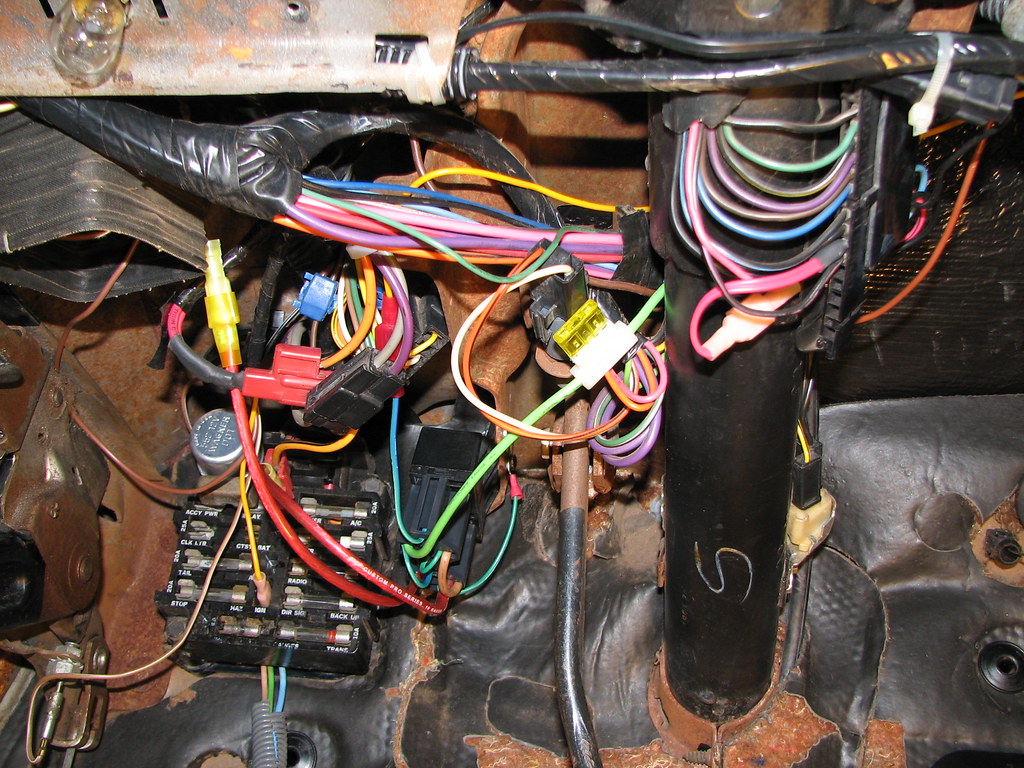
 I wrapped my wire around the guage fuse right beside it. I checked to make sure no power flowed unless the key turned the ignition on.
joepenoso
PS Thanks for the picture and interest in my problem. The battery was marginal and the slight tach draw was enough to push it over the edge.
Thread Starter
Registered User
Joined: Mar 2012
Posts: 1,257
From: Chesapeake, VA
Ok now that I'm back on land I had to time to search out the answer to the drain. I had my buddy hold my meter connected inline while I went and pulled fuses. With the meter on ohms I was getting .650-.700 draw. I found some draw on the clk fuse but there was a draw after I pulled all the fuses. Then I realized the amp in the trunk was still hooked up. After I disconnected the inline fuse it was gone. I've had a car with a amp before but never had a draw problem. My buddy said something about wiring a a kill switch in that circuit to shut off the amp draw? Now with the clk fuse pulled it kills my interior lights and my stereo? I can't remember what the draw was with the doors closed but is there supposed to be one there on this circuit? If so what is it supposed to be or would be acceptable as to not killing the battery. (I drive the car usually once a week when I'm home sometimes more or less)
Thanks
Magna
Thanks
Magna

Administrator
Joined: Oct 2009
Posts: 42,513
From: Poteau, Ok
There are a coulple of ways to power the amp, so that (1) it comes on with the key, and (2) it is not powered when the radio is off. Look at the schematic for the radio and amp, it will tell you how to hook it up correctly.
These are the 3 things that kill older car batteries, lighting, gauges and tach's, stereo equipment.
These are the 3 things that kill older car batteries, lighting, gauges and tach's, stereo equipment.
Connoisseur d'Junque
Joined: Sep 2010
Posts: 21,183
From: The Hudson Valley
Your amp is connected wrong. It shouldn't be drawing a measurable amount of current when off.
Recheck all of your connections and make sure that the turn-on wire for the amp is actually connected to the turn-on wire from the control unit, and not to a hot wire.
If it is connected correctly, then there's something wrong with it.
If you still want to use it as-is, then connect a relay in its power line, with a current rating greater than that of the fuse you are using, and trigger it off of the ACC circuit.
The CTSY ("Courtesy") circuit powers the interior lights, the clock, and the cigarette lighter(s). It should reflect the draw from those items. Several amps with a door open, a blip of ¼-½ and amp or so every few minutes when the clock winds itself, and a good 10-15 amps with the cigarette lighter pushed in.
You shouldn't have connected the stereo to it, as it is constantly on, and runs through an easily-blown fuse (any jiggling or problem with the cigarette lighter or its socket, or with an accessory plugged into it will blow the fuse).
It shouldn't have any draw with the doors closed, dome light switch off, map light switch off, lighter not pushed in, and clock not winding. If it does, there's a problem.
I just want to point out that these two sentences make no sense.
Ohms measure resistance.
Amps measure current.
Volts measure electrical potential diference.
By "connected inline," I assume you mean "connected in series." If this is the case, and you had your meter set to Ohms, then your meter would have either not read anything, or would have blown up, depending on how well it was designed.
The 0.650 - 0.700 reading you got would have been in Amps if you were measuring "draw" (current). It could not have been in Ohms, which measure resistance.
The correct procedure to check for a parasitic drain, as mentioned above, is to connect an ammeter in series with either the positive or negative battery terminal. You should start with the highest ammeter range (hopefully 10 Amps), and then adjust down if there isn't enough current to read at that range, so as not to burn the meter (or blow its fuse, as the one in there is never one you have in the toolbox).
An alternative is to check the resistance between both battery cables DISCONNECTED from the battery, but this may not be as accurate, as some electronic equipment might not pass current at the roughly 1.5 Volts that the ohmmeter puts out, but will pass current at the 12 Volts put out by the battery.
- Eric
Recheck all of your connections and make sure that the turn-on wire for the amp is actually connected to the turn-on wire from the control unit, and not to a hot wire.
If it is connected correctly, then there's something wrong with it.
If you still want to use it as-is, then connect a relay in its power line, with a current rating greater than that of the fuse you are using, and trigger it off of the ACC circuit.
The CTSY ("Courtesy") circuit powers the interior lights, the clock, and the cigarette lighter(s). It should reflect the draw from those items. Several amps with a door open, a blip of ¼-½ and amp or so every few minutes when the clock winds itself, and a good 10-15 amps with the cigarette lighter pushed in.
You shouldn't have connected the stereo to it, as it is constantly on, and runs through an easily-blown fuse (any jiggling or problem with the cigarette lighter or its socket, or with an accessory plugged into it will blow the fuse).
It shouldn't have any draw with the doors closed, dome light switch off, map light switch off, lighter not pushed in, and clock not winding. If it does, there's a problem.
Ohms measure resistance.
Amps measure current.
Volts measure electrical potential diference.
By "connected inline," I assume you mean "connected in series." If this is the case, and you had your meter set to Ohms, then your meter would have either not read anything, or would have blown up, depending on how well it was designed.
The 0.650 - 0.700 reading you got would have been in Amps if you were measuring "draw" (current). It could not have been in Ohms, which measure resistance.
The correct procedure to check for a parasitic drain, as mentioned above, is to connect an ammeter in series with either the positive or negative battery terminal. You should start with the highest ammeter range (hopefully 10 Amps), and then adjust down if there isn't enough current to read at that range, so as not to burn the meter (or blow its fuse, as the one in there is never one you have in the toolbox).
An alternative is to check the resistance between both battery cables DISCONNECTED from the battery, but this may not be as accurate, as some electronic equipment might not pass current at the roughly 1.5 Volts that the ohmmeter puts out, but will pass current at the 12 Volts put out by the battery.
- Eric
Thread Starter
Registered User
Joined: Mar 2012
Posts: 1,257
From: Chesapeake, VA
See what happens when you are away from toys too long you lose your thinking!  As far as the stereo system and its wiring the car came with it this way so not sure how they wired it but obviously have to check them out. All I know with the amp at this point is there is a hot wire run directly to the pos cable on the battery with an inline fuse. After work tonight will go look into this further and see what I find.
As far as the stereo system and its wiring the car came with it this way so not sure how they wired it but obviously have to check them out. All I know with the amp at this point is there is a hot wire run directly to the pos cable on the battery with an inline fuse. After work tonight will go look into this further and see what I find.
Administrator
Joined: Oct 2009
Posts: 42,513
From: Poteau, Ok
The amp will have a main hotwire to the battery, most likely a 10ga fused. Then it will have a trigger wire from the radio head unit to turn it on and off with the radio.
When the ignition is turned off, the radio loses power, in turn so does the amp. Also this happens when the radio is switched off with the key on.
The radio has 2 hot leads, 1 is for main power, the other is for memory to retain your settings. I know of some cases where these wires were hooked backwards, then the radio would intermittantly lose its settings and the amp would not turn off properly.
When the ignition is turned off, the radio loses power, in turn so does the amp. Also this happens when the radio is switched off with the key on.
The radio has 2 hot leads, 1 is for main power, the other is for memory to retain your settings. I know of some cases where these wires were hooked backwards, then the radio would intermittantly lose its settings and the amp would not turn off properly.

Registered User
Joined: Jan 2010
Posts: 330
From: New Brunswick Canada
lacking an amp meter,you could use a test light connected in series with bat- to - cable,if you have a draw the light will light up,the bigger the draw the brighter the light.not as good as a amp meter but will work in a pinch.

Thread
Thread Starter
Forum
Replies
Last Post
59Olds98
Electrical
19
Dec 25, 2013 08:20 AM


