When you click on links to various merchants on this site and make a purchase, this can result in this site earning a commission. Affiliate programs and affiliations include, but are not limited to, the eBay Partner Network.
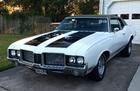
As I've previously noted in another thread, I was dealing with a pinion seal leak on my '72 Supreme. I had it replaced back in September of last year, and while it helped, I still have a leak. Since it is a static leak, I keep a close eye on it and check the level about once a month.
It's been about 2,000 miles since I had the seal replaced, and I have not added fluid since. Yet, when I check it, my level is still good.
If I've had a leak all this time, how can it be that I still haven't needed to add fluid? 🤔
As I've previously noted in another thread, I was dealing with a pinion seal leak on my '72 Supreme. I had it replaced back in September of last year, and while it helped, I still have a leak. Since it is a static leak, I keep a close eye on it and check the level about once a month.
It's been about 2,000 miles since I had the seal replaced, and I have not added fluid since. Yet, when I check it, my level is still good.
If I've had a leak all this time, how can it be that I still haven't needed to add fluid? 🤔
I can think of several things. Oil/fluid can spread out a lot.
Another things is the volume of most fluids expand with a temperature increase. If you put in oil that was 72 degrees and its now 95 degrees, its still full.
Dave - Depends on how you're quantifying a "leak". There are ~20 "drops" in a typical eye dropper. A typical eye dropper contains ~20 mL (milliliters). Therefore, there are 20ml/eye dropper. There are 1,000 mL/liter. One mL = 1 cubic cm. 16oz/pint or 568mL/pint. There are 0.033811 ounces/mL.
An Open Differential will typically hold ~4.25 pints diffy fluid. A posi will typically hold ~5.4 pints diffy fluid.
Do you have a "leak" or are you losing a couple "drops" (milliliters) of fluid? You'd have to lose an appreciable amount of fluid to have a "leak". If you haven't had to add fluid, I doubt you have a "leak" (per se).
I can think of several things. Oil/fluid can spread out a lot.
Another things is the volume of most fluids expand with a temperature increase. If you put in oil that was 72 degrees and its now 95 degrees, its still full.
I guess that makes sense, but I would think I would of had to add fluid at some point along the way.
As noted, differential fluid expands when heated. Perhaps what you're experiencing is a little seepage (from expansion) rather than a leak (per se)?
A seepage for 9 months in varying temperatures? Seems to me the "heat expansion" theory wouldn't apply when it's cooler outside, especially during winter.
If the seal surface on the pinion was grooved a new seal will not prevent leaks.
Several tricks to remedy this:
-Installing the seal slight deeper or shallower to grab a good surface.
-You may have damaged the new seal during installation. Did you pack the back side of the seal with Vaseline to prevent the spring from dislodging?
-A speedy sleeve may be needed. Beware...the sleeve can follow the groove if its deep enough and you dont fill it with JB. This is an art Ive perfected. If you need more info ask.
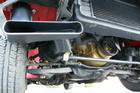
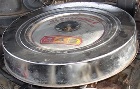
Dave - What is it we're looking at in the image? What is the exact size of that red apparent rubber "thing". Why do I see what appears to be oil underneath/below the Duralast script? Is that Duralast script floating above the apparent oil? I'm (easily) confused.
Dave - What is it we're looking at in the image? What is the exact size of that red apparent rubber "thing". Why do I see what appears to be oil underneath/below the Duralast script? Is that Duralast script floating above the apparent oil? I'm (easily) confused.
Norm-it measures approximately 4"x 4" and maybe 3/8" deep. The white spot you see on the Duralast logo is residue from the brake cleaner I used to clean it up today. That is at the bottom. The diff fluid is on top of the logo.
It's a leak, sure, but it's so slow and small that you may just be chasing your own tail. I had a very slow pinion leak that I just never could fix. Tried several seals, never got better. Just had to live with it - until I replaced the entire rear end.
A very small amount of oil makes a very large mess. It's funny because a BIG leak will often just flow away and make a mess on the floor, but may not "look" as bad as a very slow leak that dumps just enough oil to spread out and catch dirt.
It's a leak, sure, but it's so slow and small that you may just be chasing your own tail. I had a very slow pinion leak that I just never could fix. Tried several seals, never got better. Just had to live with it - until I replaced the entire rear end.
A very small amount of oil makes a very large mess. It's funny because a BIG leak will often just flow away and make a mess on the floor, but may not "look" as bad as a very slow leak that dumps just enough oil to spread out and catch dirt.
I'm ok with letting it be, but I don't get why I haven't had to add fluid since September of last year. 🤔
So since June 30th, I've accumulated a little less than an ounce. Unless my math is off, this equates to a total leak loss of 20 ounces (give or take) since September 15th. Yet, as I have said, the level in the housing is still good. 🤔
So since June 30th, I've accumulated a little less than an ounce. Unless my math is off, this equates to a total leak loss of 20 ounces (give or take) since September 15th. Yet, as I have said, the level in the housing is still good. 🤔
Exactly what is the figure supposed to represent? I see the "1/2" (of something) w/ markings of 2, 4 & 6 (of something). I'm more confused now than I was previously.
OK. I had to figure it out myself. Eight (8) ounces to one (1) cup. The "1/2" = 1/2 cup. Still, the bottom line appears to suggest a little less than 1 & 1/2 ounces. The image is not convincing.
OK. I had to figure it out myself. Eight (8) ounces to one (1) cup. The "1/2" = 1/2 cup. Still, the bottom line appears to suggest a little less than 1 & 1/2 ounces. The image is not convincing.
Norm, each graduation line is one ounce, and I'm not understanding what's not convincing to you. It seems pretty clear to me...as stated above, in two weeks I've accumulated just under 1 ounce of diff fluid.
Norm, each graduation line is one ounce, and I'm not understanding what's not convincing to you. It seems pretty clear to me...as stated above, in two weeks I've accumulated just under 1 ounce of diff fluid.
My mistake, I did say a little less than 1 & 1/2 ounces it does demonstrate a little less than 1 ounce.
Sixteen (16) fluid oz./one liquid pint. A typical (not posi) differential holds ~4.25 pints (posi ~5.4); therefore, a typical non-posi holds ~68 fl. oz. Albeit, 1 oz/68 oz means you've captured <1.5% of the total fluid volume.
Ok Norm, so it's more like a drip, but still, even a drip would create the need to add fluid at some point after 9 months, correct?
Maybe in 9 years. Unless it is leaving a large puddle under your rear that needs to be wiped up weekly, you'll barely notice a measurable decrease in fluid level by sticking your finger in a hole. Even if the level drops an inch (which would be ALOT of fluid), your rear will still be adequately lubed since the ring gear acts as a pump to splash the fluid up towards a channel in the top of the housing that allows fluid to flow down the the pinion bearing. Rear end fluid level needs to be sufficient, but it is not critical.
Maybe in 9 years. Unless it is leaving a large puddle under your rear that needs to be wiped up weekly, you'll barely notice a measurable decrease in fluid level by sticking your finger in a hole. Even if the level drops an inch (which would be ALOT of fluid), your rear will still be adequately lubed since the ring gear acts as a pump to splash the fluid up towards a channel in the top of the housing that allows fluid to flow down the the pinion bearing. Rear end fluid level needs to be sufficient, but it is not critical.
The saga continues...
Ok, so here's the latest data. I took it to a car show a week ago yesterday, and it was pretty steamy out. (95 deg with a heat index of ~105.) Up until then, the level had been holding pretty steady for the past month at ~1 oz. When I checked it this past Thursday, it had increased to 2 oz. (That’s an increase of 1 oz in just 4 days).
I checked the level, and it was still good (1/2 way up my pinky nail). Having said that, I was concerned that the issue had gotten worse, but decided to keep an eye on it.
So for the past 4 days, I've checked it every day, and it's still right at 2 oz.
My question is, why would it increase another ounce in just 4 days when up until then (and since), it's held steady @ ~1 oz? Is it because it was hot the day I took it to the car show and it was due to expansion (as Norm eluded to in #4 above?) I will also note that I've driven it on other days just as hot this summer, and I've noticed no level increase.
OK, Dave - let's test my memory. Wasn't there a time (last year?) when you found you had no vent tube in your rear axle & you elected to install an axle vent tube (AKA differential vent)? Without a complete revisit of that dialogue a differential/axle vent is critically important. Motoring about at ANY speed causes heat to build in the differential & internal to the axles. When heat builds pressure builds - the purpose of that vent is to vent pressure resulting from the increased heat when motoring about. "If" that vent is clogged, won't open or otherwise the incorrect vent installed - you got it. Pressure will build & continue to build in the differential & the axles. You might have a gander at your differential/axle vent.
OK, Dave - let's test my memory. Wasn't there a time (last year?) when you found you had no vent tube in your rear axle & you elected to install an axle vent tube (AKA differential vent)? Without a complete revisit of that dialogue a differential/axle vent is critically important. Motoring about at ANY speed causes heat to build in the differential & internal to the axles. When heat builds pressure builds - the purpose of that vent is to vent pressure resulting from the increased heat when motoring about. "If" that vent is clogged, won't open or otherwise the incorrect vent installed - you got it. Pressure will build & continue to build in the differential & the axles. You might have a gander at your differential/axle vent.
Yes, it will cause seals to leak.
Norm, I replaced the vent tube with a brand new one last year.
Remove the vent/differential vent you installed. Use something you won't drop into the axle vent hole (long paper clip?, pointed drift/punch, etc.? - ensure the hole is not clogged, plugged, etc.). Then, ride about for several weeks (or longer) w/ no vent - just leave the hole open. See if your drip stops.
When I did Drag week back in 2016, I noticed on the first day I had a leak from the C clip eliminators on my car. There was gear oil spray pattern all over the tire. Since parts and a press to change it wasn’t something I packed, I put it out of my mind. I drove the entire event, plus the drive home. All told probably 2000 miles. I have no clue how long it had been leaking before, what I do know that the rearend had plenty of oil when I fixed it later.
The differential on my 06 Ram is always a little damp, but it never leaves a puddle in the driveway. I frequently check the diffs and transfer case fluid levels, I never need to add any.
My point: a tiny amount of fluid can spread out over a very large area when it’s being blown around by the wind under the car.
If you don’t have to add fluid, it’s not leaking enough to worry about.
I have differential leaks on two cars (at least) and have never had to add any. Considering that capacity is something like 50 ounces and you measure with a finger, that's about 4%. You can't tell.
This is a check it once a year thing and be happy.
Sixteen (16) fluid oz./one liquid pint. A typical (not posi) differential holds ~4.25 pints (posi ~5.4); therefore, a typical non-posi holds ~68 fl. oz. Albeit, 1 oz/68 oz means you've captured <1.5% of the total fluid volume.
Does the factory posi rears have a bigger/deeper cover than a open.
Try'n to wrap my head around how a posi holds 1.15 pints more fluid than the open. The open has a lot less parts in the center of it than the posi that has plates/clutches and springs. I'd think all that extra metal parts would take up more space limiting the fluid , not allowing more.
Yeah, this reminds of replacing seals on a TH350 or TH2004R, only slightly slow down the leaks. Try 85W140 and call it good. Or a new yoke or sleeve and seal. The only leak I had was the cover on my 8.5" Type O, tightened and all was good. Your leak is what my 4L80E leaks which I call as good as no leak on old automatics.