When you click on links to various merchants on this site and make a purchase, this can result in this site earning a commission. Affiliate programs and affiliations include, but are not limited to, the eBay Partner Network.
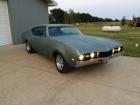
I own a 1968 Oldsmobile Holiday “S” 2 door coupe. I currently have the bone stock 350 rocket with an automatic 2 speed transmission behind it. I have found a 455 rocket block that I will be picking up on saturday to rebuild because I am looking for more horsepower, but want to keep it correct. What transmission should I put behind it? And is there anything I should be looking for in this motor other than obvious cracks? I only need the motor for the block, crank, and rods. I am planning to buy everything else aftermarket. Will some of my pulleys and brackets from the 350 work on the 455?
Thanks,
-Jayden
Transfer all of the brackets, pulleys, and water pump from the 350 to the 455. They work together as a system. If you have the non-A/C alternator bracket, there are two holes, one for the SBO, one for the BBO. Same thing for the PS pump bracket.
Transfer all of the brackets, pulleys, and water pump from the 350 to the 455. They work together as a system. If you have the non-A/C alternator bracket, there are two holes, one for the SBO, one for the BBO. Same thing for the PS pump bracket.
Thanks Joe, I do have A/C. Will the AC brackets transfer as well?
Joe, do you say this just to prevent changing the mount perches on the frame?
Yes, especially since many people buy the "455" motor mounts and then post asking why they can't get them to line up with their frame mounts. There is no need to do that. Keep in mind that the 1968 and earlier cars (including the 1968 H/O) used exactly the same motor and frame mounts for 330, 350, 400, and 455 motors.
Yes, especially since many people buy the "455" motor mounts and then post asking why they can't get them to line up with their frame mounts. There is no need to do that. Keep in mind that the 1968 and earlier cars (including the 1968 H/O) used exactly the same motor and frame mounts for 330, 350, 400, and 455 motors.
Is there any difference in engine height if you use the 350 mounts? Or are the perches and mounts just different but the motor sits the same?
Other methods:
- Cut the end of the bracket off and weld it back on so it aligns.
- Open the hole in the bracket so the bolt will align (this assumes there is enough material to open the hole).
- Fill in the hole in the manifold, then drill and tap in the correct location.
- Use a smaller diameter bolt, drill and tap a hole in the manifold at the correct location, use a large washer between the bolt head and the manifold. It doesn't need that huge bolt to hold the bracket in place.
- Leave that bolt out.
Hey Joe, Do you happen to know what the reason behind the change was? Seems odd to incur additional tooling costs without a significant difference or justifiable reason. Just curious.
Hey Joe, Do you happen to know what the reason behind the change was? Seems odd to incur additional tooling costs without a significant difference or justifiable reason. Just curious.
GM had a major recall in the late 1960s due to broken motor mounts. The original GM design was just two metal brackets with rubber molded between them. Since the driver side is in tension under acceleration, a broken motor mount caused the engine to torque over. With the solid rod throttle linkages GM used through the 1967 model year, this caused the throttle to jam open. That's also why Olds went to cable throttle controls with the 1968 model year. Olds designed new motor mounts that incorporated an interlocking feature molded into the rubber such that if the rubber separated, these interlocking metal tabs would still prevent the engine from torquing over. The initial design for these interlocks was larger than the 64-68 motor mounts and was only used on the 1969 BBO motors. These are the Anchor 2328-style mounts. Later the original design mounts were redesigned to also incorporate the interlock within the original dimensions. These are the Anchor 2261-style mounts. Starting with the 1973 model year, Olds used the 2328 style mounts (what everyone callse "big block" mounts) on every V8 from 260 to 455.
GM had a major recall in the late 1960s due to broken motor mounts. The original GM design was just two metal brackets with rubber molded between them. Since the driver side is in tension under acceleration, a broken motor mount caused the engine to torque over. With the solid rod throttle linkages GM used through the 1967 model year, this caused the throttle to jam open. That's also why Olds went to cable throttle controls with the 1968 model year. Olds designed new motor mounts that incorporated an interlocking feature molded into the rubber such that if the rubber separated, these interlocking metal tabs would still prevent the engine from torquing over. The initial design for these interlocks was larger than the 64-68 motor mounts and was only used on the 1969 BBO motors. These are the Anchor 2328-style mounts. Later the original design mounts were redesigned to also incorporate the interlock within the original dimensions. These are the Anchor 2261-style mounts. Starting with the 1973 model year, Olds used the 2328 style mounts (what everyone callse "big block" mounts) on every V8 from 260 to 455.
Interesting history there Joe. I remember 1st hand a couple of issues related to GM engine mounts when I was young: My grandfather's '67 Coupe DeVille broke an engine mount on the driver's side and it would raise up and bump into the hood when you stepped on the gas. But I never connected it to those strange little cables that were attached to the front of the SBCs in the '66 Chevy Impalas we had (283 in a sedan, 327 in a wagon) that were apparently a band-aid fix installed by the dealer from a recall related to the engine mount issue.
Interesting history there Joe. I remember 1st hand a couple of issues related to GM engine mounts when I was young: My grandfather's '67 Coupe DeVille broke an engine mount on the driver's side and it would raise up and bump into the hood when you stepped on the gas. But I never connected it to those strange little cables that were attached to the front of the SBCs in the '66 Chevy Impalas we had (283 in a sedan, 327 in a wagon) that were apparently a band-aid fix installed by the dealer from a recall related to the engine mount issue.
That's exactly what it was. The factory recall fix involved looping a cable around the upper control arm shaft and bolting it to the head on the driver's side. I remember seeing a lot of those cables on Chevys in wrecking yards in the 1970s.