When you click on links to various merchants on this site and make a purchase, this can result in this site earning a commission. Affiliate programs and affiliations include, but are not limited to, the eBay Partner Network.
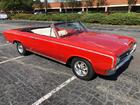
Howdy y'all I have had a 1964 Cutlass convertible for about 3 months some dumb Cretin of a woman decided to cut me off I slammed on my manual brakes locked up 2 or 3 of my wheels and by the next day all my brake fluid was missing. I have decided to use this opportunity to upgrade my braking system. Please chime in with your best opinions on brake conversion options front disc rear drum or four-wheel disc.... looking for a complete package options to do this in a one-time swoop. Thank you in advance I love you all peace love and chicken grease.
Last edited by Rob64cutlass; Jul 22, 2023 at 04:47 PM.
Personally I like my drum brakes, they stop very well. Rear discs are problematic and not worth the effort or expense. In addition, the locking up of the brakes is not what caused your stopping issues, it was the fact that your tires could not handle it.
Personally I like my drum brakes, they stop very well. Rear discs are problematic and not worth the effort or expense. In addition, the locking up of the brakes is not what caused your stopping issues, it was the fact that your tires could not handle it.
yes definitely leaning towards front disc rear drum conversion but want to hear from all that have had the years of experience. Thank you for your input
I am not familiar with what you need to do to covert your front drums to discs.
I do know that on 68-72 we would change out the spindles, master cylinder and proportioning valve from a similar disc brake car.
That made a big difference in stopping power.
Also running a high quality brake pad helps the fronts alot, I used to use Hawk semi metallic. And good brake shoes.
it's important to seat the rear drum shoes and readjust them properly and regularly, they do alot to determine when the fronts start working thru the proportioning valve. While 4 wheel disc are better remember the front does most of the stopping especially with the weight transfer on hard stops.
sorry I can't advise on how to convert 64 brakes
Has anybody heard of pirate jack hot rod parts out of NC? And or reputation. Web site seems great they have a front disc kit on ebay for 600. Seems like a good set up?
Last edited by Rob64cutlass; Feb 16, 2022 at 03:19 PM.
I would really take the time to replace all hardware and bleed the system before you go through a costly conversion. If everything is replaced with new parts, you shouldn't have any problems. There is more than just bolting up a disc brake conversion and bam they work. There are so many variables a
to go through. Just something to think about
i have disc/drum on my 73 nova,and i have never had a car,even new ones,that would brake like this one does. its a factory setup with all new quality components. trying disc/disc on my 65 cutlass factory 72 setup in front,home brew s10 in the rear. no results on that yet
Rob64:
That booster looks really small! Could be 8"or 9" single diaphragm? Looks like stock-ish size calipers & rotors to fit a '68-72 A-body, but the stock A-body booster is 11".
Rob64:
That booster looks really small! Could be 8"or 9" single diaphragm? Looks like stock-ish size calipers & rotors to fit a '68-72 A-body, but the stock A-body booster is 11".
Rodney
What is the logic to a larger diaphragm? More pressure the larger it gets? Anything is an improvment over manual brakes. What should I expect an 8 " to feel like vs the 11"? Is there any clearence issues to be concerned with in my stock MC location?
The power brake booster uses atmospheric pressure on one side of the diaphragm and manifold vacuum on the other side to create a net force. Pounds per square inch remains the same. A larger diaphragm gives you more square inches. Do the math.
The stock booster in the 1964-66 cars was 9". When GM went to disc brakes in the 1967 model year, they also bumped the booster diameter up to 11". This is why the 1967 442s used one notched valve cover on the drivers side.
The power brake booster uses atmospheric pressure on one side of the diaphragm and manifold vacuum on the other side to create a net force. Pounds per square inch remains the same. A larger diaphragm gives you more square inches. Do the math.
The stock booster in the 1964-66 cars was 9". When GM went to disc brakes in the 1967 model year, they also bumped the booster diameter up to 11". This is why the 1967 442s used one notched valve cover on the drivers side.
Thanks for the info. What should I be leaning towards? 11" sounds like the obvious choice but is there clearence issues I'm going to run into? Will a 9" suffice if an 11" won't work in my applcation?
Thanks for the info. What should I be leaning towards? 11" sounds like the obvious choice but is there clearence issues I'm going to run into? Will a 9" suffice if an 11" won't work in my applcation?
A dual diaphragm 8" has about the same area as the stock single diaphragm 11".
I have been looking at parts to convert my 65 and am leaning towards the Bear classic series. Still keeps 15 wheels as option. Haven't chosen master cylinder yet
what about Right Stuff systems ? a friend referred me to this site, they're showing a complete kit with booster and master cylinder, and able to use factory 14'' wheels for 750, part number AFXDC14A for slotted rotors, or AFXDC14N no slotted rotors.
after doing some reading, and taking the advice of my friend that has used this set up, i purchased the right stuff non slotted rotor kit from summit for 685. comes complete with booster and master cylinder. here's to stopping exactly when we want to.
I've said this many times. Except for the 1969 H/O, EVERY SINGLE Olds A-body built with disc brakes from 1967-72 came from the factory with 14" wheels. The stock disc brakes clear with no issue. The fact that the disc brake companies perpetuate the 15" wheel myth doesn't make it true. The aftermarket kits that claim they are designed for 14" wheels use tiny 10" rotors that barely provide any braking improvement over the drums. The thing people overlook is that there are different flavors of 14" wheels. In the photo below, the drum-only wheel is on the right, the disc/drum wheel on the left. Outboard is to the left for both. Note the difference in the contour of the rim drop to clear the caliper on the disc brake wheels (yellow vs green arrows). And every single factory SSII/III wheel built by Olds will clear the factory disc brakes.
I'll put the other engineering note for this topic out there:
Do not use aftermarket drum to disc conversion kits that use drum spindles. I'm not sure I'd use anything aftermarket for this application other than calipers and rotors and pads. Factory disc systems are readily available and restorable.
I'll put the other engineering note for this topic out there:
Do not use aftermarket drum to disc conversion kits that use drum spindles. I'm not sure I'd use anything aftermarket for this application other than calipers and rotors and pads. Factory disc systems are readily available and restorable.
^^^THIS. All of them use squirriley plate brackets that do not properly support the caliper in my opinion.
Now it IS possible to modify a drum spindle to turn it into a disc spindle.
yes definitely leaning towards front disc rear drum conversion but want to hear from all that have had the years of experience. Thank you for your input
Really not much need for front or rear discs. It might be more cost effective to make sure your drum setup is optimized. I had a '64 Cutlass with factory power drums and it stopped straight and true, very proportional. The factory drums on your car, apparently somewhat neglected, saved your bacon once and if you spruce them up they'll do it again. As Joe P. points out often enough (paraphrasing), I'll take old tech with factory engineering over new tech with minimal research and engineering every time.
Also factor in the kind of driving you do. Do you really need to make repeated hard stops -- this is where the advantage of discs really proves itself -- tooling down to the ice cream shop in your collector vehicle on a Sunday afternoon? Probably not.
Has anybody heard of pirate jack hot rod parts out of NC? And or reputation. Web site seems great they have a front disc kit on ebay for 600. Seems like a good set up?
My understanding of some, if not all, rotors with slot or holes are not eligible to be turned and trued. Because so many rotors eventually get warped, this feature would keep me from buying this or a similar kit.
I had the rotors on the brand sold by Rock Auto warp within the first 15K miles. I spoke with the manufacturer who confirmed that they could not be turned. They were out of warranty and had to be scrapped. The brand of the rotor and caliper kit who made this 15K longevity kit with these rotors is Power Stop.
I had the rotors on the brand sold by Rock Auto warp within the first 15K miles. I spoke with the manufacturer who confirmed that they could not be turned. They were out of warranty and had to be scrapped. The brand of the rotor and caliper kit who sold this 15K longevity kit with these rotors is Power Stop.
I had a set of those on my Dakota. They lasted about 30K, which is actually the best I've done on rotors for that truck.
I would really take the time to replace all hardware and bleed the system before you go through a costly conversion. If everything is replaced with new parts, you shouldn't have any problems. There is more than just bolting up a disc brake conversion and bam they work. There are so many variables a
to go through. Just something to think about
I totally agree. The OP's problem is probably in the hydraulics which should be completely replaced on a car this old. All wheel cylinders, hoses, metal lines, master and probably the power booster if it's original. Disc brake conversion will not fix those problems.