When you click on links to various merchants on this site and make a purchase, this can result in this site earning a commission. Affiliate programs and affiliations include, but are not limited to, the eBay Partner Network.
I've been noticing some high speed vibration in the front end of my '66 Toronado. It occurs around +65-70 MPH. Almost the entire front end is new.......new ball joints, tie rod ends, wheel bearings, shocks, pitman arm, and idler arm so I'm wondering about either the tire balance or the drums in the front.
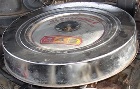
I did happen to notice that the front right brake drum was replaced a couple of years ago prior to me getting the car and, unlike the other three drums, it appears to have no balance weights applied to it. The three others have strips of metal welded on in a section, I presume, to balance the drum correctly. This replacement drum came from Rock Auto, I believe.
Is balancing of a drum something that needs to be done? I've had cars with drums in the past but they never needed to be replaced so I haven't run into this before. Sorry for the newbie question!
They are balanced at the factory, doubt the vibration is the drum.
Ok so aftermarket drums are balanced at the factory? I only mention it as that aftermarket one on my front right doesn't have any metal added that looks like weight. It makes sense though that they would balance when made but I don't see any evidence of it.
I only mention it as that aftermarket one on my front right doesn't have any metal added that looks like weight. It makes sense though that they would balance when made but I don't see any evidence of it.
It may be that added weights weren't needed because the drum was in balance as made.
I would certainly start by having the tire in that location checked for balance. I think that's far more likely to be the problem than an unbalanced brake drum (which is something I've never heard of until now.) It's certainly faster and cheaper to have the tire checked, and where do you go to have a drum checked for balance, anyway? Do tire or brake shops do that?
Another thing that comes to mind is just the geometry of the situation. A drum is much smaller in diameter than a tire, so a given amount of "out of balance" weight on a drum would be far less likely to cause vibration than a tire out of balance by the same amount of weight. At least, I would think.
It may be that added weights weren't needed because the drum was in balance as made.
I would certainly start by having the tire in that location checked for balance. I think that's far more likely to be the problem than an unbalanced brake drum (which is something I've never heard of until now.) It's certainly faster and cheaper to have the tire checked, and where do you go to have a drum checked for balance, anyway? Do tire or brake shops do that?
Another thing that comes to mind is just the geometry of the situation. A drum is much smaller in diameter than a tire, so a given amount of "out of balance" weight on a drum would be far less likely to cause vibration than a tire out of balance by the same amount of weight. At least, I would think.
Great advice, thanks. I'm sure you're right it's just something that jumped out at me looking at the new vs. old drums and I wasn't sure how these things go as this is my first all drum car.
It's not no but I've never had to replace the drums on any car I've ever owned. My '06 Civic had over 180K on it when I sold it and it still had the original rear brake shoes installed which still had plenty of material left on them. For all I know, balancing drums may have been a thing back in the day. Those gnarly welded weights on the original drums for my Olds stand out like crazy.
Agree with it is unlikely for the drum to be the problem but it could be out-of-balance. Try getting the tires Hunter Road Force balanced and tell the tech about the problem, also ask for the wheel to be checked for being bent and/or out-of-round.
Drums, rotors, wheels and tires can be balanced as an assembly with an old Hunter machine that balances the wheel on the car, BUT I don't know if that works on a FWD Toro. The disadvantage to on car balancing is that it must be redone with every tire rotation, if a wheel is removed mark the wheel stud and which hole it went through to put it back in the same position.
If you can find an old school bubble balancer put the drum by itself on it and see how it looks.
OK,
About 10 years ago one of the guys that worked with my Wife had an old Caddy that was driving him crazy with a similar problem. He narrowed it down to the drum. He brought me the drum in question and I spun it up on my crankshaft balancer and it was terribly out of balance I balanced it and it took care of his problem so ....... yes it can be the drum.
If you cant easily find another drum then see if there is a machine shop near you that does crankshaft balancing.
This is where the old school on the car wheel balancer would be nice to have
You can see the big slugs of metal on the rear drum shown here (this pic was taken before I painted them as shown earlier). The vibration is probably not that front right drum but it just stood out to me so much because they're so different.
Is balancing of a drum something that needs to be done?
Yes !
Originally Posted by ourkid2000
This replacement drum came from Rock Auto, I believe.
Especially because of that. Rock Auto is fine. But the aftermarket as a whole is not to be trusted blindly. And even factory drums needed balancing.
Back in the 2000s I was looking into every known mod for quicker acceleration on my 87 442. I purchased used OEM aluminum rear drums, Pontiac IIRC. Good shape but needed to be turned. Both had/needed balancing weights...
I bought some rear drums from Kantner about 5 years ago, they were massively out of balance. So much so they replaced one after I sent pics. I doubt the new drum was balanced… I had to add stick on wheel weights to make mine correct.
When you have the tires (re)balanced have the tech look at the tire spinning without the safety shield over the machine. The inexperienced/or in a hurry techs never look for run-out on the tire or the rim. They will also put a band-aid on a grossly out of balance tire with tons of weight on one spot vs rotating the tire around the rim to find the "sweet spot."
Primary and secondary shoes on in the correct orientation?
Are the shoes dragging on the drum a little more than they should? Try backing them off and road testing.
Have you re[placed the flexible brake hoses to the cylinders? They will de-laminate internally and cause the shoes to drag by not allowing the cylinder to fully retract which = heat and chatter at higher speeds(same for over tight shoe adjustment).





 I balanced it and it took care of his problem so ....... yes it can be the drum.