When you click on links to various merchants on this site and make a purchase, this can result in this site earning a commission. Affiliate programs and affiliations include, but are not limited to, the eBay Partner Network.
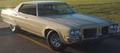
That's right. I started my 71 98 for the first time in several months this evening. While it was hesitant to start, I eventually got it idling. I added a bit of transmission fluid because the transmission was slow to go into gear and backed it out of the shop.
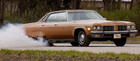
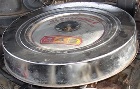
I dripped a little bit of ATF on the fender so I went into the house garage to get the detailer spray. In a matter of being away from the Olds for 30 seconds, the radiator blew the passenger's side tank off! Don't believe me, check out the pic!
When I came out to the backyard the the Olds was enveloped in steam. I thought it was on fire so I dropped the detailer, raced over and shut off the ignition. Coolant was still pouring out of the engine onto the ground as I shut off the car.
So, I sprayed off the car with the garden hose and got video washing it. You can bet your bottom dollar that I'm going to do a video on this! I just need to decide how I'm going to repair it. Make sure you vote on the poll and let me know what to do,
Scott Winn (oldspackrat) has several radiators for sale. He's got a post on facebook but you could send him a PM or email to ask what he has. Pretty sure one of his pictures had a 1975 4 row from an Olds 98 that may bolt in.
Dang Jesse. Where the heck did you get a 50-pound radiator cap? Just kidding on that but wow. I have never heard of this. But then at 76, there is lots of stuff I haven't heard of. I vote for an aluminum replacement. The car is not a W30 show car, so you don't need to worry about it being original. The aluminum radiator will cool better.
That photo looks like it's a newer aluminum radiator with plastic end tanks. I've had a similar problem where the plastic tank split open while the car sat idling.
Wow, I have never seen that. I had a suspicious spot on the passenger plastic tank in my 94 Z71 open into a garden hose before my eyes but this is insane!
You are correct gents. The radiator that blew apart was a parts store cheapie. I do have an OE style radiator that I replaced with the parts store cheapie. As I recall, the OE one wasn't leaking, it was one of those MAW projects.
I plan on filming the radiator removal and replacement. I will post the full-length video later this week. Of course, I'll have to revisit this once I get the OE replacement re-cored or a performance radiator.
Hmm , never heard of this before . Had Spectra Premium aluminium with plastic tanks in cars for
many years without any issue. Radiators with aluminium and plastic have been oem in Volvo for
many years also.
I had a plastic end-capped rad decide it hated life in my 06 Silverado, but it was the OE rad at 230k-ish miles. It did not explode, though - this is a first for me lol. That plastic must have been super thin and brittle. Wild!
I just put an ebay aluminum ran and efan setup in my 98. Surprisingly good quality for $200.
Thanks for the comments gents. I installed the OE radiator and thankfully it holds coolant just fine. It took just over 4 gallons of coolant (the CSM says 17/20 quarts for the 455 in the non-Toronado/Toronado).
Unfortunately, I think a compression check is in my future. The engine smokes constantly while idling. It doesn't smell sweet though, it smells like nasty engine grime. I know the rings are worn. It would puff blue smoke during heavy acceleration previously.
I did some reading on our site and found that burning ATF from a faulty vacuum modulator creates white smoke. Maybe that is my problem? The transmission pan was pretty dry (it wouldn't move into and out of the garage without adding 1 pint of ATF both times). The transmission does leak but not as fast as the C6 in my Ford truck, and I only have to top that off (with less than a pint) after driving it around town for a week. I'll keep everyone posted.
Pull the vacuum line off the modulator, if it is dry you're good, if ATF is in it the modulator is bad. If the car has sat for a while I'd do a ring soak if the compression is weak. Valve seals are also a likely culprit for smoke at start up. Pull valve covers to check that the oil return drains are not clogged.
Your rad probably exploded due to a bad head gasket or cracked head. I've seen this several times- excessive pressure in the cooling system from compression leaking in. Suddenly the rad goes pop! Diagnose the issue. Replacing the rad is treating a symptom, not the cure!
I was wondering how an engine that was just started and was idling could heat the coolant to the point the pressure got high enough to blow the end tank off the radiator. Unless the tank was about to fall off already.
Your rad probably exploded due to a bad head gasket or cracked head. I've seen this several times- excessive pressure in the cooling system from compression leaking in. Suddenly the rad goes pop! Diagnose the issue. Replacing the rad is treating a symptom, not the cure!
Good point... Jesse, do you have a cooling system pressure tester? I had a engine once that had too much pressure. I put the pressure tester on the radiator cap with system full of coolant and cool. Started engine and watched the gauge go up as engine was idling, I didn't pump it up it went up on it's own. In my case it was a blown head gasket..
Good point on the head gasket or cracked head. I had a Corteco head gasket go on an Olds 350, violent existing through the cap. Same thing on my Dakota with a 5.9 Magnum head gaskets then a cracked head. The radiators held together but talk about a ballooned upper rad hose. I have also had minor leakage at those crimped joints. Ford for years leaked a minor amount on their factory aluminum plastic rads at those joints.
Your rad probably exploded due to a bad head gasket or cracked head.
Yeah, that's what I'm afraid of. I will do a compression test this weekend. Sounds like it would be a good idea to get a coolant system pressure tester too, or at least rent one.
The thing is, the engine idles just fine. No lifter tick or rod knock. I will post a video on Friday.
Your rad probably exploded due to a bad head gasket or cracked head. I've seen this several times- excessive pressure in the cooling system from compression leaking in. Suddenly the rad goes pop! Diagnose the issue. Replacing the rad is treating a symptom, not the cure!
Why does everyone immediately go to the worst case? This has not been my experience with plastic radiator tanks. The plastic just ages, cracks, and boom. When this happened to me, a new radiator fixed the problem. There were zero issues with the engine.
I hope that's the case Joe. I installed the OE radiator yesterday and it holds coolant just fine. I did start the car and pull it into the shop. The engine smokes like a locomotive, but it doesn't smell sweet like burning antifreeze. I also checked the manifold vacuum hose that goes to the transmission vacuum modulator. No ATF.
Take off the cap and run it, if coolant comes flying out, then it's the head gasket. You don't need a pressure tester for that.
Also in your video it looked like you ran it for a while with no coolant. That can't be good for the engine.
It doesn't need to come flying out to indicate a combustion leak. It may just dribble out which would be hard to discern as a problem. Best bet is a chemical test at this point.
It doesn't need to come flying out to indicate a combustion leak. It may just dribble out which would be hard to discern as a problem. Best bet is a chemical test at this point.
I just figured if we are contending that the combustion leak exploded the plastic tank then the pressure could be high enough to push the water out the outlet and it's an easy test. But your suggestion is more conclusive. Mine won't rule out a small combustion leak.
Also in your video it looked like you ran it for a while with no coolant. That can't be good for the engine.
The car wasn't running in the short video I posted above (what you hear is a combination of lousy video and an exhaust fan I setup in front of my shop). I show pulling my 71 into the garage in my full-length video (but it posts in 15 minutes). I filled the radiator with coolant and water and started the engine and I had to top it off with water. If it ran without coolant it was only for a few moments, I heard coolant pouring onto the ground as I shut the car off when the radiator first failed. I wasn't too concerned with getting video of that.
Originally Posted by 66_Jetstar
It doesn't need to come flying out to indicate a combustion leak. It may just dribble out which would be hard to discern as a problem. Best bet is a chemical test at this point.
I'm going to do a compression test this weekend. I have a chemical tester to check for combustion gases in the radiator that I can use if needed.
You left out buy a quality replacement radiator from the pole.
I included buying a performance radiator from the mail order/ online vendors (i.e. Jegs or Summit). Anything you can buy online I suppose you can get at the parts store but you will pay more for it. The radiator that exploded was the lifetime warranty unit from the parts store. Take that for what it's worth.
So, the head gasket is blown between cylinders 3 and 5. Here are the numbers:
1: 148 psi
3: 128 psI
5: 92 psi
7: 152 psi
2: 150 psi
4: 148 psi
6: 132 psi
8: 132 psi
I did the compression test dry, then I retested cylinders 3 & 5 by adding oil to the cylinders. No change.
The compression tester I owned broke. I went through all 8 cylinders and the schrader valve fitting wasn't working. I had to use the video to see how high it went. I tried to change the valve core but it got cross threaded and damaged the threads.
The compression tester from the auto parts store doesn't hold pressure at all. At least with my gauge it slowly leaked down.
Now the battery on the 71 is getting tired so, I'm done for the day. We'll see what I do next...
Definitely a PITA. Thanks for the kind words Norm. I forgot to post the pic of the spark plugs. Here it is:
No steam cleaning on any of the spark plugs, but I attribute that to the fact that the engine has only run less than 5 minutes since the radiator exploded.
Bummer Jesse. I blew a head gasket on a 73 350 Olds on the way down to Tennessee. We were going to come back home but decided to go ahead and finish the trip. Found out that 50-50 worked- no more than 50 MPH and stop every 50 miles to refill rad with water. Ended up taking 2 lane roads and went easy- made it down and back- Great trip!! Sorry to derail your thread but your story reminded me of that.
The cross threaded schraeder valve might be repaired with one of these 4 way valve core tools that should be available at your favorite auto parts store.
Great trip!! Sorry to derail your thread but your story reminded me of that.
No problem Greg. That would be quite a headache if a head gasket failed on the road.
Originally Posted by Koda
We had this precise behavior at the H/O Nationals this summer. Head gasket failed, cracked the radiator. 83 H/O with a plastic tanked radiator.
I guess the plastic tank radiators aren't that strong. The failure would have been even more violent if the OE radiator failed, it's all brass and copper.
Originally Posted by Fun71
The cross threaded schraeder valve might be repaired with one of these 4 way valve core tools that should be available at your favorite auto parts store.
Good idea, I'll have to get one of those. Thanks for reminding me.
BTW, here's a pic of the heads in the back of my truck. I'll go ahead and drop them at a machinist today. I decided to tear down the engine yesterday. No steam cleaning in any of the cylinders.
I actually think a blown head gasket on an OEM copper radiator would not be violent, it would just pressure fill the overflow. I think the plastic tanks cannot handle the pressure transient of the combustion gas before the radiator cap unloads it. Perhaps the copper tanks can hold the pressure while the cap vents.
I actually think a blown head gasket on an OEM copper radiator would not be violent, it would just pressure fill the overflow. I think the plastic tanks cannot handle the pressure transient of the combustion gas before the radiator cap unloads it. Perhaps the copper tanks can hold the pressure while the cap vents.
The first car I experienced this on was the cutlass I drove in college with a 307. It blew the upper outlet off the radiator. That was a copper rad. I had no idea why so I simply replaced the rad with a used plastic tank unit from my brothers trans am. That made it about a week and the tank split on that. I started to figure out what the issue was after that..
I actually heard from the machinist today. He magnafluxed the heads and they're good cores. He said it would be over $1000 for the works. Including new valve seats, springs, guides, etc. He mentioned there are rotators on the intake valves and none on the exhaust valves. He sounded surprised. I knew Oldsmobile used valve rotators on top of the springs in the day.
I mentioned to him that $1000+ was too much. Especially considering that I'm not going to do anything to the short block and it has 90k+ miles. He revised his quote and said he could do it for $420 with new guides and cutting the valve face and seat without new seat inserts. I agreed and he says he should have it done before the holiday.