When you click on links to various merchants on this site and make a purchase, this can result in this site earning a commission. Affiliate programs and affiliations include, but are not limited to, the eBay Partner Network.
Extremely rusty intake manifold bolts.....best way to break em loose
Hi Guys - I bought a '68 400 for $100 at an estate sale. Looks extremely clean yet I feel the need to crack it open and take a look. Supposedly the owner was a local Olds mechanic yet that could be complete bs.
Intake bolts are ugly - i've coated them with penetrator several times and one simply stripped the edges of the bolt. What's the smartest way to break these babies loose without screwing it up ?
Sometimes you can break them tight, then they just come right out. I never had any luck trying to break old bolts loose 1st. Always try tight 1st, but that's me.
If that didn't work, a drift and a BFH and a couple of licks will work too. Good luck, others may have more suggestions. As far as the stripped one goes, if
you can't get vice grips on it, cut it off, there should be enough to grab hold of once you get the intake off.
Last edited by tru-blue 442; Dec 13, 2023 at 01:24 PM.
Doubtful that penetrating oil/fluid is going to to anything......it's not going to get down into the threads (which are likely coated w/oil already).
Make sure you're using a 6 point socket instead of a 12 point socket. If the heads of those intake bolts are really rusted away then you're in for some work.
Strike the bolt heads with it to set up some vibration.
If you have access to an air impact gun, you can try that. Set it on lowest setting at first and go tighten, loosen, tighten, loosen, a couple seconds at a time. This also sets up vibration that should break the corrosion loose. Or heat the bolts with a gas torch if you have it.
You might have to hammer a metric socket on it to get some bite. ALWAYS 6-point.
Then there's always the fluted bolt remover sockets.
Last edited by rocketraider; Dec 13, 2023 at 02:17 PM.
Warm it, juice it with Liquid Wrench or PB Blaster, strike it as suggested. Let it cool and repeat. When cool soak it with 50/50 acetone and ATF. Tighten it slightly first before turning it loose. I've also had success with having another person strike the bolt while applying torque.
Patience pays off big time on this job.
If you tend to work on rusty fasteners with any regularity, like even a couple of times every year or two, might want to consider an inductor. It concentrates heat in ferrous material, no flame, no collateral damage. I bought one 10-12 years ago and lamented that I didn't have one for the 30+ years prior to that! One of the best tools I own. The aggravation it saves and trouble it avoids us Heaven sent.
Put on the head of bolt, run it a few times for 20 second cycles to let the heat conduct into the threads and they will likely come out with no fight. Once you get 1mm of gap under bolt head, get some lube into the threads. As said before, 6 point socket or wrench to break them loose, but righty, tighty first.
The winner is..... a 6 point socket. To my defense I'm working remotely with a crappy lowes socket set. Once I used a 6 point the bolts barely broke loose before stripping.
Opened it up a bit more - will post more pics when I have time to pull heads.
From the looks of the pan gasket....somebody was in here soon after this thing was moth balled.
Looks like you probably got a bargain on that engine. Sometimes if a bolt strips off or the head round off. you can take a mig welder and tack a new bolt on the top of the stipped one and then screw it out. Six point sockets are the only way to go.
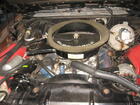
Couple of things of note. First, the curved oil fill tube was only used on A/C cars. The compressor forced the air cleaner snorkel to clock towards the front of the engine, and the curved tube was needed for clearance, however that's a non-A/C alternator bracket. Second, the 400 only came in A-body cars, which means that every one of them left the factory with notched valve covers, which this motor doesn't have, so those have been changed also.
Couple of things of note. First, the curved oil fill tube was only used on A/C cars. The compressor forced the air cleaner snorkel to clock towards the front of the engine, and the curved tube was needed for clearance, however that's a non-A/C alternator bracket. Second, the 400 only came in A-body cars, which means that every one of them left the factory with notched valve covers, which this motor doesn't have, so those have been changed also.
Joe, I believe that’s a 400 2bbl from a 1968 turnpike cruiser, for unknown reasons turnpike 400 all had the same curved oil fill tube. A couple summers ago my brother and I bought a 68 442 with a curved oil tube and a later model 4 bbl on it. I believe it was Allyolds and I did a bunch of research as that car I bought was a factory turnpike with added 4bbl. Every pic we could find of turnpikes had curved ac tube. The whole convo is on here I believe under cars for sale as I had posted the car on this site to sell.
That car also has the valve covers on backwards...
Well ok, I have seen many pics online of old cruisers, they all have the curved oil tube. Went to post some but to large of file. Your challenge, Find me one pic of. 68 TPC without a curved tube.
This motor is like a new girlfriend - you have no idea where they've been nor who has been inside!
I needed all the brackets, pulleys and a few bits and pieces. Everything else is gravy.
It's amazing how much expertise is present on this site - very much appreciated.
Well ok, I have seen many pics online of old cruisers, they all have the curved oil tube. Went to post some but to large of file. Your challenge, Find me one pic of. 68 TPC without a curved tube.
I think you’re right. Here’s a pic of an original. The curved tube is definitely needed here with the a/c
I think you’re right. Here’s a pic of an original. The curved tube is definitely needed here with the a/c
I am with you..Understandably as it has ac, I have yet to find a 68 TPC pic with no ac and a straight oil fill tube, all are curved. The car we had bought was a solid numbers matching car TPC non ac, with a curved tube.
1967 TPC cars got a unique carb number (7027035 for non-A/C, 7027133 with A/C).
1968 TPC cars got the same 2GC as did all other big block 2bbl engines that year.
I think I found the reason this thing was moth balled years ago. Passenger side push rods- 3rd from the back - it's got a pretty good bend. I'll dig in deeper when I have time. Someone asked for the casting number - attached.
Thanks