


Cracked block...what to do? (with pics)


Thread Starter
Registered User
Joined: Jul 2008
Posts: 163
From: West Point, NE
Cracked block...what to do? (with pics)
Well, I took today and tomorrow off work so I could get started on the assembly of my '68 455. The block and crank are freshly machined, the bores are perfectly matched to the pistons, the rings are gapped and deburred...I'm ready to get this short-block put together.
So I get started on a final clean-up of the block, and while I'm drying it off my heart sunk when I noticed a 4" long crack in the lifter valley area! I don't know how I (or my machinist) missed it, but it's there. (click to enlarge)
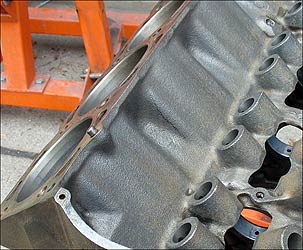

I guess I'm just looking for someone to tell me that this isn't that bad and could be welded up. I wouldn't think welding this would cause any problems with the adjacent bore's dimensions.
Just as an FYI, I do have another complete '71 455 that could be used instead, except that I believe it's a standard-bore engine, which means I'd have to get it bored out .030 to allow me to use the forged aluminum pistons I already have. Not the end of the world, but still...
So what would you do? Try to fix this block or use the back-up block?
So I get started on a final clean-up of the block, and while I'm drying it off my heart sunk when I noticed a 4" long crack in the lifter valley area! I don't know how I (or my machinist) missed it, but it's there. (click to enlarge)
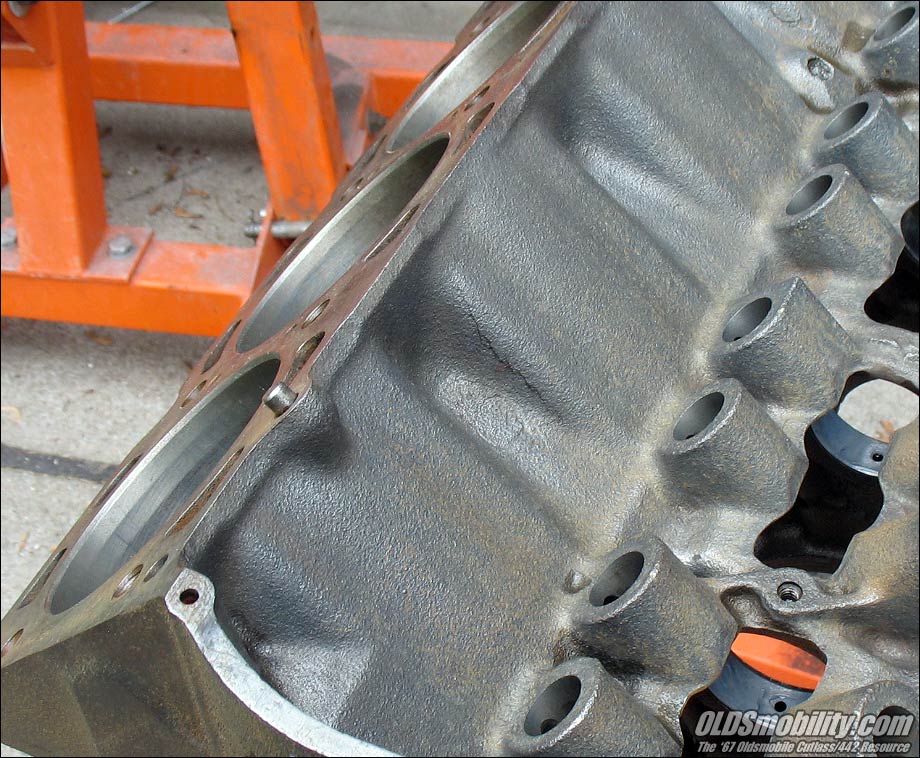
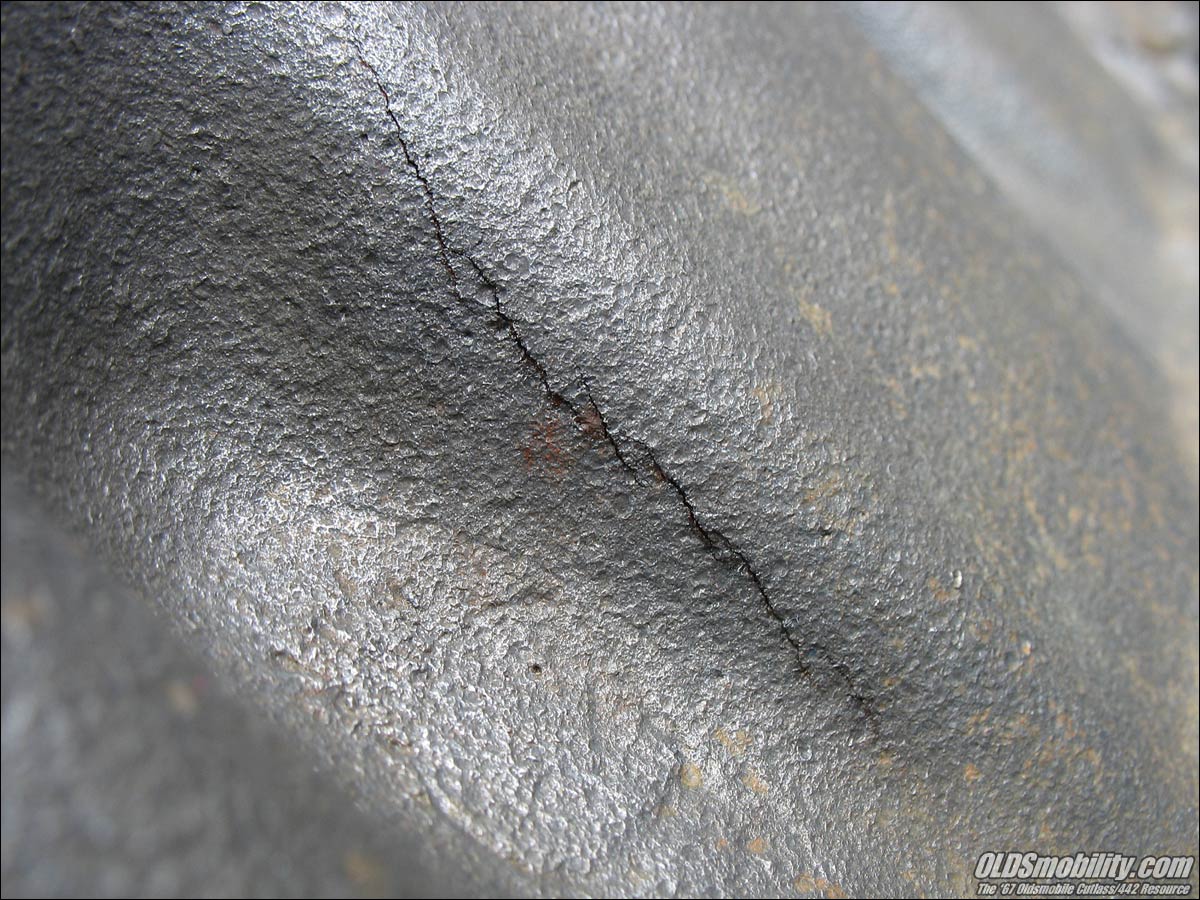
I guess I'm just looking for someone to tell me that this isn't that bad and could be welded up. I wouldn't think welding this would cause any problems with the adjacent bore's dimensions.
Just as an FYI, I do have another complete '71 455 that could be used instead, except that I believe it's a standard-bore engine, which means I'd have to get it bored out .030 to allow me to use the forged aluminum pistons I already have. Not the end of the world, but still...
So what would you do? Try to fix this block or use the back-up block?

Registered User
Joined: Oct 2005
Posts: 7,318
From: NJ
That crack is right on the water jacket area....directly behind it is water. The block should have been checked before any machine work was done after hot tank. If you paid for inspection they owe you for not spotting it. I would be on the phone or driving over to the shop and letting them tell you what to do.

Registered User
Joined: Oct 2009
Posts: 3,814
From: Erie,PA
Everything should have stopped,with a crack like that.It's pretty obvious.That crack is also deeper,or worse than what appears on the surface,since it cracked from the water jacket side.Yes,you "could" weld it,but to do it properly requires heat,and yes,you will need to remachine or at least rehone the cylinders.

Thread Starter
Registered User
Joined: Jul 2008
Posts: 163
From: West Point, NE
I guess the term "freshly-machined" is slightly misleading. I actually built this engine 20 years ago, but with less than 250 miles on it, there was an incident which allowed contact between a piston and valve which destroyed the cylinder head. The car got put into dry storage for a couple years, then I pulled the engine and set it back in a corner of the shop with a tarp over it for a few more years, and went on with life. I just recently dug it back out, tore it down and dropped it off at the machine shop to get hot-tanked and new cam bearings installed. He also did a light hone on the cylinders, nothing special. I didn't specifically request he inspect or magnaflux the block beforehand, I assumed it was still good. (My fault.)
There's nothing special about this block, there's no reason I can't use the '71 replacement, other than the time and trouble of getting it torn down, cleaned up and bored out. I was just hoping this block could be fixed less expensively than having to start over with another. However, it's not that big a deal.
Thanks for everyone's input...it's appreciated. I guess I know what I'll be doing over the next few days...
There's nothing special about this block, there's no reason I can't use the '71 replacement, other than the time and trouble of getting it torn down, cleaned up and bored out. I was just hoping this block could be fixed less expensively than having to start over with another. However, it's not that big a deal.
Thanks for everyone's input...it's appreciated. I guess I know what I'll be doing over the next few days...

Connoisseur d'Junque
Joined: Sep 2010
Posts: 21,183
From: The Hudson Valley
Yeah - that thing didn't crack on its own just sitting there.
You paid them to check it for cracks, and they did so, then did machine work on the basis of their having declared it sound. It's not your fault there is a crack, or that it wasn't noticed, then, or that it was noticed now - it's theirs.
They need to make good on this, and that might mean re-doing all of the same machine work on your other block.
- Eric
edit: delay in posting means I didn't see your post immediately above.
Never mind.
You paid them to check it for cracks, and they did so, then did machine work on the basis of their having declared it sound. It's not your fault there is a crack, or that it wasn't noticed, then, or that it was noticed now - it's theirs.
They need to make good on this, and that might mean re-doing all of the same machine work on your other block.
- Eric
edit: delay in posting means I didn't see your post immediately above.
Never mind.

Registered User
Joined: Jan 2010
Posts: 492
From: Dahlonega, GA
dont waste the time on it. if it was on the outside I would say try and fix it. if it leaked then it would just run on the ground. if the repair fails in the lifter galley the only way you will know is if you have lots of water in the oil and by then probably a bunch of junk parts. another block now is way cheaper than an entirely new motor later.

car guy
Joined: Apr 2008
Posts: 5,675
From: Dallas TX

Registered User
Joined: Feb 2011
Posts: 112
From: Eagle Point, Or.
 Cracked Block
That crack may be able to be repaired permently using a process called stiching, it is cheap, quick and requires no heat. I have used it many times on cracks even within the combustion chamber. It consists of installing a series of small threaded bolts which have a tapered wedge underneath the head, they are a shear bolt so when you install them the head shears off leaving a flush surface. Once you have installed the inintial series of plugs from one end of the crack to the other you then drill and tap holes between each of the first series of plugs. These plugs actually overlap each adjoining plug so that when you screw them in they form a positive leakproof seal. Very neat and works well. Should work on this crack. It does not work on a crack which ends in a freeze plug hole. Most modern engine shops are familiar with this technique and have the tooling to do it. I learned this technique from a large engine remanufacturer who has used it in thousands of crack repairs. Worth checking out. Dave E

Thread
Thread Starter
Forum
Replies
Last Post
jawsmon
Major Builds & Projects
14
Jul 13, 2012 07:17 AM
KRICHEN922
Small Blocks
48
Dec 5, 2009 09:39 AM


