


425 engine


Thread Starter
Registered User
Joined: Jun 2022
Posts: 8
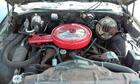
I am rebuilding this engine. It will be stock other then the Pistons. My machine shop could only find 10.25 .040 over Pistons. He said he can turn the dish to match my old 9:1 Pistons. The new pistons are Egge pistons. I looked on their website and it looks like they don’t offer 9:1 for 1966 425. Have you heard of changing 10.25 pistons to 9.1?


Registered User
Joined: Feb 2009
Posts: 1,737
From: West Hartford, CT
I’m not familiar with the piston dimensions but between the likelihood of thicker head gaskets and lower compression height of replacement pistons you are apt to come out shy of the original CR, which may not have been a full 10.25 to begin with. It would be prudent to tally up your measurements so you can be sure of the actual CR. A measured, actual CR, combined with cam specs will leave you with a good idea of octane requirements.
I agree with Eric, 93 is apt to be quite sufficient, might even find 91 could do it.
…
I agree with Eric, 93 is apt to be quite sufficient, might even find 91 could do it.
…
Last edited by bccan; Aug 9, 2022 at 03:42 PM.

Registered User
Joined: Dec 2016
Posts: 1,979
From: Beautiful Southern Maryland

Registered User
Joined: Nov 2008
Posts: 8,488
From: Central Fl
Mahle makes .030 over pistons with 10cc valve reliefs. With a typical iron head after a valve job, and replacing the shim gasket with a std one, you’d be at about 9.75:1.
In addition Egge pistons are typically shorter than the stockers. I’d be very surprised if it turns out to be 10.25:1 with their stuff anyway.
In addition Egge pistons are typically shorter than the stockers. I’d be very surprised if it turns out to be 10.25:1 with their stuff anyway.
Last edited by cutlassefi; Aug 9, 2022 at 04:56 PM.

Registered User
Joined: Jun 2018
Posts: 31
From: Wisconsin
Tgbunch: Do yourself a favor and follow the following advice. Build your cast iron headed 425 with no more than 9.5:1 static compression ratio if you intend on using 93 octane gas. No matter what anyone says, anything higher than 9.5:1 compression and you will experience audible(or inaudible) detonation, which will shorten the life span of your engine.
Registered User
Joined: Nov 2008
Posts: 8,488
From: Central Fl
Registered User
Joined: Nov 2019
Posts: 1,416
From: St. Michael, MN
I've draged and street driven my original 66 Toro long block on pump gas. No pinging whatsoever. Tune and carb has to be spot on.
Registered User
Joined: Jun 2018
Posts: 31
From: Wisconsin
Cutlassefi: Being able to "tune" your way around an engines octane requirements at a given compression ratio is a myth. This is not opinion, it's fact. There is no magic when it comes to meeting the octane requirement for any engine. You simply must! To Tgbunch: If you follow my advice in post #9, you will have an engine that is free of problems associated with detonation. Don't let your engine be a martyr because of other peoples ignorance.

Registered User
Joined: Dec 2016
Posts: 353
Registered User
Joined: Nov 2008
Posts: 8,488
From: Central Fl
Registered User
Joined: Nov 2008
Posts: 8,488
From: Central Fl
Cutlassefi: Being able to "tune" your way around an engines octane requirements at a given compression ratio is a myth. This is not opinion, it's fact. There is no magic when it comes to meeting the octane requirement for any engine. You simply must! To Tgbunch: If you follow my advice in post #9, you will have an engine that is free of problems associated with detonation. Don't let your engine be a martyr because of other peoples ignorance.
Op- Buy a wideband and tune the carb the right way etc. It’ll run fine if you take a few extra minutes to do it right.
Registered User
Joined: Nov 2019
Posts: 1,416
From: St. Michael, MN
Ignorance? I’ve done nearly a hundred on a Dyno, monitoring air/fuel, EGT’s, airflow, air temp and so on. They get installed in the vehicles with that same tune. No issues IF TUNED CORRECTLY!! However if you’re at 12.0:1 and trying to run pump gas, then yes you can’t tune your way out of a potential problem. But 10.0:1ish on todays pump gas is very doable, even with iron heads.
Op- Buy a wideband and tune the carb the right way etc. It’ll run fine if you take a few extra minutes to do it right.
Op- Buy a wideband and tune the carb the right way etc. It’ll run fine if you take a few extra minutes to do it right.




Registered User
Joined: Feb 2013
Posts: 15,411
From: Phoenix, AZ
Agreed. The cylinder pressure is a function of the static compression ratio and the cam timing events, so it is very possible to build a 10:1 engine that has the same dynamic compression ratio as a 9.5:1 engine.

Registered User
Joined: Apr 2017
Posts: 238
425
My 65 425 at 9.98 to 1 runs just fine on 92 pump. AF is at 12.0 - 12.5 wot and have no signs of detonation. BTW, I've had all sizes and years of 2nd generation Olds PowerPlants, hands down the 425 is my favorite.

Registered User
Joined: Jan 2010
Posts: 6,105
From: central Indiana
Cutlassefi: Being able to "tune" your way around an engines octane requirements at a given compression ratio is a myth. This is not opinion, it's fact. There is no magic when it comes to meeting the octane requirement for any engine. You simply must! To Tgbunch: If you follow my advice in post #9, you will have an engine that is free of problems associated with detonation. Don't let your engine be a martyr because of other peoples ignorance.
The 9.5 to one compression ratio rule of thumb is outdated. There are countless engines that run ****-poor pump gas with more that 9.5, both production and aftermarket builds.
Camshaft, cylinder head design, environment, and how well the engine is tuned is far more important than the compression ratio.
This isn’t 1985.

Old(s) Fart
Joined: Mar 2007
Posts: 50,806
From: Northern VA
I think the point that most responses in this thread are missing is that just because an engine has advertised 10.25:1 pistons doesn't mean that's what the actual CR is. Stock Olds heads typically came from the factory with larger than advertised chambers. Any machine work done to the heads in the last half century could have either decreased or increased that chamber volume, depending on what was done. Same thing with the block. Has it been decked? Where do the piston sit in the bore? And finally, Olds piston CR ratings are based on using the stock steel shim head gasket with 0.017" compressed thickness. If you are using the FelPro or similar head gaskets with the 0.041 or so compressed thickness, that will further drop CR.

Registered User
Joined: Sep 2017
Posts: 5,219
From: St. Paul Minnesota
I think the "chemistry" of gasoline has evolved since 1971. Couple that with a different octane rating system, there is plenty of room for confusion. A lot of older high compression, unmolested cars can run on 91 and 93 gas. For those cars with more than 10 to 1 actual (computed) can run on gas that is "spiked" with an additive octane booster, avgas).
In July, I hung out at the "portable chassis dyno" at the Street Machine Nationals in St. Paul, Minnesota. I talked with several different people with a variety of different engines. These were engines that had 10.5 or greater compression ratio's. There were a couple with 11.5 and 12.0 ratio's. 10.5 seemed to be ok on 93 octane pump gas (no ethanol). Above that, various mixes of additives were used on the street. A 520 CI Ford with aluminum heads used 2-5 gallons of Avgas per 20 gallon tank on the street, racing gas at the drag strip. I do think the timing was adjusted for the intended purpose/gasoline.
....My two cents worth.
In July, I hung out at the "portable chassis dyno" at the Street Machine Nationals in St. Paul, Minnesota. I talked with several different people with a variety of different engines. These were engines that had 10.5 or greater compression ratio's. There were a couple with 11.5 and 12.0 ratio's. 10.5 seemed to be ok on 93 octane pump gas (no ethanol). Above that, various mixes of additives were used on the street. A 520 CI Ford with aluminum heads used 2-5 gallons of Avgas per 20 gallon tank on the street, racing gas at the drag strip. I do think the timing was adjusted for the intended purpose/gasoline.
....My two cents worth.
Registered User
Joined: Jan 2010
Posts: 6,105
From: central Indiana
My 455 has almost 11:1 calculated compression, it runs just fine on 93. Granted, I have no doubt the aluminum heads, OAI (intake air temp is always within a few degrees of ambient temp) and a top notch cooling system all help keep the dreaded engine rattle away. I also try to run good name brand fuel.
The car runs exactly the same on pump gas as with race fuel, that tells me the engine isn’t octane limited. I’m not talking seat-of-the-pants “buttometer”, I mean actual timeslip at the track comparison.
Just as an experiment, I did try 91 octane. Occasionally, you could hear a little rattle at light part throttle acceleration. Step on the gas a little more, the vacuum advance would begin to back off the timing, the rattle stopped. That suggests that I am right on the edge of preignition. But as I mentioned, I’m far beyond the recommended 9.5 to 1.
If I was building a engine for someone, I would definitely be much more conservative. You can’t control what the owner of the engine does once it’s installed, cheap gas, lousy tune, marginal cooling system, all things out of the engine builders control.
The car runs exactly the same on pump gas as with race fuel, that tells me the engine isn’t octane limited. I’m not talking seat-of-the-pants “buttometer”, I mean actual timeslip at the track comparison.
Just as an experiment, I did try 91 octane. Occasionally, you could hear a little rattle at light part throttle acceleration. Step on the gas a little more, the vacuum advance would begin to back off the timing, the rattle stopped. That suggests that I am right on the edge of preignition. But as I mentioned, I’m far beyond the recommended 9.5 to 1.
If I was building a engine for someone, I would definitely be much more conservative. You can’t control what the owner of the engine does once it’s installed, cheap gas, lousy tune, marginal cooling system, all things out of the engine builders control.
Last edited by matt69olds; Aug 22, 2022 at 10:05 PM.

Thread
Thread Starter
Forum
Replies
Last Post


