


1970 442 carb trouble (with glamour shot)

Thread Starter
Registered User
Joined: Aug 2016
Posts: 15
From: Grand Rapids, Michigan
1970 442 carb trouble (with glamour shot)

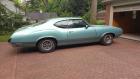
Where's the OAI hood and the W-30 stripe? But seriously, a shot of my trusty steed which I have owned since 1985 and which was refurbished and repainted in the original Reef Turquoise a around that time. Broadcast card say 9/30/1969, cowl tag 10A. The Beatles Abbey Road came out the same week.
Problem: I am not a mechanic and have only a rudimentary understanding of how a quadrajet carb works. While the engine (rebuilt in 1985) and transmission are original to the car, the carb body is unfortunately from a 71 98 or similar Olds. (Don't ask, I think my mother threw away the original carb body) The engine has had some tendency to bog when given full throttle off the line, and today things got dramatically worse. It will cruise and drive fine on the primaries, but when you got into the throttle while driving down the road it stuttered and surged as if the gas was being cut off and on, then would totally bog and then backfire through the tailpipes and through the air cleaner. A cloud of black smoke would then swirl out the tailpipes. I have a mechanic that is familiar with old cars but is not a carb specialist. I assume there are more than a few possible causes, but was thinking there might be some prime suspects than I could talk to my mechanic about. Any and all suggestions are welcome. I would not rule out sending the carb off the be totally rebuilt, or buying a rebuilt carb.
Does anyone have a spare August or September dated carb for a 70 442? (I am not holding my breath). It would be nice to get things back to being all correct. Thanks in advance for your replies.

Registered User
Joined: Oct 2016
Posts: 1,046
 Check fuel filter at carburetor also could be accelerator pump
could sludge be in the system ? Is it the original fuel tank and sending unit?
They may need to be flushed out or replaced?
This is somewhere to start
Alain 1970 platinum 442 4spd factory A/C
Registered User
Joined: Feb 2013
Posts: 15,440
From: Phoenix, AZ
It will cruise and drive fine on the primaries, but when you got into the throttle while driving down the road it stuttered and surged as if the gas was being cut off and on, then would totally bog and then backfire through the tailpipes and through the air cleaner. A cloud of black smoke would then swirl out the tailpipes.

Old(s) Fart
Joined: Mar 2007
Posts: 50,840
From: Northern VA
Assuming this is an AT car, the original carb would have been a 7040257, which used 069 primary jets, 52C primary metering rods, and AU secondary metering rods. If you have a 1971 carb it would be number 7041251, which used slightly richer 070 primary jets, 49B primary metering rods, and leaner AK secondary metering rods. You can swap out the jets and rods to match the calibration of the original carb.
CH3NO2 LEARN IT BURN IT
Joined: Jul 2010
Posts: 5,647
From: Land of Taxes
40 years of no carb or fuel system attention....
Fuel system needs to be looked at from tank to carb. There are several rubber jumper lines that need replacing with correct type of rubber hose. The pick up sock in the tank should be inspected/replaced.
The filter as mentioned should automatically get replaced. The filter requires gentile smart technique to disassemble/reassemble and not damage the carb. Its fragile in that area. The monkey approach will damage the inlet.
The carb needs to be disassembled cleaned and rebuilt. Chances are the throttle shaft bushings are shot. If so you will never get it to "tune." The rebuild or a new re-manufactured carb will need some level of expert tuning to extract the most out of the car. (same for the distributor)
Run only ethanol free gas. Stabilize the gas with marine (blue) sta-bil.
Read the attachment.
I know your car hasn't endured extended storage hibernation but I'm sure there are several other things that need attention if it more or less hasn't been touched in a long while.
Fuel system needs to be looked at from tank to carb. There are several rubber jumper lines that need replacing with correct type of rubber hose. The pick up sock in the tank should be inspected/replaced.
The filter as mentioned should automatically get replaced. The filter requires gentile smart technique to disassemble/reassemble and not damage the carb. Its fragile in that area. The monkey approach will damage the inlet.
The carb needs to be disassembled cleaned and rebuilt. Chances are the throttle shaft bushings are shot. If so you will never get it to "tune." The rebuild or a new re-manufactured carb will need some level of expert tuning to extract the most out of the car. (same for the distributor)
Run only ethanol free gas. Stabilize the gas with marine (blue) sta-bil.
Read the attachment.
I know your car hasn't endured extended storage hibernation but I'm sure there are several other things that need attention if it more or less hasn't been touched in a long while.

Thread Starter
Registered User
Joined: Aug 2016
Posts: 15
From: Grand Rapids, Michigan
Thank you all for replies and suggestions. The car is an automatic, on the column, bench seat (trim comb. 940) as verified by the broadcast card. Also verified not a W-30.
The carb that is on the car used the internals from the original (subsequently lost) carburetor and was installed by a reputable carb mechanic. The car runs and drives fine at all speeds, just not when you start to really get on the gas; then it really sputters and basically chokes, back fires, etc. I have to admit there has been little done in the way of carb or fuel system maintenance, and considering the car sat undriven for nearly 20 years (up until about 4 years ago) I can imagine the carb / fuel system may need cleaning or other attention. There is an in line fuel filter that was installed before I got the car. That should be an easy replacement and something to eliminate as a possible problem.
I am surprised that the problem has gotten so severe, seemingly so suddenly. Is there any possibility that the problem is related to the vacuum advance (or failure to advance) of the distributor? Thanks again for any and all input.
The carb that is on the car used the internals from the original (subsequently lost) carburetor and was installed by a reputable carb mechanic. The car runs and drives fine at all speeds, just not when you start to really get on the gas; then it really sputters and basically chokes, back fires, etc. I have to admit there has been little done in the way of carb or fuel system maintenance, and considering the car sat undriven for nearly 20 years (up until about 4 years ago) I can imagine the carb / fuel system may need cleaning or other attention. There is an in line fuel filter that was installed before I got the car. That should be an easy replacement and something to eliminate as a possible problem.
I am surprised that the problem has gotten so severe, seemingly so suddenly. Is there any possibility that the problem is related to the vacuum advance (or failure to advance) of the distributor? Thanks again for any and all input.
Registered User
Joined: Feb 2013
Posts: 15,440
From: Phoenix, AZ
Vacuum to the distributor advance drops to zero at full throttle so that’s not the issue.
Any idea if the distributor is the original points unit? If so, the points could be in poor shape and unable to support the heavier engine load at WOT.
Any idea if the distributor is the original points unit? If so, the points could be in poor shape and unable to support the heavier engine load at WOT.
CH3NO2 LEARN IT BURN IT
Joined: Jul 2010
Posts: 5,647
From: Land of Taxes
Dont blindly throw parts at a problem. Find the root cause.
Eliminate one problem at a time.
Investigate one system at a time.
Start with the simple problems and work toward the complex.
Always keep track of the settings you adjusted so you can return back home.
A cracked rubber hose from dry rot can suddenly occur without warning.
A broken negative wire from the coil to the points can occur without warning,
An ignition coil, cap, or rotor can go suddenly....et al....
The rubber fuel hoses are (should always be) on the suction side of the fuel pump.
The crack can be small enough not to leak fuel and large enough to suck air in during peak demand thus causing fuel starvation (bog, stumble).
Cheap inline filters between the pump & carb are not recommended as they present a fire hazard. Correct that with a new metal pump to carb line.
Let us back up a few steps and grab a mountaintop view of the overall state of tune of your engine, verses zeroing in what you preveive to be the problem.
Troubleshooting 101:
-Air filter clean?
-Gas fresh?
-Fuel pump pressure in spec? Y/N?
-Engine off, look down the carb while actuating the throttle. Do you see 2 strong pump shots of fuel with full travel of the accelerator pump? Y/N? Does the carb open up to WOT (wide open throttle) by hand and by flooring the gas pedal?
-Look at all rubber fuel lines. Do any look wet? Y/N
-Measure manifold vacuum at warm idle (on a manifold not a carb nipple). What is it? Can you raise it up with air fuel and timing adjustments?
-Inspect the points (gap and condition), cap rotor weights springs (under the rotor) plugs, and wires...etc.Read the spark plugs.
-Inspect all the vacuum lines on the engine.
The above items verify the general health of the engine and will provide a solid starting point to begin a deep dive into each system.
Feel free to IM me for my cell # if you need more depth or get to a dead end.
Steve
Lisle fuel pressure/vacuum gauge. Buy one. You don't really need a timing light if you have one of these.
https://www.homedepot.com/p/Lisle-Fu...aBa10pSCKvx7aA
Eliminate one problem at a time.
Investigate one system at a time.
Start with the simple problems and work toward the complex.
Always keep track of the settings you adjusted so you can return back home.
A cracked rubber hose from dry rot can suddenly occur without warning.
A broken negative wire from the coil to the points can occur without warning,
An ignition coil, cap, or rotor can go suddenly....et al....
The rubber fuel hoses are (should always be) on the suction side of the fuel pump.
The crack can be small enough not to leak fuel and large enough to suck air in during peak demand thus causing fuel starvation (bog, stumble).
Cheap inline filters between the pump & carb are not recommended as they present a fire hazard. Correct that with a new metal pump to carb line.
Let us back up a few steps and grab a mountaintop view of the overall state of tune of your engine, verses zeroing in what you preveive to be the problem.
Troubleshooting 101:
-Air filter clean?
-Gas fresh?
-Fuel pump pressure in spec? Y/N?
-Engine off, look down the carb while actuating the throttle. Do you see 2 strong pump shots of fuel with full travel of the accelerator pump? Y/N? Does the carb open up to WOT (wide open throttle) by hand and by flooring the gas pedal?
-Look at all rubber fuel lines. Do any look wet? Y/N
-Measure manifold vacuum at warm idle (on a manifold not a carb nipple). What is it? Can you raise it up with air fuel and timing adjustments?
-Inspect the points (gap and condition), cap rotor weights springs (under the rotor) plugs, and wires...etc.Read the spark plugs.
-Inspect all the vacuum lines on the engine.
The above items verify the general health of the engine and will provide a solid starting point to begin a deep dive into each system.
Feel free to IM me for my cell # if you need more depth or get to a dead end.
Steve
Lisle fuel pressure/vacuum gauge. Buy one. You don't really need a timing light if you have one of these.
https://www.homedepot.com/p/Lisle-Fu...aBa10pSCKvx7aA
Registered User
Joined: Feb 2013
Posts: 15,440
From: Phoenix, AZ
Back in the 80s I had an issue when one of the terminals on the resistor wire to the points corroded. The engine ran OK for normal driving, but going WOT resulted in bogging, popping, and a dramatic reduction in power. I don't recall any backfiring and smoky exhaust like you stated, but those could occur with a weak ignition system.
Registered User
Joined: Nov 2015
Posts: 685
From: So. Ca.
Nice car. Your problem may be the Choke Pull-Off aka Vacuum Break. This actually controls the opening rate of the secondary air valve (top flapper). This can cause problems similar to what you are describing.
https://quadrajetparts.com/quadrajet...onti-p-216.htm
Cliffs high performance may have tuneable pull-offs for your application
https://cliffshighperformance.com/
https://quadrajetparts.com/quadrajet...onti-p-216.htm
Cliffs high performance may have tuneable pull-offs for your application
https://cliffshighperformance.com/

Thread
Thread Starter
Forum
Replies
Last Post
sx455raidercelticfan
General Discussion
4
Jul 8, 2010 07:30 AM


