


Engine stalling randomly


Connoisseur d'Junque
Joined: Sep 2010
Posts: 21,183
From: The Hudson Valley
Some meters have a **** to select the number of cylinder of the engine - be sure yours is set to "8."
Some meters have different scales for different numbers of cylinders - be sure you are reading from the "8 cyl" scale.
Note that this one has three dwell scales, "8cyl," "6cyl," and "4cyl."

- Eric

Thread Starter
Registered User
Joined: Jan 2013
Posts: 68
From: San Jose , Ca
well s#*&, i may have been reading it wrong this whole time. This is the actual Engine Analyzer i have

I looks like the cylce switch does not affect the dwell, so perhaps i was looking at the wrong scale. The top one says its 8 cycle and lower says 4 cycle. The 4 cycle, appears to be where the needle was sitting around 30*, the top one shows it was at 15*. So my car is a 4 cycle not 8? (stupid question, i know)
I looks like the cylce switch does not affect the dwell, so perhaps i was looking at the wrong scale. The top one says its 8 cycle and lower says 4 cycle. The 4 cycle, appears to be where the needle was sitting around 30*, the top one shows it was at 15*. So my car is a 4 cycle not 8? (stupid question, i know)

Registered User
Joined: Jun 2010
Posts: 3,613
From: Rogues Island, USA
That 4 and 2 switch on the bottom refers to four or two stroke (cycles). You have a 4 stroke engine, put it on 4.
You need to be looking at the 8 cylinder scale. Set the dial on DWELL, the blue scale, and read the corresponding number on the blue 8 cylinder scale
You need to be looking at the 8 cylinder scale. Set the dial on DWELL, the blue scale, and read the corresponding number on the blue 8 cylinder scale
Connoisseur d'Junque
Joined: Sep 2010
Posts: 21,183
From: The Hudson Valley
George has you covered there.
"Cycle" refers to a 2-stroke (old motorcycle) or 4-stroke (darn near everything else) engine.
"Cyl" refers to the number of cylinders.
You've got a 4-stroke V-8 engine, so set accordingly.
30° and 8 cylinders is usually dead-center on the scale.
- Eric
"Cycle" refers to a 2-stroke (old motorcycle) or 4-stroke (darn near everything else) engine.
"Cyl" refers to the number of cylinders.
You've got a 4-stroke V-8 engine, so set accordingly.
30° and 8 cylinders is usually dead-center on the scale.
- Eric
Connoisseur d'Junque
Joined: Sep 2010
Posts: 21,183
From: The Hudson Valley
 ??? ???
Why use the #6 cylinder?
Why not use #1?
#1 is certainly easier to get to, being right at the front of the engine.
Granted, either one will read the same on the timing indicator, but why not just use #1?
- Eric
Thread Starter
Registered User
Joined: Jan 2013
Posts: 68
From: San Jose , Ca
Thread Starter
Registered User
Joined: Jan 2013
Posts: 68
From: San Jose , Ca
(7) Ignition & Oiling:
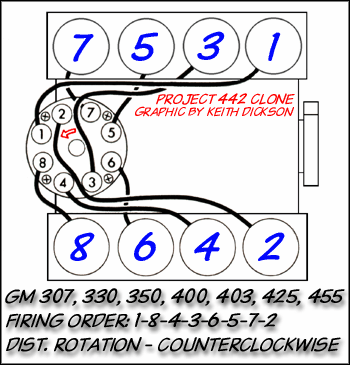
When you line up the dots on the timing chain and don't turn the motor , the number six piston is the one on fire. Drop the distributor in with the rotor pointing to number six, you most likely put at number one and were 180 out of time.
Distributors:
1949-1955: No Window for points adjustment. Advance weights are below points. (D style cam gear)
1956-1958: Window for points adjustment. Weights are below rotor. (D style cam gear)
1959-1964: Hex Camshaft Gear.
According to Mallory all distributors will interchange if you match the cam gear to
your engine's year.
If you wanted to put a 1964 distributor in your 1949 motor you would have to swap the
camshaft gear or change the oil pump to a 1959-60 pump which fits the 1949-1960 engines.
If you wanted to put a 1949 distributor in your 1964 motor you would have to swap the
camshaft gear. You cannot use an earlier oil pump in the 1961-64 engines. The newer Oldsmobile engines (330,400,425,455) fit & are the hex drive only. Maybe they have different roll pin or shaft sizes? (0.5 or 0.49)
Crane Cams makes an adjustable vacuum advance unit for the 1956 distributor, there's also a Petronix Ignitor kit for this unit. It will replace the points & allow you to only worry about replacing the cap & rotor.
**Distributors got timing marks on it because it wasn't on the balancer.

Administrator
Joined: Oct 2009
Posts: 42,496
From: Poteau, Ok
What does the above have to do with setting timing, it pertains to where you stab the distributor with relation to #1 or #6, and there is always a 50-50 chance of being 180 out. #1 or #6 will be firing
Thread Starter
Registered User
Joined: Jan 2013
Posts: 68
From: San Jose , Ca
Well it looks like the 371 isn't on the list. Although it was mentioned in the HAMB post, im assuming. If i were to drop in the distributor pointing to the #6 while on TDC would the car actually work? Or would i tell right off the bat that there is something wrong?
Registered User
Joined: Jun 2010
Posts: 3,613
From: Rogues Island, USA
As long as you have the rotor pointed to the terminal on the distributor that you are going to use for #1 cylinder at TDC it doesn't matter where the rotor points. You could point the rotor toward China for all the engine cares as long as you make that the #1 terminal and start the spark plug wire rotation from that point. The firing order for a 371 Olds is:
1-8-7-3-6-5-4-2
The only difference is the 4/7 swap. I was unable to find it but I believe it is a counter-clockwise rotation like modern Olds
1-8-7-3-6-5-4-2
The only difference is the 4/7 swap. I was unable to find it but I believe it is a counter-clockwise rotation like modern Olds
Administrator
Joined: Oct 2009
Posts: 42,496
From: Poteau, Ok
Thread Starter
Registered User
Joined: Jan 2013
Posts: 68
From: San Jose , Ca
Awesome, thank fellas.
I just ordered the accel points conversion kit and a accel coil, to hopefully be done with this whole, dwell, burning points and timing troubles im having.
Once i get it, i'll make sure to have the #1 piston on TDC then time it to about 5* initial.
Thanks again for the help.
If you guys have any suggestions on oild sludge and how i might be able to clear this from the engine, that would be great. I think i mentioned that there was a crap load of buildup on the distributor shaft when i finally removed it.
https://classicoldsmobile.com/forums...l-buildup.html
I just ordered the accel points conversion kit and a accel coil, to hopefully be done with this whole, dwell, burning points and timing troubles im having.
Once i get it, i'll make sure to have the #1 piston on TDC then time it to about 5* initial.
Thanks again for the help.
If you guys have any suggestions on oild sludge and how i might be able to clear this from the engine, that would be great. I think i mentioned that there was a crap load of buildup on the distributor shaft when i finally removed it.
https://classicoldsmobile.com/forums...l-buildup.html

Hot Rod Has Been
Joined: Dec 2012
Posts: 339
From: Central Wisconsin
You can do more harm than good if you try to "flush" out the built up sludge. Having random pieces of goo floating around in the engine can plug up your vale lifters, and plug the oil screen... instant no oil pressure!
If you must pull off the valve covers and clean out the sludge from them but don't mess with the top of the heads or the rocker shafts. The ONLY way to clean them is to pull them off, plug the oil return holes in the head, and get busy with some diesel fuel/kerosene or stoddard solvents. Then reassemble.. you don't want sludge in the lifter valley.
The best thing to do is leave well enough alone... buy some good 10W30 oil with the older API rating of SL... do not use oils with the SL,SM or SN ratings. 99% of all 10W30 oils will only meet the older ratings anyway. The oil will slowly clean the engine from within and that's fine. Hopefully the sludge will not plug the oil screen and that old 371 will live a happy li, long life.
BTW... check you fuel lines... I have brought many old cars back from the dead and most of the time the fuel lines are rusty, porous or collapsed causing exactly the symptoms you have described (before you attacked the electrical system)...
If you must pull off the valve covers and clean out the sludge from them but don't mess with the top of the heads or the rocker shafts. The ONLY way to clean them is to pull them off, plug the oil return holes in the head, and get busy with some diesel fuel/kerosene or stoddard solvents. Then reassemble.. you don't want sludge in the lifter valley.
The best thing to do is leave well enough alone... buy some good 10W30 oil with the older API rating of SL... do not use oils with the SL,SM or SN ratings. 99% of all 10W30 oils will only meet the older ratings anyway. The oil will slowly clean the engine from within and that's fine. Hopefully the sludge will not plug the oil screen and that old 371 will live a happy li, long life.
BTW... check you fuel lines... I have brought many old cars back from the dead and most of the time the fuel lines are rusty, porous or collapsed causing exactly the symptoms you have described (before you attacked the electrical system)...
Last edited by krooser; Feb 14, 2013 at 07:30 AM.
Thread Starter
Registered User
Joined: Jan 2013
Posts: 68
From: San Jose , Ca
vYou can do more harm than good if you try to "flush" out the built up sludge. Having random pieces of goo floating around in the engine can plug up your vale lifters, and plug the oil screen... instant no oil pressure!
If you must pull off the valve covers and clean out the sludge from them but don't mess with the top of the heads or the rocker shafts. The ONLY way to clean them is to pull them off, plug the oil return holes in the head, and get busy with some diesel fuel/kerosene or stoddard solvents. Then reassemble.. you don't want sludge in the lifter valley.
The best thing to do is leave well enough alone... buy some good 10W30 oil with the older API rating of SL... do not use oils with the SL,SM or SN ratings. 99% of all 10W30 oils will only meet the older ratings anyway. The oil will slowly clean the engine from within and that's fine. Hopefully the sludge will not plug the oil screen and that old 371 will live a happy li, long life.
BTW... check you fuel lines... I have brought many old cars back from the dead and most of the time the fuel lines are rusty, porous or collapsed causing exactly the symptoms you have described (before you attacked the electrical system)...
If you must pull off the valve covers and clean out the sludge from them but don't mess with the top of the heads or the rocker shafts. The ONLY way to clean them is to pull them off, plug the oil return holes in the head, and get busy with some diesel fuel/kerosene or stoddard solvents. Then reassemble.. you don't want sludge in the lifter valley.
The best thing to do is leave well enough alone... buy some good 10W30 oil with the older API rating of SL... do not use oils with the SL,SM or SN ratings. 99% of all 10W30 oils will only meet the older ratings anyway. The oil will slowly clean the engine from within and that's fine. Hopefully the sludge will not plug the oil screen and that old 371 will live a happy li, long life.
BTW... check you fuel lines... I have brought many old cars back from the dead and most of the time the fuel lines are rusty, porous or collapsed causing exactly the symptoms you have described (before you attacked the electrical system)...
Do you have any suggestions on oils that i can use? So you are saying to not mess with the rockers under the valve cover and just use the new oil? Synthetic or conventional?
I do not mind getting under the valve covers and trying to manually clear some of the built up oil. What risk do i run if i am careful using a rag or scraping tools?
Hot Rod Has Been
Joined: Dec 2012
Posts: 339
From: Central Wisconsin
If you have a good source of air you can bow out the lines to be sure there isn't any dead gas varnish in the lines. After six months or so the gasoline begins to turn to varnish... a gooey mess. A new tank, filter even fuel pump all help but if the lines are plugged you will generally have an intermittent stalling or no start problem.
I have de-sludged many old engines but you have to be very careful that the crap doesn't entire the lifter valley. You have hydraulic lifters that can get plugged from the stuff. If it gets into the oil pan via the oil drain holes the oil pick-up will suck it up and it will plug the oil pick-up screen... bingo! no oil pressure.
If you DO try to clean up the top engine you should also disassemble the rocker arm shafts and clean out the mess inside the shaft... they are likely sludged up, too.
All of this mess was due to the lower grade oil we used to have for our cars... plus lots of city driving tends to produce water vapor since the engine doesn't often really get up to temp. This water vapor condenses in the oil causing sludge.
Years ago, many cars ran without a T-stat in the summer to prevent overheating... still more cold engine running.
Todays oil's are better but you have to be careful on what you buy. The oils for modern overhead cam engines don't require the amount of ZDDP that a vintage flat tappet engine needs to live. You are pretty safe with most any 10W30 oil as the newer API ratings don't include this grade of oil. But you have to read the label. If it's sez API-SL or SN put it back. This stuff will clean off the anti-wear barrier on the engines moving parts... a barrier that is put in place by ZDDP. And the newer diesel oils now have detergents that will also wipe out the ZDDP barrier... stay away from them, too. What you want is a single grade 20W or an older spec 10W30.
Stay away from any synthetic or synthetic blend... you have an old car that needs a older style oil... I've been working on these old cars since they were new. I love synthetics but they have no place in your engine.
I have de-sludged many old engines but you have to be very careful that the crap doesn't entire the lifter valley. You have hydraulic lifters that can get plugged from the stuff. If it gets into the oil pan via the oil drain holes the oil pick-up will suck it up and it will plug the oil pick-up screen... bingo! no oil pressure.
If you DO try to clean up the top engine you should also disassemble the rocker arm shafts and clean out the mess inside the shaft... they are likely sludged up, too.
All of this mess was due to the lower grade oil we used to have for our cars... plus lots of city driving tends to produce water vapor since the engine doesn't often really get up to temp. This water vapor condenses in the oil causing sludge.
Years ago, many cars ran without a T-stat in the summer to prevent overheating... still more cold engine running.
Todays oil's are better but you have to be careful on what you buy. The oils for modern overhead cam engines don't require the amount of ZDDP that a vintage flat tappet engine needs to live. You are pretty safe with most any 10W30 oil as the newer API ratings don't include this grade of oil. But you have to read the label. If it's sez API-SL or SN put it back. This stuff will clean off the anti-wear barrier on the engines moving parts... a barrier that is put in place by ZDDP. And the newer diesel oils now have detergents that will also wipe out the ZDDP barrier... stay away from them, too. What you want is a single grade 20W or an older spec 10W30.
Stay away from any synthetic or synthetic blend... you have an old car that needs a older style oil... I've been working on these old cars since they were new. I love synthetics but they have no place in your engine.
Thread Starter
Registered User
Joined: Jan 2013
Posts: 68
From: San Jose , Ca
If you have a good source of air you can bow out the lines to be sure there isn't any dead gas varnish in the lines. After six months or so the gasoline begins to turn to varnish... a gooey mess. A new tank, filter even fuel pump all help but if the lines are plugged you will generally have an intermittent stalling or no start problem.
I have de-sludged many old engines but you have to be very careful that the crap doesn't entire the lifter valley. You have hydraulic lifters that can get plugged from the stuff. If it gets into the oil pan via the oil drain holes the oil pick-up will suck it up and it will plug the oil pick-up screen... bingo! no oil pressure.
If you DO try to clean up the top engine you should also disassemble the rocker arm shafts and clean out the mess inside the shaft... they are likely sludged up, too.
All of this mess was due to the lower grade oil we used to have for our cars... plus lots of city driving tends to produce water vapor since the engine doesn't often really get up to temp. This water vapor condenses in the oil causing sludge.
Years ago, many cars ran without a T-stat in the summer to prevent overheating... still more cold engine running.
Todays oil's are better but you have to be careful on what you buy. The oils for modern overhead cam engines don't require the amount of ZDDP that a vintage flat tappet engine needs to live. You are pretty safe with most any 10W30 oil as the newer API ratings don't include this grade of oil. But you have to read the label. If it's sez API-SL or SN put it back. This stuff will clean off the anti-wear barrier on the engines moving parts... a barrier that is put in place by ZDDP. And the newer diesel oils now have detergents that will also wipe out the ZDDP barrier... stay away from them, too. What you want is a single grade 20W or an older spec 10W30.
Stay away from any synthetic or synthetic blend... you have an old car that needs a older style oil... I've been working on these old cars since they were new. I love synthetics but they have no place in your engine.
I have de-sludged many old engines but you have to be very careful that the crap doesn't entire the lifter valley. You have hydraulic lifters that can get plugged from the stuff. If it gets into the oil pan via the oil drain holes the oil pick-up will suck it up and it will plug the oil pick-up screen... bingo! no oil pressure.
If you DO try to clean up the top engine you should also disassemble the rocker arm shafts and clean out the mess inside the shaft... they are likely sludged up, too.
All of this mess was due to the lower grade oil we used to have for our cars... plus lots of city driving tends to produce water vapor since the engine doesn't often really get up to temp. This water vapor condenses in the oil causing sludge.
Years ago, many cars ran without a T-stat in the summer to prevent overheating... still more cold engine running.
Todays oil's are better but you have to be careful on what you buy. The oils for modern overhead cam engines don't require the amount of ZDDP that a vintage flat tappet engine needs to live. You are pretty safe with most any 10W30 oil as the newer API ratings don't include this grade of oil. But you have to read the label. If it's sez API-SL or SN put it back. This stuff will clean off the anti-wear barrier on the engines moving parts... a barrier that is put in place by ZDDP. And the newer diesel oils now have detergents that will also wipe out the ZDDP barrier... stay away from them, too. What you want is a single grade 20W or an older spec 10W30.
Stay away from any synthetic or synthetic blend... you have an old car that needs a older style oil... I've been working on these old cars since they were new. I love synthetics but they have no place in your engine.
I'll run my compressor through the lines this weekend.
What specific brands do you recommend for the oil? I've been reading and hearing good things about the Rotella 15W4, a little thicker, but that may add to my sludge problem..
Thread Starter
Registered User
Joined: Jan 2013
Posts: 68
From: San Jose , Ca
Heres an update (still having problem)
I have a rebuilt carb
replaced points with electronic
new coil, cap and wires
new ballast resistor
freshly rebuilt fuel pump
MY CAR IS STILL STALLING
i was coming to a stop light and the car lost all power and would not restart.
I pulled it over, there was spark and there was fuel - but the choke was closed
I opened it and the car took a few crank and it fired up. So im asuming it shut on me while driving so i tied it wide open.
Now, i have to keep my foot on the gas to keep it on or else it will shut off on me no matter how warmed up the car is.
also, i noticed that as i worked the throttle with my hand i could hear the gas squirt, sizzle then some "steam" would come out of the top. Is this vapor lock? my lines to the carb are steel.
I have a rebuilt carb
replaced points with electronic
new coil, cap and wires
new ballast resistor
freshly rebuilt fuel pump
MY CAR IS STILL STALLING
i was coming to a stop light and the car lost all power and would not restart.
I pulled it over, there was spark and there was fuel - but the choke was closed
I opened it and the car took a few crank and it fired up. So im asuming it shut on me while driving so i tied it wide open.
Now, i have to keep my foot on the gas to keep it on or else it will shut off on me no matter how warmed up the car is.
also, i noticed that as i worked the throttle with my hand i could hear the gas squirt, sizzle then some "steam" would come out of the top. Is this vapor lock? my lines to the carb are steel.
Connoisseur d'Junque
Joined: Sep 2010
Posts: 21,183
From: The Hudson Valley
... there was spark and there was fuel - but the choke was closed
I opened it and the car took a few crank and it fired up. So im asuming it shut on me while driving so i tied it wide open.
Now, i have to keep my foot on the gas to keep it on or else it will shut off on me no matter how warmed up the car is.
I opened it and the car took a few crank and it fired up. So im asuming it shut on me while driving so i tied it wide open.
Now, i have to keep my foot on the gas to keep it on or else it will shut off on me no matter how warmed up the car is.
However, if you block it open, as you have done, the problems should go away.
It sounds like your carburetor is set VERY wrong, like with a much too slow idle speed or a much too lean mixture, or, possibly, that there's something wrong with it, like a blocked idle passage.
Try to readjust the carb correctly - if you can, it was the settings, if you can't, you'll have to take the carb apart and check every passage, jet, and vent.
- Eric
Registered User
Joined: Mar 2012
Posts: 2,163
From: Sistersville, WV
Your plugs may now be badly fouled due to the closed choke.
Have you checked the voltage at the pos. terminal of coil ?
Does the Accel coil you installed call for the ballast resistor? The conversion kit requires one depending on which coil is used. If your car had an existing resistor wire, and you installed another resistor you have low volts at the coil.
Have you checked the voltage at the pos. terminal of coil ?
Does the Accel coil you installed call for the ballast resistor? The conversion kit requires one depending on which coil is used. If your car had an existing resistor wire, and you installed another resistor you have low volts at the coil.

Registered User
Joined: Dec 2011
Posts: 7,286
Can you post a link to where i can buy these bushings? Are they specific to the distributor in size or universal across pre-65?
I would love to dismantle the whole thing, clean the plates down, the weights, shoot, maybe even mess with the springs then re-assemble.
the cam lobes are pretty rounded, there was some real uneven wear going on, but since im going breaker-less, i guess the cam doesn't really matter.
===========================
Cam lobes are supposed to be smoothish
The vette bushing supplier is listed at RealOldsPower.com
Oh, yeah, lost that too
Google Corvette distributor rebuild parts?
Oh, have never been into a pre-65 Olds engine, so not sure they use the same part!
Might be time to learn.
I would love to dismantle the whole thing, clean the plates down, the weights, shoot, maybe even mess with the springs then re-assemble.
the cam lobes are pretty rounded, there was some real uneven wear going on, but since im going breaker-less, i guess the cam doesn't really matter.
===========================
Cam lobes are supposed to be smoothish
The vette bushing supplier is listed at RealOldsPower.com
Oh, yeah, lost that too
Google Corvette distributor rebuild parts?
Oh, have never been into a pre-65 Olds engine, so not sure they use the same part!
Might be time to learn.

Thread Starter
Registered User
Joined: Jan 2013
Posts: 68
From: San Jose , Ca
A choke that won't open far enough will definitely cause stalling like you describe, also bogginess and black smoke.
However, if you block it open, as you have done, the problems should go away.
It sounds like your carburetor is set VERY wrong, like with a much too slow idle speed or a much too lean mixture, or, possibly, that there's something wrong with it, like a blocked idle passage.
Try to readjust the carb correctly - if you can, it was the settings, if you can't, you'll have to take the carb apart and check every passage, jet, and vent.
Nope, that's normal.
- Eric
However, if you block it open, as you have done, the problems should go away.
It sounds like your carburetor is set VERY wrong, like with a much too slow idle speed or a much too lean mixture, or, possibly, that there's something wrong with it, like a blocked idle passage.
Try to readjust the carb correctly - if you can, it was the settings, if you can't, you'll have to take the carb apart and check every passage, jet, and vent.
Nope, that's normal.
- Eric
Any suggestions on adjusting the carb? They were adjusted by a mechanic about 2 weeks ago. He suggested the fuel pump was going out.
Connoisseur d'Junque
Joined: Sep 2010
Posts: 21,183
From: The Hudson Valley
Yes. Follow the procedure in the Chassis Service Manual.
Connect timing light, tach, and vacuum gauge.
Make sure timing is correct.
Emergency brake on, car in Drive, set idle to factory spec. using idle speed screw (if you've got a hot cam, you may need to set to a different number).
Turn idle mixture screws, very slowly, about ¼ turn at a time, to set for maximum speed and vacuum.
reset speed screw.
Reset mixture screws.
Repeat.
Well, that explains it.
Why?
- Eric
Connect timing light, tach, and vacuum gauge.
Make sure timing is correct.
Emergency brake on, car in Drive, set idle to factory spec. using idle speed screw (if you've got a hot cam, you may need to set to a different number).
Turn idle mixture screws, very slowly, about ¼ turn at a time, to set for maximum speed and vacuum.
reset speed screw.
Reset mixture screws.
Repeat.
Well, that explains it.
Why?
- Eric
Thread Starter
Registered User
Joined: Jan 2013
Posts: 68
From: San Jose , Ca
Your plugs may now be badly fouled due to the closed choke.
Have you checked the voltage at the pos. terminal of coil ?
Does the Accel coil you installed call for the ballast resistor? The conversion kit requires one depending on which coil is used. If your car had an existing resistor wire, and you installed another resistor you have low volts at the coil.
Have you checked the voltage at the pos. terminal of coil ?
Does the Accel coil you installed call for the ballast resistor? The conversion kit requires one depending on which coil is used. If your car had an existing resistor wire, and you installed another resistor you have low volts at the coil.
Im assuming 12v at the coil + terminal?
Thread Starter
Registered User
Joined: Jan 2013
Posts: 68
From: San Jose , Ca
I am considering taking the car to Ace Fuel, a reputable carburetor specialist rebuild shop that also serves as a local mechanic shop. Im thinking they might be able to help with the carb issues.
Thread Starter
Registered User
Joined: Jan 2013
Posts: 68
From: San Jose , Ca
Yes. Follow the procedure in the Chassis Service Manual.
Connect timing light, tach, and vacuum gauge.
Make sure timing is correct.
Emergency brake on, car in Drive, set idle to factory spec. using idle speed screw (if you've got a hot cam, you may need to set to a different number).
Turn idle mixture screws, very slowly, about ¼ turn at a time, to set for maximum speed and vacuum.
reset speed screw.
Reset mixture screws.
Repeat.
Well, that explains it.
Why?
- Eric
Connect timing light, tach, and vacuum gauge.
Make sure timing is correct.
Emergency brake on, car in Drive, set idle to factory spec. using idle speed screw (if you've got a hot cam, you may need to set to a different number).
Turn idle mixture screws, very slowly, about ¼ turn at a time, to set for maximum speed and vacuum.
reset speed screw.
Reset mixture screws.
Repeat.
Well, that explains it.
Why?
- Eric
He couldn't determine why the car was stalling. We ran down all of the common culprits and he was left thinking the fuel pump was going out. It had been replaced 10-15 years ago, I think it had original diaphragms from the 60. The new rebuilt one has modern rubber diaphragms.
Connoisseur d'Junque
Joined: Sep 2010
Posts: 21,183
From: The Hudson Valley
He couldn't determine why the car was stalling. We ran down all of the common culprits and he was left thinking the fuel pump was going out. It had been replaced 10-15 years ago, I think it had original diaphragms from the 60. The new rebuilt one has modern rubber diaphragms.
Doesn't sound like a fuel pump problem to me.
The 2GC is a reliable carburetor.
I'd recheck the choke and the idle adjustments.
Did you rebuild it yourself, or did someone else get their mits on it?
- Eric
Registered User
Joined: Mar 2012
Posts: 2,163
From: Sistersville, WV
You should have 12 volts coming into the resistor, less then that at the + coil terminal. @ 8 volts? The directions from Accel also list coils that do not use a resistor.
Thread Starter
Registered User
Joined: Jan 2013
Posts: 68
From: San Jose , Ca
So long as you marked it accurately, you're alright, but you are going to need a new balancer before that one gets loose.
So it was just a WAG.
Doesn't sound like a fuel pump problem to me.
The 2GC is a reliable carburetor.
I'd recheck the choke and the idle adjustments.
Did you rebuild it yourself, or did someone else get their mits on it?
- Eric
So it was just a WAG.
Doesn't sound like a fuel pump problem to me.
The 2GC is a reliable carburetor.
I'd recheck the choke and the idle adjustments.
Did you rebuild it yourself, or did someone else get their mits on it?
- Eric
I adjusted the float a few times, as i got a few different "drop" numbers from a few different places for the '60 Olds.
Could the float really be an issue? It doesnt seems like it's flooding or else it would need to sit longer, i feel.
now that i think of it, the choke doesnt even work. The mechanic put a new choke stove pipe on and im pretty sure its inoperable as the car was heating up and the choke was still moveable by hand. There was no tension on the part that is affected by the choke.
Last edited by thapachuco; May 6, 2013 at 08:59 AM.
Thread Starter
Registered User
Joined: Jan 2013
Posts: 68
From: San Jose , Ca
http://econtent.autozone.com:24999/z...50/acc2020.pdf
Connoisseur d'Junque
Joined: Sep 2010
Posts: 21,183
From: The Hudson Valley
The Repair Manual should have a definitive number for the float drop.
Choke valve flapping around as you drive, flaps closed, makes the car stall, flaps open again.
Happens over and over at random.
What is the wire that powers the ballast resistor connected to?
- Eric
Thread Starter
Registered User
Joined: Jan 2013
Posts: 68
From: San Jose , Ca
Did you blow out all passages with compressed air?
The float can ALWAYS be an issue, but I have no idea whether it is in this case.
The Repair Manual should have a definitive number for the float drop.
Well, that'd kinda do it, doncha think?
Choke valve flapping around as you drive, flaps closed, makes the car stall, flaps open again.
Happens over and over at random.
It looks like it's right - you need a ballast resistor with this system.
What is the wire that powers the ballast resistor connected to?
- Eric
The float can ALWAYS be an issue, but I have no idea whether it is in this case.
The Repair Manual should have a definitive number for the float drop.
Well, that'd kinda do it, doncha think?
Choke valve flapping around as you drive, flaps closed, makes the car stall, flaps open again.
Happens over and over at random.
It looks like it's right - you need a ballast resistor with this system.
What is the wire that powers the ballast resistor connected to?
- Eric
I'll have to check the book for the float drop.
yes, i know the choke would shut off the car. That is why i zip-tied it open, but now there are issues with the idle wanting to drop at stop lights and stop signs etc.
not exactly sure where its powered from, its the factory harness with a replacement resistor in the original location.
CH3NO2 LEARN IT BURN IT
Joined: Jul 2010
Posts: 5,635
From: Land of Taxes
Just to muddle things up and make it clear. The float level adjustment from the 60s should be set slightly lower due to today's excuse for gas, especially out in sunny CA. If the level is high enough it will cause percolation or boil over when hot or during heat soak in which case you will get a rough idle, a rich idle and rich off idle condition. The drop can stay per spec. your Carb person can further comment. But Im pretty sure this applies to a 2GC as well as a 4GC and QudraJet.
If it was me I'd start from scratch, somethings here isn't making sense. The fact that you say your damper has slipped has me concerned that maybe it hasn't and the cam timing is out of whack or the dist is in a tooth or two off. If that's the case it will never run until its corrected IE timing chain R&R or realign the dist. Have you put your finger in #1 plug hole while cranking until it spits your finger out? Thats a decent way of getting the engine in the ball park of #1 compression stroke. The timing mark should be visible. Grab the fan or the crank and put the mark on 0*. Look at the distributor. The rotor should be pointing at #1 cylinder. If all that checks then yes start looking at fuel PSI. "T" into the line and hook a gauge up to it (safely) and take for a spin and see if it maintains 4-6psi. Is the fuel filter in backwards? If not you have a restriction, air leak or the new pumps bad? How do you know the balancer has "slipped". These things do one of two things they either are good or the outer ring fly's off. Everyone speaks of slip. I've never witnessed one slip in a street car. Once the bond between the two rings looses its grip off it comes, that I have seen. One last thing what color are your plugs?
If it was me I'd start from scratch, somethings here isn't making sense. The fact that you say your damper has slipped has me concerned that maybe it hasn't and the cam timing is out of whack or the dist is in a tooth or two off. If that's the case it will never run until its corrected IE timing chain R&R or realign the dist. Have you put your finger in #1 plug hole while cranking until it spits your finger out? Thats a decent way of getting the engine in the ball park of #1 compression stroke. The timing mark should be visible. Grab the fan or the crank and put the mark on 0*. Look at the distributor. The rotor should be pointing at #1 cylinder. If all that checks then yes start looking at fuel PSI. "T" into the line and hook a gauge up to it (safely) and take for a spin and see if it maintains 4-6psi. Is the fuel filter in backwards? If not you have a restriction, air leak or the new pumps bad? How do you know the balancer has "slipped". These things do one of two things they either are good or the outer ring fly's off. Everyone speaks of slip. I've never witnessed one slip in a street car. Once the bond between the two rings looses its grip off it comes, that I have seen. One last thing what color are your plugs?
Last edited by droldsmorland; May 6, 2013 at 09:52 AM.
Thread Starter
Registered User
Joined: Jan 2013
Posts: 68
From: San Jose , Ca
Just to muddle things up and make it clear. The float level adjustment from the 60s should be set slightly lower due to today's excuse for gas, especially out in sunny CA. If the level is high enough it will cause percolation or boil over when hot or during heat soak in which case you will get a rough idle, a rich idle and rich off idle condition. The drop can stay per spec. your Carb person can further comment. But Im pretty sure this applies to a 2GC as well as a 4GC and QudraJet.
If it was me I'd start from scratch, somethings here isn't making sense. The fact that you say your damper has slipped has me concerned that maybe it hasn't and the cam timing is out of whack or the dist is in a tooth or two off. If that's the case it will never run until its corrected IE timing chain R&R or realign the dist. Have you put your finger in #1 plug hole while cranking until it spits your finger out? Thats a decent way of getting the engine in the ball park of #1 compression stroke. The timing mark should be visible. Grab the fan or the crank and put the mark on 0*. Look at the distributor. The rotor should be pointing at #1 cylinder. If all that checks then yes start looking at fuel PSI. "T" into the line and hook a gauge up to it (safely) and take for a spin and see if it maintains 4-6psi. Is the fuel filter in backwards? If not you have a restriction, air leak or the new pumps bad? How do you know the balancer has "slipped". These things do one of two things they either are good or the outer ring fly's off. Everyone speaks of slip. I've never witnessed one slip in a street car. Once the bond between the two rings looses its grip off it comes, that I have seen. One last thing what color are your plugs?
If it was me I'd start from scratch, somethings here isn't making sense. The fact that you say your damper has slipped has me concerned that maybe it hasn't and the cam timing is out of whack or the dist is in a tooth or two off. If that's the case it will never run until its corrected IE timing chain R&R or realign the dist. Have you put your finger in #1 plug hole while cranking until it spits your finger out? Thats a decent way of getting the engine in the ball park of #1 compression stroke. The timing mark should be visible. Grab the fan or the crank and put the mark on 0*. Look at the distributor. The rotor should be pointing at #1 cylinder. If all that checks then yes start looking at fuel PSI. "T" into the line and hook a gauge up to it (safely) and take for a spin and see if it maintains 4-6psi. Is the fuel filter in backwards? If not you have a restriction, air leak or the new pumps bad? How do you know the balancer has "slipped". These things do one of two things they either are good or the outer ring fly's off. Everyone speaks of slip. I've never witnessed one slip in a street car. Once the bond between the two rings looses its grip off it comes, that I have seen. One last thing what color are your plugs?
I will try the fuel psi inline gauge and see what it reads. The only filer currently is the old brass filament in the glass bowl of the fuel pump. I realize that this is below standard, however i am still running steel lines. Until i replace them with rubber lines then i will put in a better filter.
the balancer is definitely slipping. As i put my strobe light on the timing marks, you can see the balancer marking jump around forwards and backwards as the car is running.
I could remove the valve covers and check the lifters for clearance as the car is being turned over to eliminate a worn cam.
Thread Starter
Registered User
Joined: Jan 2013
Posts: 68
From: San Jose , Ca
considering all these issues, why would the car start up nice and run really smooth. Then after about 15-20 minutes of driving, the issues begin to start - if the float was not adjusted properly would it cause these problems after 20 minutes?
Connoisseur d'Junque
Joined: Sep 2010
Posts: 21,183
From: The Hudson Valley
- Eric


