When you click on links to various merchants on this site and make a purchase, this can result in this site earning a commission. Affiliate programs and affiliations include, but are not limited to, the eBay Partner Network.
The Scorpion are a quality US made rocker arm. No, it was the rocker arms bottoming out on the stud nut. You could try slightly clearancing your roller tip rocker arms.
Ok, good to know! Thanks a lot for the help!
I took my die grinder and tapered the bottom of the rocker arm, so that theres clearance to the 'trumped shape' of the rocker stud:
Have to finish it a bit nicer and then 15 more to do. Theyre made out of some tough, pretty hard meterial! Seems like theyre a pretty good quality product.
Then, i tested with the adjustable pushrod at 8.300, clearance rocker to stud is good now. This is my pattern with 8.300 pushrod lenght:
Is this good to go? For me its looking pretty good. Not that wide and well centered.
Pattern looks good. Most of what I have heard and read say that you do not have to mill the rocker pads on iron heads when using the 1/16" thick guide plates. What I have personally experienced is with a 7/16" stud, 1/16" thick guide plate, and Harland Sharp rockers, model 5001, The bottom of the rocker will contact the radius of the stud before the correct length pushrod is established. Bernard Mondello sells a modified Harland Sharp rocker which is clearanced on the bottom to eliminate contact. I would think that Sharp would have picked up on that by now and made that a part of regular production of their Oldsmobile rocker. Just my two cents! Carry on!
Pattern looks good. Most of what I have heard and read say that you do not have to mill the rocker pads on iron heads when using the 1/16" thick guide plates. What I have personally experienced is with a 7/16" stud, 1/16" thick guide plate, and Harland Sharp rockers, model 5001, The bottom of the rocker will contact the radius of the stud before the correct length pushrod is established. Bernard Mondello sells a modified Harland Sharp rocker which is clearanced on the bottom to eliminate contact. I would think that Sharp would have picked up on that by now and made that a part of regular production of their Oldsmobile rocker. Just my two cents! Carry on!
ok, good. Yeah i saw mondello's post about the modified rockers on theyre facebook site! I took a look on HS 5001 on Summit, and on the picture, they have the clearanced bottom, but are for 7/16 studs. I would like to have a rocker that fits for 3/8 stud, since i already have the 5/16/3/8-24 studs and would like to avoid machining/re-threading of the stud holes.
So, you think modifying/clearancing my comp rockers should be no problem? Is there anyone else, using the comp magnum rockers and had to clearance them on the bottom?
What do you think about PRW's stainless steel full roller rockers (1.6 ford smallblock)? If i would know that theyre giving more clearance to the stud, i would purchase them instead of modifying my comp rockers. I think coppercutlass runs them with no issues.
Last edited by 71OldscutlassS; Apr 25, 2022 at 09:17 AM.
My opinion on this: The small amount you have removed from the comp rocker should not become an issue (be sure to polish the grind marks smooth); The PRW stainless full roller rocker appears to be a nice piece and I believe Copper drives that vehicle on the street as well as at the track (Copper we could use some input here)(maybe PM him if he doesn't respond); If you do decide to use the PRW rocker you will have to go through the pushrod length check again; If you use the comp rocker I would highly recommend the use of camshaft break in lube on the ball and socket of the rocker as it is a high load area and also on the tips of the pushrods. Another area that some people forget to lube during assembly is where the camshaft contacts the block at the very front of the motor. Keep us posted and good luck!
Last edited by 67OAI; Apr 26, 2022 at 08:12 AM.
Reason: add info
My opinion on this: The small amount you have removed from the comp rocker should not become an issue (be sure to polish the grind marks smooth); The PRW stainless full roller rocker appears to be a nice piece and I believe Copper drives that vehicle on the street as well as at the track (Copper we could use some input here)(maybe PM him if he doesn't respond); If you do decide to use the PRW rocker you will have to go through the pushrod length check again; If you use the comp rocker I would highly recommend the use of camshaft break in lube on the ball and socket of the rocker as it is a high load area and also on the tips of the pushrods. Another area that some people forget to lube during assembly is where the camshaft contacts the block at the very front of the motor. Keep us posted and good luck!
I ended up grinding/clearancing them like this, i took a bit more material off than first. no binding up at pushrod lenght of 8.300 - 8.350:
i doubt that this clearancing would make them too weak, but i dont feel very comfortable with this solution.
i asked copper for some advice and he told me that the Stainless Steel Ford PRWs are a nice set, but can be tight on body to stud clearance too. I decided to order a set of them (1.6 3/8) to give it a try. If not, ill go with my modifyed comp rockers and hope that no one of them will break or something!
yeah, i know that i need to determine pushrod lenght again with different rocker arms 👍Thanks for the advice to use break in lube on the ball sockets and tip of the rockers, that clearly makes sense. I would have just used oil on that surfaces.
Thanks a lot, its very helpful to get some expieriences from people who have much more of it than me, i really apprechiate that!
Today, finally my PRW 3/8 1.6 302 ford rockers arrived.
After one try, i guess with them i have the opposite problem than with the comp rockers. I have MUCH space to the bottom of the stud, but, to get a pattern that is somewhere close to the center of the valve stem, i would have to use a very long pushrod.
This makes the rocker sitting very high on the stud.
on this picture, lifter is on base circle. Just made my tester that long to come somewhere close to center of the valve stem:
Not much thread left on the stud:
If i go shorter on the pushrod (tester), still no bottoming out on the stud, but completely off-center on the valve stem:
are my valves "too long"?
I guess, i have a real geometry problem here and im getting close to the "running out of ideas-situation".
Maybe those ford rockers arent the right choice for my build.
I have to check that and do a tip pattern. yesterday i just had short time, tried a few lenghts just to find out that if i doesnt have the rocker really high on the stud (with the issue of running out of thread on the stud), the roller tip sits very far towards the intake manifold side. I will try to do a pattern today and find out a proper pushrod lenght.
Edit:
Cant get a pattern that is better centered than this, this is with 8.700 pushrod lenght:
Nearly no thread left on the stud, it even looks just false with that rocker sitting that high on the stud.
I guess these rockers arent the right choice. Im wondering why they work at some applications (with unmilled pads) here and not on mine.
Do i really have to pull the heads again and disassemble them to get my pads milled? How much? Thickness of the guideplates? I guess in this case, it would work with the comp 1442's, since with them, i have no geometry problem and a nice pattern with about 8.300 pushrod lenght, just bottoming out.
sometimes this carstuff is just annoying
Last edited by 71OldscutlassS; May 10, 2022 at 10:33 AM.
Modify you Comp rocker arms. They aren't an expensive rocker arm and material you have to remove is minimal, which shouldn't effect strength. If you go to the bother of milling the rocker arm pads, the amount should be the thickness of the guide plate. Subtract your pushrod lengths for binding to not binding. You should upgrade to proper 3/8" studs as well, if you are milling rocker pads.
Modify you Comp rocker arms. They aren't an expensive rocker arm and material you have to remove is minimal, which shouldn't effect strength. If you go to the bother of milling the rocker arm pads, the amount should be the thickness of the guide plate. Subtract your pushrod lengths for binding to not binding. You should upgrade to proper 3/8" studs as well, if you are milling rocker pads.
ok, so im going on modifying the comp rockers. Maybe pulling heads again somewhen else in wintertime to mill down the pads and drill/tap for 3/8 studs.
Made a pattern with a modifyed comp rocker and ended like i need a 8.350 pushrod. Well centered and not that much sweep:
8.300 looks fine too, but i would prefer 8.350 just to add a bit clearance.
Which pushrod manufacturer would you recommend? I red somewhere that its better to use one-piece pushrods instead of the ball end type?
These days, anything available with a decent review is the way to go. These have limited, but good reviews, are available, US made and cheaper than some of others. They call them ball end but look like one piece contoured at the end. https://www.summitracing.com/parts/tfs-21408350
These days, anything available with a decent review is the way to go. These have limited, but good reviews, are available, US made and cheaper than some of others. They call them ball end but look like one piece contoured at the end. https://www.summitracing.com/parts/tfs-21408350
hello, sorry for not posting for a longer time!
i purchased the trick-flow pushrods and they seem to be very good quality made. I installed them and got the engine ready for cam break in. Intake sealed perfect with fel pros turkey tray gasket and a bead of RTV on the end rails.
now to the bad part of the story, during 30 minutes break in process on 2000 rpm all seemed to be good. No valvetrain noises or something else. Used redline lube on the cam lobes and oil with high ZDDP + redline's break in additive. Then, i decided to drive the car for a short run (~4-5 miles) and noticed a lifter ticking from the right valve cover. I pulled the valvecover and found cyl.#4 exhaust rocker very loose, all others have beed OK.
I turned the engine to cyl.#4's compression stroke TDC and removed the rockers and pushrods just to find that the exhausts lifter is "more down" than the intake lifter. I hoped that maybe just the lifters plunger is maybe stuck, but after looking through the pushrod holes on the lifters with a light, i have known whats the problem here, no collapsed or stuck plunger.
my engine wiped a lobe. I drained the oil and cut open the oil filter and found very small metal chips in there, so i was quite sure. I pulled the intake and yep, the exh. lifter sits lower than the int. Lifter. It spins freely in the lifter bore, but its impossible to pull it out, i guess because its mushroomed/burred on the bottom. I will pull the cam first to get the lifters out.
Maybe it was no good idea to reuse the cam with new lifters, because i cant find any other possible reason for this to happen.
well, i know that its time for yanking the engine out and do a teardown to inspect/clean everything. Today, i got it ready to pull:
After some bad cursing and swearing, i already learned to live with the situation, and my original and untouched 71 engine will find its way back in the car, just for some driving this summer. I have to install this nicely painted intake though:
meanwhile, i will tear down the 355, clean and inspect everything and hoping no serious damage happened. I will think about maybe to go with a roller cam setup the next try.
Greetings from Austria and again, thanks to all for the great help!
i purchased the trick-flow pushrods and they seem to be very good quality made. I installed them and got the engine ready for cam break in. Intake sealed perfect with fel pros turkey tray gasket and a bead of RTV on the end rails.
now to the bad part of the story, during 30 minutes break in process on 2000 rpm all seemed to be good. No valvetrain noises or something else. Used redline lube on the cam lobes and oil with high ZDDP + redline's break in additive. Then, i decided to drive the car for a short run (~4-5 miles) and noticed a lifter ticking from the right valve cover. I pulled the valvecover and found cyl.#4 exhaust rocker very loose, all others have beed OK.
I turned the engine to cyl.#4's compression stroke TDC and removed the rockers and pushrods just to find that the exhausts lifter is "more down" than the intake lifter. I hoped that maybe just the lifters plunger is maybe stuck, but after looking through the pushrod holes on the lifters with a light, i have known whats the problem here, no collapsed or stuck plunger.
my engine wiped a lobe. I drained the oil and cut open the oil filter and found very small metal chips in there, so i was quite sure. I pulled the intake and yep, the exh. lifter sits lower than the int. Lifter. It spins freely in the lifter bore, but its impossible to pull it out, i guess because its mushroomed/burred on the bottom. I will pull the cam first to get the lifters out.
Maybe it was no good idea to reuse the cam with new lifters, because i cant find any other possible reason for this to happen.
well, i know that its time for yanking the engine out and do a teardown to inspect/clean everything. Today, i got it ready to pull:
meanwhile, i will tear down the 355, clean and inspect everything and hoping no serious damage happened. I will think about maybe to go with a roller cam setup the next try. Greetings from Austria and again, thanks to all for the great help!
I find it odd that you wiped only one lobe on the camshaft. That burred lifter could be what is the problem. I would measure the length of the suspect lifter and also the lobe on the camshaft and compare them to other cylinders.
Its possible the lifter was defective and rolled material over the edge and kept it from going in the lifter bore and wiped the lobe. I am hoping the lifter was "soft" and wore excessively and didn't ruin your camshaft. Measuring things will give you a clue.
I also had a cam go flat, it sucks. Hopefully you caught it in time and the oil filter caught all the ugliness. Yeah, the roller will cure that issue but get ready to spend $$$. It is about $1000 for a cam, lifters and button!
I find it odd that you wiped only one lobe on the camshaft. That burred lifter could be what is the problem. I would measure the length of the suspect lifter and also the lobe on the camshaft and compare them to other cylinders.
Its possible the lifter was defective and rolled material over the edge and kept it from going in the lifter bore and wiped the lobe. I am hoping the lifter was "soft" and wore excessively and didn't ruin your camshaft. Measuring things will give you a clue.
Through the "window" in the valley, where the lobe of cyl. #6 is visable, i could feel that this lobe has a burr too. Maybe all of them have this, but #4's exhaust is the baddest. Only this rocker have been loose and made the ticking noise. I guess, if would have run it further, some more would have come loose too. I will see when im gonna pull the cam. I will definitely measure lobe heights and base circle diameter of all lobes and measure/inspect all lifters!
I also had a cam go flat, it sucks. Hopefully you caught it in time and the oil filter caught all the ugliness. Yeah, the roller will cure that issue but get ready to spend $$$. It is about $1000 for a cam, lifters and button!
Yes, i have broken in 2 cams on my brothers mopar SB 408 successfully and this cam on this engine before (no loose rockers or damaged cam, but some lifters with a slight burr too) and this is the first time i had a problem like this. I was always afraid of it, and now it came true.
i only did the break in procedure and drove the car for a very short time, this was all on its running time. For sure, as i discovered this problem, i haven ran it any more.
When i drained the oil from the pan, lust a verry small amount of metal debris was in the oil, when i cut open the filter, there have been much more, so i guess the filter catched a lot. But i will inspect the oil pump too, even if the oil pressure has always been good.
Yeah, i know that roller cams are very expensive. And i have to get me some more informations about the conversion, specially because of the thrust button, and if some machine work has to be done to the block. But thinking about is worth it, if i just think about of getting rid of the lack of ZDDP in oil stuff and break in procedure, less friction and so on. There has to be a reason why manufacturers changed over to roller cams over the time.
I am going with a roller cam as well. Cutlassefi had a mild 218/218 for a few hundred US. The button was cheap, like $40 US. The new roller lifters are brutal, they ended up around $800 US or $1000 CAD!
When you tear it down, be sure to remove the pistons so that you can inspect the piston skirts. You are looking for small bits of metal imbedded in the aluminum
When you tear it down, be sure to remove the pistons so that you can inspect the piston skirts. You are looking for small bits of metal imbedded in the aluminum
I will definitely check all Pistons! Thanks for the help!
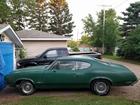
now the car is back on the road with its stock engine and purrs like a (slow) kitten. I also got a non-ac alternator bracket now and since i removed the ac 1 year ago, i made the bracket conversion. Looks much better now an theres a lot more space in the engine bay:
Now to the bad part, i pulled the oil pan (with metal crap inside) and cam from the 355 today and yep, cylinder #4's exhaust lobe/lifter is wiped badly:
i had to pull the cam first to get this one and cylinder #6's exhaust lifter out:
#6's exhaust lifter has a burr too:
All other lifters went out with no problem and all other cam lobes/lifters have no visable damage.
I guess, #4's exhaust lifters wasn't able to spin in its bore and maybe its neighbour (#6's exhaust) got some of #4's metal chips.
Im pretty sure on this lifter rotated ZERO degrees in its bore, because all running time this engine had was the break in procedure and about 5 miles driving. And all others except number 6's exhaust with the slight burr are looking good.
I can't imagine any other reason for this kind of damage
Last edited by 71OldscutlassS; Jun 14, 2022 at 12:39 PM.
Im pretty sure on this lifter rotated ZERO degrees in its bore, because all running time this engine had was the break in procedure and about 5 miles driving. And all others except number 6's exhaust with the slight burr are looking good.
I can't imagine any other reason for this kind of damage
The camshaft was fine before you changed lifters and other valve train parts.
From the coloration near the bottom of the lifters (#4 & #6) it shows excessive heat/friction. This could be due to lack of rotation of the lifter as well as lack of lubrication on the cam lobes.
Because of the extreme wear on the #4 lifter bottom, and burring, I have to wonder about the hardness. It would be nice to check the hardness of the two defective lifters and a couple other randomly picked lifters. Using an industrial type hardness tester and Rockwell "B" and "C" settings may tell something.
Something seriously wrong happened to wear a valve lifter to wear to that extent and also that quickly.










 .
.

 I have seen some fairly bad but that one beats them all.


