When you click on links to various merchants on this site and make a purchase, this can result in this site earning a commission. Affiliate programs and affiliations include, but are not limited to, the eBay Partner Network.
Been considering going E85 as its plentiful and cheap here in LA. Everyone knows the HP gains to be had on E85, the
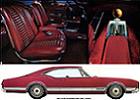
cooler running motor, 105+ octane rating, etc....but I didnt realize the big gains in volumetric efficiency. Here are outputs of my 455 in my 67 Cutlass. According to my desktop dyno, a switch to E85 (with richer mixture) adds 43HP and a whopping 11% additional in volumetric efficiency. Is anyone running E85 and can offer some thoughts? I know the dragstrip is full of E85....
Thanks for the information....very interesting. That equates to very nearly 1/2 second in the 1/4, very impressive. I think I'm sold on converting as well. Cooler running motor and more power, sounds like a win-win. Thanks again.
But if you’re going to run it all the time I’d consider raising the comp ratio. I did an aluminum headed BBO a few years ago with 11.7:1. Ran great and I found that it really didn’t use 30% more fuel as believed, more like 20-25%.
Recent engine masters addressed E85. On its own it doesn't necessarily do much. You need to take advantage of its heat of vaporization (via boost), and/or its high octane (via compression ratio and/or timing). An engine built for gas and tuned spot-on for gas won't necessarily see any great gains just from changing the fuel and then fixing the jetting.
If you're in the planning stages, then like Mark said, you're better off planning for E85 and building a high compression ratio. Just know that you are wed to e85 and build all the fuel system appropriately.
And fwiw you can’t increase VE by changing fuels. VE is a measurement of airflow thru the engine. If anything the actual “airflow” will be reduced when using E85. Why? Because the air is now having to carry more fuel with it as that’s needed when running E85 vs gasoline.
This is just another reason why I don’t rely on desktop dynoes.
As far as volumetric efficiency, there does seem to be a strong correlation with forced induction (very high volumetric efficiency), which is more oxygen in the chamber. E85 is an oxygenated fuel. At the large quantities of E85 being run through a motor, it seems there is notably more oxygen molecules in the chamber for combustion vs all gasoline. Of course, thats why forced induction is so strong...more oxygen in the chamber for combustion. Seems to me that would translate into higher volumetric efficiency as the desktop dynos allege. Most sites online state around 7.25% more energy release for E85 than typical 91 or 92 (of course you are rejetting and advancing timing). More oxygen in the chamber=more HP. Regardless of the compression ratio, an oxygenated fuel like E85 (in greater quantities) has the potential to bring its characteristic 7% more energy release to the party. If indeed the engine runs cooler as many allege, than means a more dense intake charge (yet more oxygen!). It isnt merely "airflow", its oxygen in the cylinder. And with E85 costing less than 87 unleaded, and waaaaaaay less than race gas, seems like a win-win. I have buddies on E85 and they love it.
Last edited by Chris6542; Oct 2, 2020 at 05:40 PM.
I’m an E85 fan too. But let me explain VE further.
VE is airflow thru the engine measured in lbs, not oxygen. The only real way to change the VE is to change the intake, heads, cam etc. or thru boost, again lbs/hr. You get the idea.
Relative to airflow, which is the air in our atmosphere, and knowing it is 21% Oxygen and 78% Nitrogen (totals 99% plus 1% trace elements), and nitrogen is non-flammable, what good is more Nitrogen (i.e. airflow)? Seems like relative to combustion, oxygen is the key. Thoughts?
When heated Nitrogen expands. If you reduce Nitrogen you reduce cylinder pressure. N2O works well because you condense the Oxygen & Nitrogen, one burns the other expands.
Relative to airflow, which is the air in our atmosphere, and knowing it is 21% Oxygen and 78% Nitrogen (totals 99% plus 1% trace elements), and nitrogen is non-flammable, what good is more Nitrogen (i.e. airflow)? Seems like relative to combustion, oxygen is the key. Thoughts?
Because more flow is better. It brings the fuel with it. You're not going to be able to make an engine "breathe better" by thinking the oxygen in E85 will cover for not doing head and intake work. This isn't really a rocket engine, that's just Olds's marketing name.
The way I understand this, because the BTU rating of E85 is lower than gasoline, all things being equal, the same engine on E85 will be down on power over gas. So, the key is making things unequal, while at the same time using the benefit of E85. Since the octane rating is so much higher, adding compression will more than offset the lower BTU.
The way I understand this, because the BTU rating of E85 is lower than gasoline, all things being equal, the same engine on E85 will be down on power over gas. So, the key is making things unequal, while at the same time using the benefit of E85. Since the octane rating is so much higher, adding compression will more than offset the lower BTU.
This is exactly right. If a typical gas engine has a thermal efficiency of 30%, that means you are using 30% of the energy in the fuel to push down a piston. The rest goes to heat. Engines can be made more efficient with higher compression ratios, timing advance, and other things, but then you run into fuel limitations like knock.
With E85, the fuel has 27% less energy density than gasoline, but you should be able to increase the thermal efficiency of the engine to more than make up for that shortage of energy in the fuel.
As far as the "more power by switching over to E85 with no significant changes." I would say that if your engine is limited by air flow, you should be able to make more power with E85. The simple reason being the stoichiometric ratio of E85 is 9.77:1 as apposed to 14.7:1 for gasoline. This means you need 33.5% less air per molecule of E85 than you do for each molecule of gasoline.
So, in theory, you should be able to make 6.5% more power in your engine just by re-jetting to run e85. (33.5% more fuel-27% less energy density) This number has nothing to do with timing and compression ratio improvements. This also has nothing to do with improving thermal efficiency. It's just plain old more fuel is more power.
Interesting stuff!
Anyone here ever converted one of these old high compression engines to E85 and used as a daily driver? Seems like a great idea, but I haven't tried it myself.
Running dragsters on methanol was basically the same thing, since ethanol is just alcohol distilled from corn and methanol from wood. Not to claim that the charachteristics of both alcohol types are identicle. The blower unit compensated any concerns over air flow, while simultaneously raising compression
Running dragsters on methanol was basically the same thing, since ethanol is just alcohol distilled from corn and methanol from wood. Not to claim that the charachteristics of both alcohol types are identicle. The blower unit compensated any concerns over air flow, while simultaneously raising compression
Exactly. Different stoichiometric ratio, different energy density, same benefits.