When you click on links to various merchants on this site and make a purchase, this can result in this site earning a commission. Affiliate programs and affiliations include, but are not limited to, the eBay Partner Network.
We finished the next test session. We are approaching the 1 year anniversary of our first dyno pull! I will make a post on that day. Here is a quick summary of what's covered in this shorter write up.
Performer vs. Victor intake manifold testing
Spacer with the Performer
Run the solid roller camshaft
Different lash setting
Different intake manifold
FCR cylinder head testing
5 different intake manifolds
Miscellaneous comments and observations
Conclusions Next steps
I changed some things with the graphs to hopefully make them easier to read. I changed the color of the name/configuration in the legend below the graph to be the same color as the graph. I also attempted to make colors common from one pull to another.
On a positive note, Lloyd had purchased a set of Gen3 Edelbrock heads. We will get them to Livernois to cut the valves, seats, guide clearance, etc and then run them unmodified from a porting standpoint. Not sure we will run these next session, but you never know.
Next test session will be 12/1 to 12/5. Any help would be appreciated! This next session will be pretty busy.
If you want to run the Gen III’s as is, don’t cut the valves or seats. Just make sure the guides are fine and run em like that.
We actually did test them out of the box, that's in one of the previous write ups. When we fixed the valve out of roundness they were already ported. So the question is was the power gained from head porting or the valves being "proper" now? So the heads that Lloyd bought should tell us that difference.
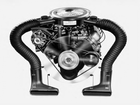
No idea. I have one and Kryta has one that I know of. I can't tell you if either of them is the one in this photo on the green SOHC motor in the back row, but that's the same style cross ram.
Very cool historical intake. Joe do you have the linkage for the cross ram as well? This will take quite the effort to sort out if its to be run on the dyno.
Very cool historical intake. Joe do you have the linkage for the cross ram as well? This will take quite the effort to sort out if its to be run on the dyno.
Not really that difficult. The Qjets mount back-to-back. You can see in my photos that I have the two bellcranks for the linkage. All it needs are a couple of rods with ball ends to the carbs and a rod from the center bellcrank to the one on the side. I've fabricated plenty of linkages for non-stock setups, including progressive linkage for dual quads. I'm an aerospace engineer and I work on much more complex linkages and mechanisms for my day job. Jerry similarly has the background and resources to adapt to the carbs he plans on using. Fabrication isn't that difficult.
Joe I was referring more to the tunning, to actually get the Qjets and the intake manifold to perform well. A lot of these cool intakes do not perform as well as they look.
Last edited by Bernhard; Nov 22, 2025 at 01:01 PM.
Terry had pointed out that I messed up the flow numbers. He sent me the correct numbers. I will correct that in the next publication. We test the combinations we talk about and agree upon. We tested Terrys heads with the Air Gap intake and we have tested with it here and there as we see fit. If anyone wants a voice as to what we test please show up to Livernois when we are there testing or express to any of us what specific combination you want us to test and we will consider it. We have made 46 dyno pulls with the air gap intake (as a guess that's 10-11 different combinations), that's 5.5% of all pulls with that manifold and we didn't have that manifold when we started.
I do plan to make the graphing changes to all the previous write ups, but I don't know if the old ones will ever leave my computer again unless there is a demand.
Joe I was referring more to the tunning, to actually get the Qjets and the intake manifold to perform well. A lot of these cool intakes do not perform as well as they look.
When you look at the ports on this specific intake, they do need some "cleaning" up to make them better, mainly where the manifold meets the heads. I do agree that these intakes typically don't perform as well as they look, but we will see. Hopefully early next year we will test this one. I view this intake essentially as an underhood tunnel ram.
"Factory experimental" does not mean refined or "pre-production". Manufacturers usually make parts in small batches of 3-5. If modifying the a couple parts doesn't produce results they have others to develop. My guess is that if two of these cross ram manifolds are known to exist, Oldsmobile didn't do much development work.
Chrysler had a couple cross ram manifolds they used on the wedge engines in the mid 1960's. Neither configuration lasted long.
"Factory experimental" does not mean refined or "pre-production". Manufacturers usually make parts in small batches of 3-5. If modifying the a couple parts doesn't produce results they have others to develop. My guess is that if two of these cross ram manifolds are known to exist, Oldsmobile didn't do much development work.
Chrysler had a couple cross ram manifolds they used on the wedge engines in the mid 1960's. Neither configuration lasted long.
As was demonstrated by the various Chrysler cross rams, these manifolds are tuned for fairly narrow RPM bands. That matches the physics behind the concept. This is no different than the theory behind a tunnel ram or the Chevy TPI, or even most modern EFI intake manifolds. Some manufacturers have attempted to incorporate various active devices to provide flow paths of different lengths depending on engine RPM, though it appears that in all cases the cost and complexity outweigh the benefits.
Some manufacturers have attempted to incorporate various active devices to provide flow paths of different lengths depending on engine RPM, though it appears that in all cases the cost and complexity outweigh the benefits.
Hmmm not so fast. Gen III hemi’s have a computer controlled flapper valve in the intake tract. It actually works pretty well. BUT, I’d bet part of the reason for it is fuel distribution, and the subsequent potential reduction in emissions.
Hmmm not so fast. Gen III hemi’s have a computer controlled flapper valve in the intake tract. It actually works pretty well. BUT, I’d bet part of the reason for it is fuel distribution, and the subsequent potential reduction in emissions.
I did not realize that the new Hemi motors have that. Thanks.
Hmmm not so fast. Gen III hemi’s have a computer controlled flapper valve in the intake tract. It actually works pretty well. BUT, I’d bet part of the reason for it is fuel distribution, and the subsequent potential reduction in emissions.
Since I have a pretty large OEM background, I'll give you some history.
The GenIII hemi's that is strickly for a flatter torque curve. I'm sure you know, but others probably do not, a long runner makes more low end torque and a short runner makes more peak horsepower. So being able to switch gives a flatter toque curve. This is what the GenIII hemi uses it for, and only for power. Ford had this in their 4.6L 4V in the Mark8 (93-98) and the 4.6L 4V Cobra (96-98). Again these dual runner intakes were just for power. When you have a 281 cubic engine and are trying to compete against the LS's, you have to do something. Even in the 5.4L trucks there is a device that changes the plenum volume of the intake manifoild. Smaller for better low end torque and larger for more top end power. Once variable camshaft was "perfected" these things went away at Ford. The 3V Mustang and the 5.0L 4V's have what's called a CMCV, Charge Motion Control Valve. This forces the air to travel across a certain part of the port, based on a speed and load table, and this 100% is for better combustion resulting in lower emissions. I don't follow the latest Coyote's, so I'm not sure if the Gen4 has kept this. or not.
Oh how I'd love to get my hands on one of those to scan and duplicate in CAD. Can't wait to see the dyno numbers. Good or bad...very interesting.
I can probably get the new CNC guy at Livernois to scan it if that interests you. He's really sympathitic to our cause. He always stops by and talks to me and Ron when we are running the engine and is really interested.
I can probably get the new CNC guy at Livernois to scan it if that interests you. He's really sympathitic to our cause. He always stops by and talks to me and Ron when we are running the engine and is really interested.
"Blueprints" are so last century.
Actually what a digital scan produces is a 3D CAD model, which is infinitely better than a blueprint.
HAHAHA Joe P. I am an old "handles and cranks" machinist. They are sometimes called "manual machinists" around here. The manual machinists are still in demand at times for prototype and "model shops" to fabricate things.
I have had training and classes in CNC and CNC programming but never had the opportunity to use it enough to remember it. I have a Bridgeport with Accurite Millvision with 4 axis digital readouts and programmable, so they tell me. I also have a "gap bed" engine lathe in the "garage" with a complete collet set, 4 jaw manual chuck, 3 jaw self centering chuck, and a faceplate.
.
I can probably get the new CNC guy at Livernois to scan it if that interests you. He's really sympathitic to our cause. He always stops by and talks to me and Ron when we are running the engine and is really interested.
jerry
That would be great! Please PM with a cost and what format(s) it could be in.
Perfect. That would be the best Birthday / Christmas present that I could ever hope for. Have a great Thanksgiving.
the intake won’t make it up there until about 12-15. Not sure when he will have time to scan it So if he agrees, it will happen, just unsure of the timeline.
You may have to cast silicone models (removable) of the runners in order to get cad data of the size and shape. A 3d scan of the exterior will only be half the battle.
Oh how I'd love to get my hands on one of those to scan and duplicate in CAD. Can't wait to see the dyno numbers. Good or bad...very interesting.
Originally Posted by RWK
You may have to cast silicone models (removable) of the runners in order to get cad data of the size and shape. A 3d scan of the exterior will only be half the battle.
Its looking like a one piece casting and no access to the interior, which is the functional part. I don't see how you can make an internal model. With a blueprint of the exterior, you can start to approximate what the inside looks like. Its the inside that actually yields the performance. A digital scan will make lots of "wall art".
You can access the runners from the head side of the manifold to make silicone castings. The interiors of the plena will require some guesstimating. Those round bosses with holes are to access the mounting bolts to the heads and get closed out with NPT plugs after torquing.
You can access the runners from the head side of the manifold to make silicone castings. The interiors of the plena will require some guesstimating. Those round bosses with holes are to access the mounting bolts to the heads and get closed out with NPT plugs after torquing.
Joe P, thanks for the info. I was wondering what all those NPT ports were for. There is a fair amount of "guesstimating" required. What does the bottom side look like ?
Just curious how you would go about manufacturing a copy?
As previously stated, scans of the runners would be required to duplicate the manifold. I am just interested in the outside data for posterity and 3D printing some wall and desk "art". I can "guess" the internals close enough for my needs but the more data the better.
The scanner will see quite a way up the port. You scan from all angles so it sees the walls of the port. It's an amazing tool. I think it will see farther than you think. After that you can take away everything but the port so if parts are missing they could be filled in and get pretty close. As far as the plenum I don't think it's much more than a box. You may be able to get part of it , mostly where the runners meet it thru the carb holes. Not sure on that. This gives you an idea of how you can see inside the scanned item
Last edited by MR OLDS FCR PERFORMANCE; Dec 1, 2025 at 12:03 PM.
Reason: Add photo
I designed (and reverse engineered) various cylinder heads in the Detroit area in the '90's. If someone was interested in reproducing one of these cross-ram intakes to actually reverse engineer the performance (not just a visual representation), yes, silicone molds of the runners are the easiest/simplest way to go. This happens every day on various parts. Pull the solidified mold and scan that. What you get is (usually) point cloud data which can then be 'turned into' an actual 3D CAD model with surfaces. Depending on the quality of the scanner, it may be able to 'see' a good ways into the ports but it still relies on 'line of sight' so it won't get everything. If you really wanted to get serious about it (and didn't want to cut open an original part), MRI technology is used a lot today to 'see' inside castings. You're usually looking for porosity but it can give you a good view of interior compartments.
It'll be interesting to see how this performs. I have to believe there were more than a handful of these made and tested. Hell, you'd use up a few just in machining set-up. They likely had 5-ish parts they ran on the dyno and then scrapped them once the testing was done. I'd love to know how the two mentioned above 'made it out alive'!