


Info needed on a '63 Dynamic 88


Thread Starter
Registered User
Joined: Aug 2012
Posts: 9
Info needed on a '63 Dynamic 88
Hello
I'm new here, wondering where's the best place to get some info on a friend's 1963 Oldsmobile Dynamic convertible. It's missing the VIN plate from the driver's pillar but does still have the one on the firewall.
I also have an engine number.
Is it possible to figure out where and when the car was built? What date and what plant.
I can try to post a few photos of the car if that helps.
Thanks
Mike
I'm new here, wondering where's the best place to get some info on a friend's 1963 Oldsmobile Dynamic convertible. It's missing the VIN plate from the driver's pillar but does still have the one on the firewall.
I also have an engine number.
Is it possible to figure out where and when the car was built? What date and what plant.
I can try to post a few photos of the car if that helps.
Thanks
Mike
Thread Starter
Registered User
Joined: Aug 2012
Posts: 9
Hello Rocketraider and thanks for the quick reply.
We're not sure what happened to the door post VIN, I suspect it was removed when the car was repainted.
It's a little odd in that the car is registered here as a 1966, that's what on the V5 document - which is the English version of a pink slip. The car is running and road legal but I just wanted to find out more about it. It's definitely a 1963 but that's not so important in the UK.
I'll try to insert some images - please let me know if they work
DSCI7712.jpg
DSCI8354.jpg
DSCI8356.jpg
DSCI8362.jpg
DSCI7709.jpg
Hopefully you should see some images of the Olds, she's not mint but is a good running, much loved car. One of about 3 in the United Kingdom I'm told.
I'm guessing the air cleaner is the wrong colour?
Is there any way of telling which engine is fitted, I'm guessing it's the 280hp 394ci ?
Chassis / frame number is down as CNV267
Engine number is 632E02632
But these numbers don't seem to match any I've found on VIN checking websites.
I'd really like to know which plant it was built in and on what date. Having air con fitted would suggest a warm state.
Any information is welcome.
Many thanks
Mike
We're not sure what happened to the door post VIN, I suspect it was removed when the car was repainted.
It's a little odd in that the car is registered here as a 1966, that's what on the V5 document - which is the English version of a pink slip. The car is running and road legal but I just wanted to find out more about it. It's definitely a 1963 but that's not so important in the UK.
I'll try to insert some images - please let me know if they work
DSCI7712.jpg
DSCI8354.jpg
DSCI8356.jpg
DSCI8362.jpg
DSCI7709.jpg
Hopefully you should see some images of the Olds, she's not mint but is a good running, much loved car. One of about 3 in the United Kingdom I'm told.
I'm guessing the air cleaner is the wrong colour?
Is there any way of telling which engine is fitted, I'm guessing it's the 280hp 394ci ?
Chassis / frame number is down as CNV267
Engine number is 632E02632
But these numbers don't seem to match any I've found on VIN checking websites.
I'd really like to know which plant it was built in and on what date. Having air con fitted would suggest a warm state.
Any information is welcome.
Many thanks
Mike

Registered User
Joined: Jun 2009
Posts: 15,194
From: southeastern Michigan
The "10E" on the body tag is the month and week the car was assembled, and that translates to the fifth week (E) of October (10). The production year typically ran from late summer of one year through early summer of the next, so, given that this is a '63 model, that build date is fifth week of October 1962.
The VIN would have indicated the assembly plant. I don't believe there's any info on that body tag that would indicate the plant, but I might be wrong. Others will know.
As far as the A/C, which assembly plant the car was built in has no bearing on where it was originally sold or what options it had. Cars were shipped all over the country. While it's true that someone living in the southern U.S. might want A/C more than someone living in the north, the entire country experiences warm summers, so A/C cars could have been sold anywhere.
Thread Starter
Registered User
Joined: Aug 2012
Posts: 9
Thanks for that info Jaunty - much appreciated.
I had always assumed that any car built to order would be constructed at the nearest plant to that dealer.
Hadn't especially occurred to me about warm summers all over the US but I guess air con can be used to rid a car of damp air just as easily as hot air too.
Regards
Mike
I had always assumed that any car built to order would be constructed at the nearest plant to that dealer.
Hadn't especially occurred to me about warm summers all over the US but I guess air con can be used to rid a car of damp air just as easily as hot air too.
Regards
Mike
Registered User
Joined: Jun 2009
Posts: 15,194
From: southeastern Michigan
Hadn't especially occurred to me about warm summers all over the US but I guess air con can be used to rid a car of damp air just as easily as hot air too.
Thread Starter
Registered User
Joined: Aug 2012
Posts: 9
Hi
No I don't no that the car was built to order, I was speaking generally assuming that most cars of the time would have been built after someone sat down with an options form and a salesman at their local dealership. Sorry for the confusion.
Obviously there must have been a certain amount of customers that walked in off the street and saw their dream car in the perfect colour scheme there on the showroom floor. It would be interesting to know what proportions of cars were built to order versus a big dealership happening to have the exact right car in stock already.
I know that in the late 50s GM had a complex computerised card system that the factory used to build cars with the correct options and colours once an order was taken.
Also assuming that GM would try to save as much money as possible by building cars locally rather than shipping them cross country.
I understand the '63 Olds were built in 7 different plants. One website listed the following with a letter noting which plant that car was condstructed at:
W - Wilmington, DE
T - Arlington, TX
M - Lansing, MI
L - Linden, NJ
K - Kansas City, KS
C - Southgate, CA
A - Atlanta, GA
Yes A/C does seem to be a bit of a rarity especially, again I'm assuming, on base model convertibles such as this Dynamic 88.
I'm purely speculating about this Olds, all the information I have is listed above so anything else is guesswork apart from what knowledge I can hopefully gain from the users of this site.
Thanks again
M
No I don't no that the car was built to order, I was speaking generally assuming that most cars of the time would have been built after someone sat down with an options form and a salesman at their local dealership. Sorry for the confusion.
Obviously there must have been a certain amount of customers that walked in off the street and saw their dream car in the perfect colour scheme there on the showroom floor. It would be interesting to know what proportions of cars were built to order versus a big dealership happening to have the exact right car in stock already.
I know that in the late 50s GM had a complex computerised card system that the factory used to build cars with the correct options and colours once an order was taken.
Also assuming that GM would try to save as much money as possible by building cars locally rather than shipping them cross country.
I understand the '63 Olds were built in 7 different plants. One website listed the following with a letter noting which plant that car was condstructed at:
W - Wilmington, DE
T - Arlington, TX
M - Lansing, MI
L - Linden, NJ
K - Kansas City, KS
C - Southgate, CA
A - Atlanta, GA
Yes A/C does seem to be a bit of a rarity especially, again I'm assuming, on base model convertibles such as this Dynamic 88.
I'm purely speculating about this Olds, all the information I have is listed above so anything else is guesswork apart from what knowledge I can hopefully gain from the users of this site.
Thanks again
M
Registered User
Joined: Nov 2006
Posts: 1,918
From: SE Wisconsin
A nice looking '63. I used to own one like it in my college days, many a moon ago.
As for what engine, the engine # might help answer that question. If it starts with an "F," that would tell you it is the economy, low compression engine.
As for what engine, the engine # might help answer that question. If it starts with an "F," that would tell you it is the economy, low compression engine.
Registered User
Joined: Jun 2009
Posts: 15,194
From: southeastern Michigan
But that didn't mean people didn't order cars with specific options as well. Back then, options were much more individual things, so you could order a car with any particular options you wanted and not others.
That's not so true today as manufacturers, to save production costs and probably a lot of other reasons, now usually just offer several trim lines that each include a set of options. So if you want, say, power windows, you get power door locks and power seats, too. Of if you want a moon-roof, you also get tinted glass and leather seats. That sort of thing.
Also assuming that GM would try to save as much money as possible by building cars locally rather than shipping them cross country.
 On every window sticker, then and now, is something called a "destination charge." GM was making sure that the customer paid for the shipping of the car.
 It always seemed to me to be silly to break that out on a price list. After all, you go to the store to buy a new refrigerator, and all there is on the price tag is a single price. There is no extra notation with the cost to ship the thing from the factory to that store. That cost is factored into the selling price. Why that's not done with cars, I don't know.
Registered User
Joined: Jun 2009
Posts: 15,194
From: southeastern Michigan

Plus, the grille and taillights were the same on the '88s and the Starfire, so you can't distinguish them by these features.

Last edited by jaunty75; Aug 14, 2012 at 08:56 AM.
Thread Starter
Registered User
Joined: Aug 2012
Posts: 9

the engine # might help answer that question. If it starts with an "F," that would tell you it is the economy, low compression engine.
I'm guessing that 02632 is the 2632nd engine of this type they built which probably ties in with an Oct '62 build date.
most cars sold, then and now, were chosen off the dealer's lot. Most cars on the lot would have the most popular options, so buyers could find what they want in stock and not have to wait two months to get the car they wanted.
On every window sticker, then and now, is something called a "destination charge." GM was making sure that the customer paid for the shipping of the car.
Might you have, in an extreme case, two identical $3000 cars on a California car lot, one built in Long Beach with a $3010 sticker and the other from, say, Detroit for $3400 or would they have a way around that?

Thanks fellas, this is all useful information.
It's a Starfire? Oh don't confuse things even more!

I'm going by the badges:
DSCI8367.jpg
Of course if you can point to anythig that suggests it's a Starfire that some one had put Dynamic badges on I'd really love to hear it.
I don't know much about these cars.
I'm assuming it's been repainted at some point anyway.
Did wonder if the red paint on and around the VIN plate was primer or the original colour...? Anyone


Oldsdruid
Joined: Dec 2007
Posts: 10,629
From: Southside Vajenya
Interesting car! It's had a Starfire grille, taillights, rear panel and wheelcovers installed which dress the car up a lot.
I'm thinking that BC in the BODY space on the trim tag indicates Southgate CA assembly plant. Those New Mexico plates corroborate that- says it was probably a Southwestern US car and likely to have had factory installed airconditioning.
Can't get any better than that!
*Edit- 3267 indicates a Dynamic 88 convertible. It's just had the Starfire pieces installed. E in the engine number indicates Export low compression (8.3:1) which would stand to reason for a car exported to Europe or any destination outside the US and Canada.
I'm thinking that BC in the BODY space on the trim tag indicates Southgate CA assembly plant. Those New Mexico plates corroborate that- says it was probably a Southwestern US car and likely to have had factory installed airconditioning.
a good running, much loved car
*Edit- 3267 indicates a Dynamic 88 convertible. It's just had the Starfire pieces installed. E in the engine number indicates Export low compression (8.3:1) which would stand to reason for a car exported to Europe or any destination outside the US and Canada.
Last edited by rocketraider; Aug 14, 2012 at 09:07 AM.
Thread Starter
Registered User
Joined: Aug 2012
Posts: 9
Those New Mexico plates corroborate that
The frame actually says Essex - Land of Enchantment, which is a bit of a joke because Essex is a county near London renowned for... criminal activity.
(Other frame says 'Sex Instructor - 1st lesson free'...)
Thread Starter
Registered User
Joined: Aug 2012
Posts: 9
So we're happy it's almost certainly a genuine Dynamic 88 and NOT a Starfire with the side mouldings / trim removed and Dynamic bodywork badges and dashboard badges added?
But it IS a Dynamic with a Starfire grille because of the -+- in the grille centre?
Not sure what the differences are between Starfire and Dynamic tailights...? The small circular pieces of trim?
So, the 88 was originally the mid series between the 76 and 98. When the 76 model was discontinued in 1958 the 88 was divided into base Dynamic 88 and upscale Super 88 ranges. By 1963 there were three different 88s - Starfire, Dynamic and Super.
My understanding is that the Starfire came in for 1963 as the new base model elevating the Dynamic 88 from base model to second lowest model range? Or did that actually happen in '64?
There was fullsize Starfire and smaller Jetfire and Cutlass models - ‘Oldsmobile’s Sports Cars’ and the 88s were the base and mid range fullsize models with the bigger 98 top of the tree.
Is that correct? I've gone thru various websites and brouchures but I'm still a bit in the dark.
Thanks everyone.
M
But it IS a Dynamic with a Starfire grille because of the -+- in the grille centre?
Not sure what the differences are between Starfire and Dynamic tailights...? The small circular pieces of trim?
So, the 88 was originally the mid series between the 76 and 98. When the 76 model was discontinued in 1958
the 88 was divided into base Dynamic 88 and upscale Super 88 ranges. By 1963 there were three different 88s - Starfire, Dynamic and Super. My understanding is that the Starfire came in for 1963 as the new base model elevating the Dynamic 88 from base model to second lowest model range? Or did that actually happen in '64?
There was fullsize Starfire and smaller Jetfire and Cutlass models - ‘Oldsmobile’s Sports Cars’ and the 88s were the base and mid range fullsize models with the bigger 98 top of the tree.
Is that correct? I've gone thru various websites and brouchures but I'm still a bit in the dark.
Thanks everyone.
M
Last edited by cycolac fan; Aug 14, 2012 at 10:25 AM.
Registered User
Joined: Jun 2009
Posts: 15,194
From: southeastern Michigan
Here's the history of the Olds model names.
The "76" series was last produced in 1950. The "88" series was introduced in 1949, so for 1949 and 1950, 76, 88, and 98 series Oldsmobiles were produced.
The "Super" 88 was first introduced in 1951. The base 88 model was called simply "88" in 1951, "Deluxe 88" in 1952 and 1953, and then back to simply "88" again in 1954, 1955, and 1956. For 1957, the base 88 was called the "Golden Rocket 88." Beginning in 1958, the base model was called the "Dynamic 88," and that name lasted through 1966. For 1959 through 1963, the full-size lineup was Dynamic 88, Super 88, and 98. The "Futuramic" name was also applied to Olds models back in the late '50s and early '50s, but I think it was used on all of the series, so you could have had a "Futuramic 88" or "Futuramic 98," but I don't know this for sure.
The name "Dynamic" was actually first used, for one year, in 1948, for the series 66, 68, and 76 Oldsmobiles. So apparently you could have had a Dynamic 66, a Dynamic 68, and a Dynamic 76, although I don't know any of this for absolute certainty. I'm taking this info from the book "Setting the Pace - Oldsmobile's First 100 Years" by Helen Jones Earley and James R. Walkinshaw. It would be a good book to get if you're at all interested in the history of Oldsmobile.
The Starfire name was first used for the convertible version of the 98 in 1954. That name persisted apparently through 1957, after which the 98 convertible was just the 98 convertible.
The Starfire name was resurrected in 1961 and was used on the convertible version of the Super 88. So the car was called Super 88 Starfire. Beginning in 1962 and lasting through 1966, the Starfire we all know and love was its own series. Convertible versions were made through 1965. For 1966, only a 2-door coupe was offered.
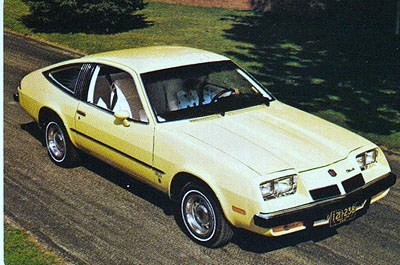
The Starfire name was again resurrected in 1975 but was a much different vehicle, that being the Oldsmobile version of the compact, sporty Chevy Monza. This version of the Starfire was produced through 1980. You rarely, if ever, see this car at car shows. I don't think I ever have.
1975 Oldsmobile Starfire:
Getting back to the 88s, a third, lower-cost series, the Jetstar 88, was added in 1964 in Oldsmobile's attempt to capture more of the "low-price" market. The car was the same size as the other 88s, but it used the smaller F-85 engine, driveline, and brakes. The Jetstar 88 was built for three model years, being replaced in 1967 by the Delmont 88, which itself was built for only two model years, '67 and '68.
Just to add to the confusion a little more, in addition to the Jetstar 88, for 1964 and 1965, there was also the Jetstar I offered only as a 2-door ("Sports") coupe. While it shared sort of the same name as the Jetstar 88 and was a full-size car, it used the same engine and so forth as the other full-size cars. It was basically a lower-cost version of the Starfire
The famous Delta 88 was first introduced in 1965 and became the only 88 series after 1968. The Delta name was used all the way through the 1988 model year. After that, and for the remainder of the 88's existence, the series was simply called "88" again, which was kind of neat as it was a throwback to the earliest days of the 88 series. Once the "Delta" was dropped, the "88" was actually written out in script "Eighty-Eight" on the sides of the car. The last year for the 88 was 1999.
One other thing that might be of interest as far Oldsmobile model designations. Early on, names like "66" and "68" and "88" and "98" actually meant something. The first digit was the "series," so you could have a "60-series" Oldsmobile, a "70-series" Oldsmobile, and so forth. The second digit designated the number of cylinders in the engine. So a 76 meant a 70-series Oldsmobile with a 6-cylinder engine. An 88 meant an 80-series Olds with an 8-cylinder engine. This more or less fell apart later on, especially when the F-85 came out, as it was not an 80-series Olds and certainly did not have a 5-cylinder engine. History has it that it was name for a fighter jet, I think.
Hope this helps!
The "76" series was last produced in 1950. The "88" series was introduced in 1949, so for 1949 and 1950, 76, 88, and 98 series Oldsmobiles were produced.
The "Super" 88 was first introduced in 1951. The base 88 model was called simply "88" in 1951, "Deluxe 88" in 1952 and 1953, and then back to simply "88" again in 1954, 1955, and 1956. For 1957, the base 88 was called the "Golden Rocket 88." Beginning in 1958, the base model was called the "Dynamic 88," and that name lasted through 1966. For 1959 through 1963, the full-size lineup was Dynamic 88, Super 88, and 98. The "Futuramic" name was also applied to Olds models back in the late '50s and early '50s, but I think it was used on all of the series, so you could have had a "Futuramic 88" or "Futuramic 98," but I don't know this for sure.
The name "Dynamic" was actually first used, for one year, in 1948, for the series 66, 68, and 76 Oldsmobiles. So apparently you could have had a Dynamic 66, a Dynamic 68, and a Dynamic 76, although I don't know any of this for absolute certainty. I'm taking this info from the book "Setting the Pace - Oldsmobile's First 100 Years" by Helen Jones Earley and James R. Walkinshaw. It would be a good book to get if you're at all interested in the history of Oldsmobile.

The Starfire name was first used for the convertible version of the 98 in 1954. That name persisted apparently through 1957, after which the 98 convertible was just the 98 convertible.
The Starfire name was resurrected in 1961 and was used on the convertible version of the Super 88. So the car was called Super 88 Starfire. Beginning in 1962 and lasting through 1966, the Starfire we all know and love was its own series. Convertible versions were made through 1965. For 1966, only a 2-door coupe was offered.
The Starfire name was again resurrected in 1975 but was a much different vehicle, that being the Oldsmobile version of the compact, sporty Chevy Monza. This version of the Starfire was produced through 1980. You rarely, if ever, see this car at car shows. I don't think I ever have.
1975 Oldsmobile Starfire:
Getting back to the 88s, a third, lower-cost series, the Jetstar 88, was added in 1964 in Oldsmobile's attempt to capture more of the "low-price" market. The car was the same size as the other 88s, but it used the smaller F-85 engine, driveline, and brakes. The Jetstar 88 was built for three model years, being replaced in 1967 by the Delmont 88, which itself was built for only two model years, '67 and '68.
Just to add to the confusion a little more, in addition to the Jetstar 88, for 1964 and 1965, there was also the Jetstar I offered only as a 2-door ("Sports") coupe. While it shared sort of the same name as the Jetstar 88 and was a full-size car, it used the same engine and so forth as the other full-size cars. It was basically a lower-cost version of the Starfire
The famous Delta 88 was first introduced in 1965 and became the only 88 series after 1968. The Delta name was used all the way through the 1988 model year. After that, and for the remainder of the 88's existence, the series was simply called "88" again, which was kind of neat as it was a throwback to the earliest days of the 88 series. Once the "Delta" was dropped, the "88" was actually written out in script "Eighty-Eight" on the sides of the car. The last year for the 88 was 1999.
One other thing that might be of interest as far Oldsmobile model designations. Early on, names like "66" and "68" and "88" and "98" actually meant something. The first digit was the "series," so you could have a "60-series" Oldsmobile, a "70-series" Oldsmobile, and so forth. The second digit designated the number of cylinders in the engine. So a 76 meant a 70-series Oldsmobile with a 6-cylinder engine. An 88 meant an 80-series Olds with an 8-cylinder engine. This more or less fell apart later on, especially when the F-85 came out, as it was not an 80-series Olds and certainly did not have a 5-cylinder engine. History has it that it was name for a fighter jet, I think.
Hope this helps!
Last edited by jaunty75; Aug 14, 2012 at 11:47 AM.
Connoisseur d'Junque
Joined: Sep 2010
Posts: 21,183
From: The Hudson Valley
Two points that haven't been addressed from your original post:
The air cleaner is close to the right color for a high-compression engine (I think it's actually Chebby Orange, rather than Olds air cleaner Orange), but since you have a low-compression engine, the air cleaner would have been black.
The VIN plate is the only place on the car where you can find the VIN, aside from a few hidden spots on the body and frame (a '63 owner might be able to tell you exactly where to look).
None of the numbers on the Fisher Body plate is the VIN, or any part of the VIN. The same goes for the engine number - it's not related to the VIN.
As has been pointed out, the 63-3267 simply means 1963 Dynamic 88 Convertible. The other numbers are date and trim information.
Don't casually mention to any government officials that it's got no VIN plate, as I would imagine that registering and driving a car with a defaced VIN is just as illegal in the UK as it is in the US. (While it is entirely possible that the VIN plate was, in fact, lost after a paint job, it is also possible that this is a car that was stolen and shipped overseas).
- Eric
The air cleaner is close to the right color for a high-compression engine (I think it's actually Chebby Orange, rather than Olds air cleaner Orange), but since you have a low-compression engine, the air cleaner would have been black.
The VIN plate is the only place on the car where you can find the VIN, aside from a few hidden spots on the body and frame (a '63 owner might be able to tell you exactly where to look).
None of the numbers on the Fisher Body plate is the VIN, or any part of the VIN. The same goes for the engine number - it's not related to the VIN.
As has been pointed out, the 63-3267 simply means 1963 Dynamic 88 Convertible. The other numbers are date and trim information.
Don't casually mention to any government officials that it's got no VIN plate, as I would imagine that registering and driving a car with a defaced VIN is just as illegal in the UK as it is in the US. (While it is entirely possible that the VIN plate was, in fact, lost after a paint job, it is also possible that this is a car that was stolen and shipped overseas).
- Eric
Registered Luser
Joined: Aug 2006
Posts: 3,785
From: LI,NY
Eric, the overseas part did cross my mind, when originally reading the thread....hope not though! As confirmed by Glenn, it is a dynamic 88 with Starfire trim added. If I wasn't on my I Pad right now, I'd post pics of the taillights and grille of the '63 Dynamic 88 for the OP. I had a '63 D 88, and it was different. I still have some taillight lenses and taillight trim spares from my car. Don't know why I felt the need to "hoard" those pieces from e bay.....story for another day....anyway, the car is beautiful! Have fun and enjoy!
Thread Starter
Registered User
Joined: Aug 2012
Posts: 9
Thanks again for all the replies fellas - greatly appreciated all of you taking the time and trouble to help.
It certainly is! The thing is the car was presumably imported without the plate - though it may have come over here in '63 and lost here for all we know - and has been registered using the info on the firewall plate pictured and the engine number.
So it does have a legal identity just not one that an Oldsmobile enthusiast would recognise as an ID. Bear in mind it's officially registered on the paperwork as a 1966 Olds!
I've seen it happen a few times with American cars here - a friend's Plymouth had exactly the same issue and was registered with a body number not a VIN. As long as there's an identity number they don't mind too much. Might be fun if it ever went back Stateside though...
The main thing our government is concerned about is the age of a car because in Britain we currently pay road tax for cars built 1st January 1973 and later, but 31 Dec 1972 and earlier are tax exempt. No, it doesn't really make sense to us either...
Depending on engine size, mpg figures and pollution output road tax costs between $80 a year for a small car - say about 60ci - up to maybe $400 a year for a big V8 or 4x4 in a city.
Means in theory owning a 200ci 1972 BMW (or '71 455ci Olds) is the same or slightly cheaper than a modern fuel efficent Mercedes diesel if you only do 5000 miles a year.
Gets very complex when buying a 10 year old used car though.
Sorry went off the point a bit there.
Mike
Don't casually mention to any government officials that it's got no VIN plate, as I would imagine that registering and driving a car with a defaced VIN is just as illegal in the UK as it is in the US.
So it does have a legal identity just not one that an Oldsmobile enthusiast would recognise as an ID. Bear in mind it's officially registered on the paperwork as a 1966 Olds!
I've seen it happen a few times with American cars here - a friend's Plymouth had exactly the same issue and was registered with a body number not a VIN. As long as there's an identity number they don't mind too much. Might be fun if it ever went back Stateside though...
The main thing our government is concerned about is the age of a car because in Britain we currently pay road tax for cars built 1st January 1973 and later, but 31 Dec 1972 and earlier are tax exempt. No, it doesn't really make sense to us either...
Depending on engine size, mpg figures and pollution output road tax costs between $80 a year for a small car - say about 60ci - up to maybe $400 a year for a big V8 or 4x4 in a city.
Means in theory owning a 200ci 1972 BMW (or '71 455ci Olds) is the same or slightly cheaper than a modern fuel efficent Mercedes diesel if you only do 5000 miles a year.
Gets very complex when buying a 10 year old used car though.
Sorry went off the point a bit there.
Mike
Registered User
Joined: Nov 2006
Posts: 1,918
From: SE Wisconsin
I would think the opposite--that most cars sold, then and now, were chosen off the dealer's lot. Most cars on the lot would have the most popular options, so buyers could find what they want in stock and not have to wait two months to get the car they wanted.
But that didn't mean people didn't order cars with specific options as well. Back then, options were much more individual things, so you could order a car with any particular options you wanted and not others.
But that didn't mean people didn't order cars with specific options as well. Back then, options were much more individual things, so you could order a car with any particular options you wanted and not others.
Registered User
Joined: Jun 2009
Posts: 15,194
From: southeastern Michigan
But the car that would primarily be for my mother to shuttle us kids around? She didn't care that the car even had a radio so long as it had a heater and four doors. For her, he tended to buy something low-end off the lot that would met the needs.

Thread
Thread Starter
Forum
Replies
Last Post
Kaline
Brakes/Hydraulic Systems
7
Mar 31, 2025 06:49 PM
CRH
Body work
10
Mar 4, 2012 07:56 PM


