


R 12 or R134A



Thread Starter
Registered User
Joined: Jul 2016
Posts: 549
From: Tucson, Arizona
Wow Guys thanks for your responses.
I didn't expect this post to get this many responses.
As I mentioned before, I will definitely service my system with R 12.
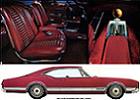
My 442 was a 1st place winner in OCA class 13C on Apr.16, 2016 at Texas Motor Speedway which the previous owner had entered the car.
It scored a 983 out of a possible 1000 points.
The only AC issue that I have found is that someone serviced the system with R 134 without changing the service fittings. The AC was not working as I felt it should and I had the service checked, that's when I found it had R 134 in it.
I took the car home and removed the compressor for rebuild and replaced all the hoses and the dryer. The compressor was pressure checked, serviced with oil and reinstalled.
System has not had a vacuum pulled and freon serviced yet. That is to come in the next few weeks when I get to the point where I can comfortably drive it again. So far only one short trip and I had trouble shifting after Major back surgery 5 weeks ago.
Thanks to all
I didn't expect this post to get this many responses.
As I mentioned before, I will definitely service my system with R 12.
My 442 was a 1st place winner in OCA class 13C on Apr.16, 2016 at Texas Motor Speedway which the previous owner had entered the car.
It scored a 983 out of a possible 1000 points.
The only AC issue that I have found is that someone serviced the system with R 134 without changing the service fittings. The AC was not working as I felt it should and I had the service checked, that's when I found it had R 134 in it.
I took the car home and removed the compressor for rebuild and replaced all the hoses and the dryer. The compressor was pressure checked, serviced with oil and reinstalled.
System has not had a vacuum pulled and freon serviced yet. That is to come in the next few weeks when I get to the point where I can comfortably drive it again. So far only one short trip and I had trouble shifting after Major back surgery 5 weeks ago.
Thanks to all

Registered User
Joined: Jul 2011
Posts: 820
From: Northeast Connecticut
How did you clean the old PAG and debris from the old compressor from the system? On my 1962 Chevrolet, I purchased a used evaporator and case, so I could "build" it with all newly reconditioned parts, and do the change over all in one day. When I took the evaporator out of the case, this is what it looked like.

This is what it looks like after cleaning....

This is why I suggest removing the evaporator and cleaning it prior to putting the system back together and charging it. It is difficult to get the proper cooling of the cars interior, when the evaporator is dirty. I used compressed air, followed by spraying it with Simple Green Coil Spray Cleaner, rinsed with water, and then dried with compressed air.
This is what it looks like after cleaning....
This is why I suggest removing the evaporator and cleaning it prior to putting the system back together and charging it. It is difficult to get the proper cooling of the cars interior, when the evaporator is dirty. I used compressed air, followed by spraying it with Simple Green Coil Spray Cleaner, rinsed with water, and then dried with compressed air.
Registered User
Joined: Sep 2013
Posts: 885
From: Freiburg, Germany
There is also a third option, depending if one's a purist or not or if a resto-mod requires more under-the-hood space. There are now electrically-powered compressors available of which can be mounted elsewhere in the vehicle. For instance, in the trunk where a power top unit would otherwise find its place. The oil for these is of a non-electrically-conductive type and the compressor runs on 48-volts. Which means, you'll either need to add 3 more 12 volt batteries in series of whose total output of all batteries combined should add up to be large enough to power the compressor or you'll have to add a 24v to 48v converter combined with a higher-output battery and alternator for updating your original layout. A calibrated to these systems metering valve will also be required, in order to suit the refrigerant, on vehicles still using R-12, of course.
The following video unfortunately isn't available with English-language subtitles. But, it's explicitly set up to where one can visually get an idea on how it works. The compressor itself is fully silent, being that no pistons are used. Instead, the compressor operates sort of like a Wankel rotory engine:
The following video unfortunately isn't available with English-language subtitles. But, it's explicitly set up to where one can visually get an idea on how it works. The compressor itself is fully silent, being that no pistons are used. Instead, the compressor operates sort of like a Wankel rotory engine:
Last edited by Killian_Mörder; Oct 11, 2020 at 01:12 AM.

Thread
Thread Starter
Forum
Replies
Last Post


