When you click on links to various merchants on this site and make a purchase, this can result in this site earning a commission. Affiliate programs and affiliations include, but are not limited to, the eBay Partner Network.
I’m not a Mopar guru, although I do love the looks of the old (and new) Challengers, and of course the Charger.
Circa 1980 I would tag along with my older brother from time to time. He had a 70 Barracuda and one of his best friends had a 70 Charger. My dad had a 73 Town and Country with the 440 and a 70 Coronet. I was practicing my driving with the Coronet circa 1985. Needless to say I thought all those cars were awesome. You would think with all that mopar exposure I would be a mopar guy but it never happened.
Around 1986 I saw my first car a 67 Cutlass Coupe and Olds has had me ever since. By 1994 I still had the 67 and realized I will be an Olds guy for the rest of my life.
Last edited by 69CSHC; Aug 12, 2020 at 08:42 PM.
Reason: spelling
I figure A/C or cruise control with the Hemi wasn’t available, or the 6 barrel engine. With the multiple carburetors I’m guessing cruise control would be a nightmare to make functional. With the Hemi, the huge valve covers would make A/C compressor mounting a packaging hassle. I thought you could get those options with the base 440 engine? I’m not a Mopar guru, although I do love the looks of the old (and new) Challengers, and of course the Charger.
Doesn't show the Hemi, but I'm pretty sure speed control wasn't available with the Hemi and this is an early production dealer item. In fact, let's look at the Challenger:
I tracked down every previous owner, as well as the dealership mechanic, and the actual salesman of my 70 W30 4spd. I got the typical "fastest car I ever owned". And one
"I would shift at 10,000 rpm" 😆🤦🏼♂️ The original salesman however, told me that he was allowed to tell potential customers that the W30 produced 450 hp. I didn't think much of it all those years ago. I passed it off as fondly remembering incorrectly. That was until I read R Huntingdons article a few years later. This doesn't confirm anything. But it does sway me more towards the upper 400s than the advertised 375 🙄😒
An Olds friend of mine has docs of actual hp ratings for 1970 Olds engines and some cross-town GM cousins, and the W30 didn't put out anywhere near 450.
We know what the Stage 1 455 put out in 1970 per the engineer who developed it. We know what the 428 CJ put out for the same reason. None of those are anywhere near 450 either.
A car doesn't need loads of horsepower to be the fastest car in town.
An Olds friend of mine has docs of actual hp ratings for 1970 Olds engines and some cross-town GM cousins, and the W30 didn't put out anywhere near 450.
We know what the Stage 1 455 put out in 1970 per the engineer who developed it. We know what the 428 CJ put out for the same reason. None of those are anywhere near 450 either.
A car doesn't need loads of horsepower to be the fastest car in town.
Diego, I'm curious as to what these actual HP ratings are. Are these Olds engineering dyno sheets? And as always, which "W30" engine? The AT version with the mild cam or the MT version with the 328/328 cam?
There are dyno graphs included in the 1970 dealer product information books. The highest HP is the Toranado W-34 with 400hp and 500tq and 10.25 compression and the highest TQ is the standard Toronado @ 510tq and 375hp with 10.25 compression. The W-30 only has one graph, 370hp , 500tq w/10.50 compression.
The numbers are wrong somewhere for sure. Either the "dumbed down, ac/ps/pb automatic equipped grocery getter" is overrated at 375. Or the "no frills ordered, 4spd, overcammed and 4.66 geared street racer" is underrated at 375. What I do know is that when I was 21 and I took the local police chief (and local gas station owner) for a ride, it was a religious experience for him. The moment I launched out of first he cried out "J---- C-----!!!" 😄
There are dyno graphs included in the 1970 dealer product information books. The highest HP is the Toranado W-34 with 400hp and 500tq and 10.25 compression and the highest TQ is the standard Toronado @ 510tq and 375hp with 10.25 compression. The W-30 only has one graph, 370hp , 500tq w/10.50 compression.
Those graphs are the "official" HP numbers, not actual. And again, they do not differentiate the AT W30 motors with the 285/287 cam from the MT W30 motors with the 328/328 cam. Those two motors do NOT make the same HP and torque. Also, as I've said many, many times, why would Olds go through all the trouble and expense of designing and casting unique heads, intake, and cam, along with unique carb and distributor calibrations, to make 30 HP LESS than they could get from the existing Toro motor?
Those graphs are the "official" HP numbers, not actual. And again, they do not differentiate the AT W30 motors with the 285/287 cam from the MT W30 motors with the 328/328 cam. Those two motors do NOT make the same HP and torque. Also, as I've said many, many times, why would Olds go through all the trouble and expense of designing and casting unique heads, intake, and cam, along with unique carb and distributor calibrations, to make 30 HP LESS than they could get from the existing Toro motor?
A secret can be kept by three men, if two of them are dead.
I had the motor in my ‘70 W-30 4-Speed rebuilt top to bottom during my cars restoration process. It was obviously never opened before. The motor and everything with it was original to the car. The motor had the original W-30 4-Speed camshaft in it. Cam and components, pistons and rings were replaced. .030 over. Compression is 9.5:1. Everything was run on the dyno using otherwise ‘70 W-30 stock components : carburetor, manifold - both intake and exhaust, F heads. There was no radical machine work done on the block or the heads. Here are the numbers :
Last edited by Bigmikey65; Jan 20, 2024 at 03:41 PM.
A thread on Yenko.net regarding a very stock 455 engine. It was a low miles car and the second owner (prior to rebuild) raced it in New York and Toronto. The car when stock with no headers, but L60s and air shocks was able to break into the 12's.
"Thread ToolsSearch this ThreadRate ThreadDisplay ModesKenMaisano
Yenko Contributing Member
Join Date: Jun 2013
Location: So .Cal.
Posts: 446
Thanks: 0
Thanked 165 Times in 81 Posts #1 07-28-2016, 12:05 AM 1970 455 W30 Dyno ResultsI thought I would share my results on a recent build. This engine is the original engine for our Black W30 four speed. The specs are 100% original except for a half point lower compression. and a complete blueprint. Ran with the stock camshaft,intake, carb and exhaust manifolds.No tuning on the QJet just a quick timing loop. Timing didn't seem to matter between 31 and 36 degrees.
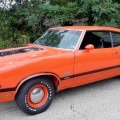
I tracked down every previous owner, as well as the dealership mechanic, and the actual salesman of my 70 W30 4spd.
So dedicated and absolutely cool! How many years from the cars original sale had passed, when you started, completed, and verified, all this information ?
Originally Posted by 344870M
I got the typical "fastest car I ever owned". And one "I would shift at 10,000 rpm" 😆🤦🏼♂️ The original salesman however, told me that he was allowed to tell potential customers that the W30 produced 450 hp.
One of the quickest and most powerful cars in Oldsmobile History, its lore is well deserved. And you clearly understand that, or I doubt you would've gone to the tremendous effort you did. In documenting its history since day 1. Beautiful car by the way.
Originally Posted by 344870M
I didn't think much of it all those years ago. I passed it off as fondly remembering incorrectly. That was until I read R Huntingdons article a few years later. This doesn't confirm anything. But it does sway me more towards the upper 400s than the advertised 375 🙄😒
The 1970 W30 was and wasn't underrated...
Luckily between the Horsepower Hijinks article and Car Lifes road test. We know and can confirm what we know. Between both sources we can extrapolate that the engine produced 400 hp gross, when original.
What I do know is that when I was 21 and I took the local police chief (and local gas station owner) for a ride, it was a religious experience for him. The moment I launched out of first he cried out "J---- C-----!!!" 😄
Now that makes a lot of sense !
Nothing feels like an original muscle car cutting loose.
Here's another example of the fallacy of the factory HP numbers. The 1970 442 AT engine was rated at 365 HP. The 1970 Toro W-34 motor used the exact same "E" heads with the same valves, the same block, the same pistons, and the same 285/287 degree cam. By changing to the crappy Toro intake and exhaust manifolds, this engine was now rated at 400 HP.
Does ANYONE really believe that?
Here's my theory. The GM limit of 10 lbs per HP on the A-body cars was well documented. The 1970 442 had a curb weight right around 3700 lbs. Magically, the W-30 was rated at 370 HP (do the math). The lesser 442s naturally had to have a lower HP number than the W-30, thus the 365 rating.
I've noted previously that automotive writer Roger Huntington famously wrote an article in the early 1970s comparing the advertised and actual HP numbers of selected musclecar engines. The 1970 W-30 MT motor put out an actual 440 HP vs. the 370 HP advertised in that article.







 Search this Thread
  KenMaisano

 07-28-2016, 12:05 AM
 1970 455 W30 Dyno ResultsI thought I would share my results on a recent build. This engine is the original engine for our Black W30 four speed. The specs are 100% original except for a half point lower compression. and a complete blueprint. Ran with the stock camshaft,intake, carb and exhaust manifolds.No tuning on the QJet just a quick timing loop. Timing didn't seem to matter between 31 and 36 degrees.