When you click on links to various merchants on this site and make a purchase, this can result in this site earning a commission. Affiliate programs and affiliations include, but are not limited to, the eBay Partner Network.
Welcome to the group... You most likely have a 66 400 or 425 since you have B-Heads... Your 388 885 could possibly be 389 895...
Thanks, I've always loved Olds. 442's were
"The gentleman's muscle car"
Yes, I could be a # off on "388 885"
442 is '67, could be some '66 heads used on early '67
production ?
Ignition is standard points, not trick ignition some 442's had ?
On right front of block, (left front behind power steering pump?)
M700140 (should be 2-digits before the "M" - "3?" - the "?" is a model year - 1, 2, 3, for model year '71, '72, '73, etc. - it appears to be an early '70s 455 from a Toronado) what's the casting number on the block next to the oil fill tube & behind the water pump?
Large B on back of passenger head
On left head,
CFO or D - CFD = Central Foundry Division
388 885 - 389895 is a '66 "B" head
GM cast near driver's end of head
Large B on front of head
(Looks like I see smog pump tubing holes plugs in both heads)
Last edited by hurst68olds; Sep 6, 2017 at 11:24 AM.
There is no factory stamping on the right front of the block. The 1964-67 motors will have an engine unit number stamp on the front of the right HEAD.
ASSUMING you are talking about the engine unit number on the front of the HEAD, the M prefix indicates that these heads came off a 1966 425 2bbl motor. That is consistent with the "B" casting designation below.
Large B on back of passenger head
On the BACK (as in facing the firewall) or near the no. 8 spark plug hole?
On left head,
CFO or D
388 885
GM cast near driver's end of head
Look again. That number is 389395, which is consistent with 1966 model year "B" head castings.
Large B on front of head
Again, do you mean FRONT (as in facing the radiator) or next to the no. 1 spark plug. It's the latter, by the way.
(Looks like I see smog pump tubing holes plugs in both heads)
Which would be consistent with a 1966 California Olds.
If I'm seeing the right place,
this is where M700140 is stamped front pass side,
looks like top of block.
Is it stamped like the one I posted above. just below the valve cover? That's the HEAD, not the block.
Found this in front of oil fill,
389244 (large) D
Is there a chance I've got a real deal 67 442 engine ?
Well, the "D" block is an 1966-67 425 block, so no, it isn't a "442 engine". Per the head castings and other info you posted, it's a 1966 425 low compression 2bbl motor, originally.
Originally Posted by J2 #1
Would these also be low compression heads ?
Olds varied CR with piston dish, not head chamber size. All "B" head castings have the same chamber size.
Front (to me) means towards radiator, back, towards firewall.
Which is confusing when you claim that the "B" casting letters on the heads are on the "front" and "back"...
Do I have a '66-'67 425 Toronado engine
w/"decent" B heads ?
Not even close.
Don't remember 425 offered in 67 442's
Because they weren't. They especially didn't put 1966 425s into 1967 442s.
Which is confusing when you claim that the "B" casting letters on the heads are on the "front" and "back"...
Quote:
Do I have a '66-'67 425 Toronado engine
w/"decent" B heads ?
Not even close.
"B" is toward front of head when head is installed on one side of block, when same head is put on other side of block "B" will be towards firewall end of head.
As I searched B heads, seems they have some of the biggest valves available, not ?
The "D" code is not a '66-'67 Toronado 425 engine ?
As I remember, all first gen Toronados were hi-comp 4 bbls.
Could my "2bbl low comp 425" be some sort of 66-67 Calif smog motor ?
(I'm East Coast, most smog motors were around '70-'71 here)
From another site,
Best, easier to find:
Toro/442 engine, 1967. Big valve C heads, all the usual Toro goodies. 4V carb. Will need hard exhaust seats. Some racers favor the Toro D block's large lifters, with the modern 39 degree cam bank angle, because the large lifters seem to tolerate high cam lift better. 400 CID E-block 442 engines are very rare, easily tradeable for a nice 455.
and this,
B 389395 80cc 2.000, 2.072" 1.625"
1966 400/425's. Toronado and 442 heads had the larger 2.072" intake valves. Shallow spring seats. No hard exhaust seats. RH head will have the engine ID stamped into the front. First to use the one piece aluminum rocker pivots with 5/16" mounting bolts. Some early ones used the 3 piece rocker arm pivots with studs.
This is all new to me, SBC guy here...also own 383 '55,
bought 442 for comfort.
1) EVERY SINGLE 425 block cast in the years 1966-67 has the 389244 D casting number. Low compression, high compression, Delta 88, Starfire, Ninety Eight, Toro. All the same. Nothing on the block or casting numbers will tell you what it came out of.
2) EVER SINGLE big block cylinder head cast by Olds in the 1966 model year (and ONLY in the 1966 model year) had the 389395 casting number and letter B near the first spark plug hole. Every one came with the same 80(ish) cc combustion chambers (actual as-cast volumes varied slightly due to production tolerances). This casting could have come with either big (2.070") or small (2.000") valves. Exhaust was the same 1.625" in all cases. There is no way to tell externally which valves are in the heads, EXCEPT from the engine unit number on your RH head that decodes to a 2bbl small valve motor. This assumes the heads are original to that block, however.
3) The A.I.R. ports indicate that this motor came from a car originally sold in Calif. All 1966-67 Olds motors sold in Calif came with A.I.R. The valve size and compression ratio is unrelated to that.
Finally, I'll repeat my previous post, with one correction. Based on the engine unit number and casting numbers, this motor is a 1966 model year small valve 2bbl 425 out of either a Dynamic or Delta 88. It was available in either 9:1 or 10.25:1 compression ratios with a 2bbl. The high compression 2bbl motor was rated at 310 HP using premium fuel and was standard equipment in both cars. The RPO L65 low compression version was rated at 300 HP using regular fuel and was a no cost option in both cars.
Despite the fact that I've now provided this information two or three times, you still keep asking the same questions, which tells me you don't like the answer and will continue to ask these questions until you hear an answer you like. At this point I'm done. I hope you get what you want out of this thread.
The hard exhaust seats are unnecessary unless you are going to be driving at sustained highway speeds for a long time. If you do decide to have the seats replaced, be sure the machinist knows to use Olds seats not Chavy seats because the depth is different and will possibly cut into the water jacket when trying to put in the Chevy seats. I had a 67 442 that I put over 40K miles on the soft exhaust seats with no problems.
The hard exhaust seats are unnecessary unless you are going to be driving at sustained highway speeds for a long time. If you do decide to have the seats replaced, be sure the machinist knows to use Olds seats not Chavy seats because the depth is different and will possibly cut into the water jacket when trying to put in the Chevy seats. I had a 67 442 that I put over 40K miles on the soft exhaust seats with no problems.
^^^This. On a lightly driven car that only sees weekend duty in the summer, you'll never see the difference between original and hardened seats. For a daily driver or hard use (like the drag strip or towing), I'd go with the seats. I am having seats put in the heads from my 67 Delta since it's a daily driver.
Despite the fact that I've now provided this information two or three times, you still keep asking the same questions, which tells me you don't like the answer and will continue to ask these questions until you hear an answer you like. At this point I'm done. I hope you get what you want out of this thread.
Why the attitude ?
I began this thread stating I believed to "have a homemade engine",
your comments seem to confirm as much. I bought this car @ a home-made engine price....Later commented "This is all new to me, SBC guy here...also own 383 '55, bought 442 for comfort." If I get in a hurry, I fire up the 383.
There is no answer that I have to have (concerning 442) to "Make my life complete"
442 engine appears to have factory color (bronze?), very stock w/exception of Hookers...and oddly enough, a chrome oil pan. Stock appearing intake
w/Quadrajet (leaking, soon to be replaced w/Holley). 1 pushrod looks new.
Everything about this engine appears original.
3) The A.I.R. ports indicate that this motor came from a car originally sold in Calif. All 1966-67 Olds motors sold in Calif came with A.I.R. The valve size and compression ratio is unrelated to that.
^ This is consistent w/my opinion this car spent much of its' youth in SW US.
w/Quadrajet (leaking, soon to be replaced w/Holley).
Get some input on that before you commit. Back in the 80s I swapped the QJet on my 70 Supreme with a Holley and spent a lot of money and time trying to tune it so it worked as well as the QJet. I finally put the QJet back on and for the next 10+ years had no further issues.
Get some input on that before you commit. Back in the 80s I swapped the QJet on my 70 Supreme with a Holley and spent a lot of money and time trying to tune it so it worked as well as the QJet. I finally put the QJet back on and for the next 10+ years had no further issues.
I would have kept the QJet, but told I can't get parts. True dat on the Holleys.
I like Holley carbs, I have one on my SBC and it works great. I also like Qjets, built right they are awesome carbs. Theres a very likely chance the Qjet off that 425 is bigger than that 670 Holley, its probably a 750 or 800. Qjets are easy to rebuild, im no pro with them but I can build one to work pretty well. I have a friend back home who can perform magic with a Qjet or Holley. I hope to have him tweek my Qjet soon.
If it were me on that Olds engine I would keep the Qjet.
I like Holley carbs, I have one on my SBC and it works great. I also like Qjets, built right they are awesome carbs. Theres a very likely chance the Qjet off that 425 is bigger than that 670 Holley, its probably a 750 or 800. Qjets are easy to rebuild, im no pro with them but I can build one to work pretty well. I have a friend back home who can perform magic with a Qjet or Holley. I hope to have him tweek my Qjet soon.
If it were me on that Olds engine I would keep the Qjet.
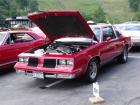
Agreed, QJet's allow big CFM's w/o the surging @ cruise equal bore carbs seem to create. I'm keeping the QJet and rebuild later. I mentioned the QJet only in surprise that 88s had low comp/smog pump 425s w/QJets. My 442 is no hot rod, a/c, p/b, p/s, p/w, Holiday Coupe (HT), electric antenna and rear defrost.
btw, 65' Corvette Coupe owner in late 80's also....what a car !