When you click on links to various merchants on this site and make a purchase, this can result in this site earning a commission. Affiliate programs and affiliations include, but are not limited to, the eBay Partner Network.
Teach me please.
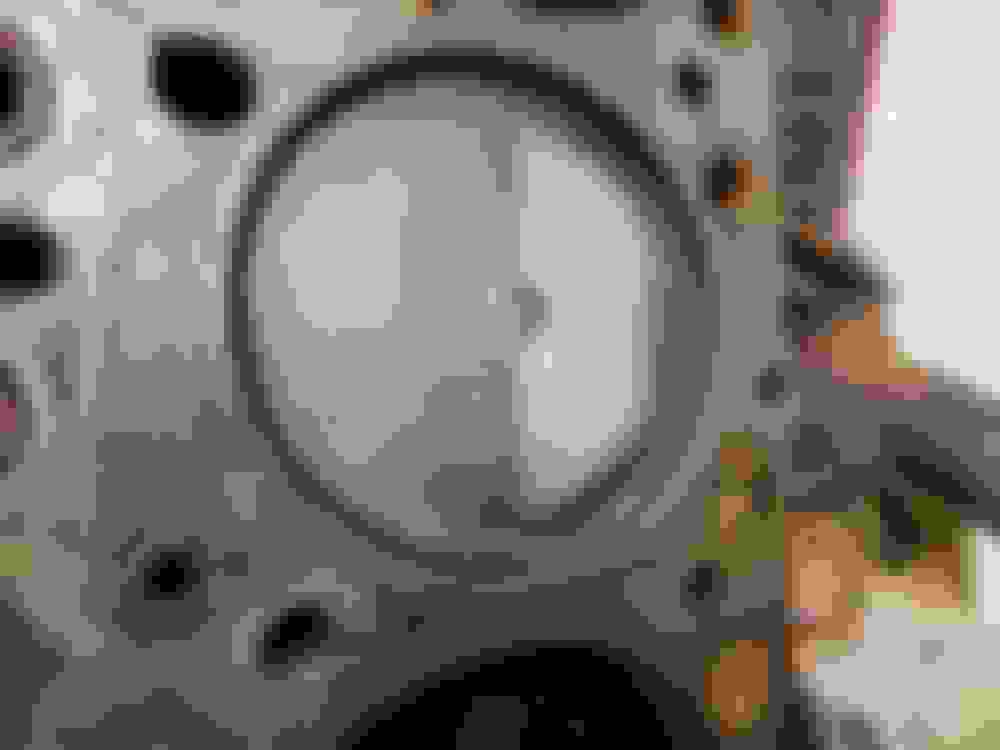
I recently took the engine apart because it was a broken piston ring.
The casting number on the cylinder block identifies it as 1957 371.
The cylinder head is a 1962 394.
The manual says the cylinder bore is 4 inches, but this engine had a domed piston of about 4.183 inches.
Pistons don't have numbers.
It seems that the cylinder is enlarged considerably.
Which piston are you using?
Is it the classic hop-up of the past?
Please help me.
Thank you.
Please excuse my strange English.
from Japan.
That's exactly what this sounds like.
62 thru 64 heads flowed better and would bolt on 371 blocks.
4.183 bore on a 371 does sound like a lot. But it was common to bore them to 4.125 and use 394 pistons.
These old blocks had very thick cylinder walls, so I suppose it was possible.
I would be leery about boring it any further, unless you have the cylinders "sonic checked"
Thank you for teaching me.
Does that mean that the 394 standard has a 4.125 bore, so a 0.060 oversize piston is used?
Do you sell dome type pistons?
Or is it a diversion of something?
Enlarging the bore any further may be a concern.
Do you have a shop over there that can sonic check the thickness of the block?
You may be OK, but it's wise to check.
A domed piston sounds like it is really high compression. You may want to get a set of flat top pistons, and even then you will need 93 octane fuel.
I don't make or sell any parts. However here is a link to a company that makes custom forged pistons; Home - RaceTec Pistons
Maybe I'm misunderstanding, but are all the pistons this size not just this one? 60 over would be close but sonic check as mentioned above should very well be done. That era engine were known for their thick blocks, but that is a bunch for a 371..Tedd
That sounds like the stamped in number. There should also be a casting number at the back near the transmission. I dont have a way to identify the stamped number but I think Joe does so hopefully he will see this post.
Maybe I'm misunderstanding, but are all the pistons this size not just this one? 60 over would be close but sonic check as mentioned above should very well be done. That era engine were known for their thick blocks, but that is a bunch for a 371..Tedd
English was fine.
There is a carved seal of A143778.
That is the stamped engine unit number, and is the correct format for a 1957 Olds 371. All 1957 Olds engine unit numbers started with the letter "A" followed by a six digit sequence number. I assume this is on the driver's side on the block deck surface, correct?
The block casting number for a 1957 371 should be 568929.
Last edited by joe_padavano; Jul 9, 2023 at 07:26 PM.
The 394 used a 4.125" bore. 0.060" oversize pistons for a 394 would be 4.185", which sounds a lot like what you have. Your cast domed pistons are aftermarket. I have no idea who made them. In the late 1950s and early 1960s the first gen Olds V8s were the go-to performance motor for hot-rodders and there was a wealth of aftermarket performance parts available. I suspect that it is unlikely that you will find a match for that particular piston today, unless you get really lucky and find one or a set on ebay. As others have noted, I'd sonic check the block before putting any real money into it. The first gen Olds V8s were thickwall blocks, so the massive overbore on a 371 might not be an issue, but you'd better check. You'll likely be buying a complete set of 394 pistons if you can't find one to match.
Thanks for the detailed explanation.
I want to build a durable engine,
I'm thinking of using the new 394 cylinder sleeve.
Bore is 4.125.
The piston is a dish type.
I don't race, just run on the street.
Is there a better way?
Thanks for the detailed explanation.
I want to build a durable engine,
I'm thinking of using the new 394 cylinder sleeve.
Bore is 4.125.
The piston is a dish type.
I don't race, just run on the street.
Is there a better way?
So you are saying that the other seven cylinders are 4.125 and this one is oversize? Yes, a sleeve would be a good solution in that case, assuming the remaining wall thickness is adequate.
Sorry if my explanation was bad.
No, the other seven cylinders also use 4.183 pistons.
OK, let's start again. This engine was assembled from mis-matched parts. If you plan to put any money into it, check EVERYTHING. Start with sonic testing cylinder wall thickness. If it's sufficient, just get a new set of 0.060" over pistons for a 394. There's no need to spend any money on sleeves, and frankly I doubt there's enough wall left to bore out enough to install those sleeves. Once you buy new pistons, you'll need to check the compression ratio. This will require a mockup of the short block so you can verify deck clearance to the new pistons. You should CC the heads to verify chamber volume. I would also have the rotating assembly balanced with the new pistons, since they are almost certainly a different weight than the old ones. Once things are together, verify correct pushrod length and rocker geometry on the valve tips. Do all that and you should have a stout street motor that you'll be happy with.
Egge charges forged prices for cast pistons ($728 a set!). Google shows these, but even for that price I'd talk to someone like Mahle or Icon or Diamond and get exactly what you need in a higher quality piston.
A 57 could take .125 bore (394 size) and with that 59 crank .250 offset
ground stroke its over 400 cubes. The 394 piston could be used.
I'll also note that 394 pistons have a 1.765" compression height and a 0.981" pin diameter. Olds 455 pistons have a 1.750" compression height and a 0.981" pin. Deck the block and you probably make up the compression height difference.
I'll also note that 394 pistons have a 1.765" compression height and a 0.981" pin diameter. Olds 455 pistons have a 1.750" compression height and a 0.981" pin. Deck the block and you probably make up the compression height difference.
455 pistons won't work, unless they are set up with circlips for full floating pins.
All first generation Olds engines had full floating pins.
Mahle does do business in Japan. Perhaps go to their global website to see if there is a piston application for your Olds there, using the info posted here.
got it.
thank you.
Better yet, how about putting in a 371 cylinder sleeve?
Back to 4 inch bore.
Sonography is difficult in Japan.
You will need to sonic check the block before fitting sleeves anyway. Sure you can sleeve it. That's probably the most expensive way possible to build this motor. Keep in mind that you have to sleeve all eight cylinders, have the block rebored, and then buy new 371 pistons. Stock 371 cast pistons from Egge will cost MORE than custom pistons from a company like Diamond or Icon or Mahle. It would probably even be less expensive to ship another 371 block over from the US than to do all this. Your money, your call, but getting pistons to fit the block you have is probably the most cost-effective and lowest work path.
My 371 is bored to 4.125 and has Jahns pistons in it. Look familiar? Turn the pistons upside down and you should see a cross hatch reinforcement and the words Jahns cast into it. My catalog does not show that piston but it may be under 394 not 371.
My 371 is bored to 4.125 and has Jahns pistons in it. Look familiar? Turn the pistons upside down and you should see a cross hatch reinforcement and the words Jahns cast into it. My catalog does not show that piston but it may be under 394 not 371. If it ran fine and just broke a ring replace the rings hone everything and move on. If it scored a cylinder and the rest are fine sleeve, Hone, new rings and freshen it up. Mine will be sonic checked to see if I can go 185 but will be sleeved on 2 cylinders otherwise.
Thanks for all the advice.
I'm going to put the stock sleeve back in and go back to the 371.
It costs money.
Ultrasound is expensive in Japan.
Thanks guys.