


Things kept getting in the way, you see...


Thread Starter
Registered User
Joined: Aug 2009
Posts: 333
Things kept getting in the way, you see...
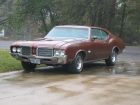
Five and a half years ago, I decided to rebuild the engine in my Frankenstein. 1953 Rocket 88, subframe with a 1965 Delta 88 front end along with the 45-degree A block/heads 425. I bought it a few years prior in barely running shape, gotten it running pretty well, found a cylinder that needed valve work, and went completely overboard with might-as-wells.
With Mark's help I got parts together, took it to the machine shop for boring, balancing, etc. Went with the high compression pistons, Harland Sharp 1.7 rockers, Melling high volume oil pump, high flow water pump, Griffin radiator, Taurus 2-speed fan and Volvo relay for cooling, had the switchpitch TH400 rebuilt and bought one of Bruce Roe's electronic controllers for it. Then I wrapped it in heavy plastic along with a bunch of silica packs for the winter.
See, I don't actually have any garage space. I work in my driveway, and get limited by the seasons. I also teach, so summers are pretty much the time I can get anything complicated or time consuming done. Well, every summer, something kept coming up. New roof and flooded bathroom (sounds easy, but it took out the bathroom, bedroom, and two rooms below them in the basement), finishing a master's degree, various disasters of all kinds. This summer I decided enough was enough, I was going to push the car into the driveway and it wasn't going to leave until I drove it out. I went through a lot of hair-pulling and double-checking to make sure everything was still good to go. I even picked up a camera to check out the cylinders, make sure no surface rust had developed and the grease was still good.
Today I finally fired it up to break in the cam! Minor hiccups ensued, since the entire cooling system was brand new, I rebuilt the carb using one of Cliff Ruggle's recipes, a good deal of rewiring was needed, and so on, and on - but it caught and fired on the first crank, so I haven't lost all my marbles. Keeping it running once it fired up was a bit more of an issue, but that was eventually solved.
Tomorrow I do a bit of tuning and drive it to seal the rings!
And yes, my wife is both awesome and very happy.
With Mark's help I got parts together, took it to the machine shop for boring, balancing, etc. Went with the high compression pistons, Harland Sharp 1.7 rockers, Melling high volume oil pump, high flow water pump, Griffin radiator, Taurus 2-speed fan and Volvo relay for cooling, had the switchpitch TH400 rebuilt and bought one of Bruce Roe's electronic controllers for it. Then I wrapped it in heavy plastic along with a bunch of silica packs for the winter.
See, I don't actually have any garage space. I work in my driveway, and get limited by the seasons. I also teach, so summers are pretty much the time I can get anything complicated or time consuming done. Well, every summer, something kept coming up. New roof and flooded bathroom (sounds easy, but it took out the bathroom, bedroom, and two rooms below them in the basement), finishing a master's degree, various disasters of all kinds. This summer I decided enough was enough, I was going to push the car into the driveway and it wasn't going to leave until I drove it out. I went through a lot of hair-pulling and double-checking to make sure everything was still good to go. I even picked up a camera to check out the cylinders, make sure no surface rust had developed and the grease was still good.
Today I finally fired it up to break in the cam! Minor hiccups ensued, since the entire cooling system was brand new, I rebuilt the carb using one of Cliff Ruggle's recipes, a good deal of rewiring was needed, and so on, and on - but it caught and fired on the first crank, so I haven't lost all my marbles. Keeping it running once it fired up was a bit more of an issue, but that was eventually solved.
Tomorrow I do a bit of tuning and drive it to seal the rings!
And yes, my wife is both awesome and very happy.
Thread Starter
Registered User
Joined: Aug 2009
Posts: 333
Things are moving along now. Still a couple small leaks to fix (gas leak at fuel pump outlet, trans leak at radiator). Cooling system works, so far, although I haven't driven it yet. The temp sensor is kicking the fan on properly, and it doesn't seem to be overheating. Problem with the carb, though.
Fires up and runs, idles well for 3-6 seconds, then it appears to flood, with typical dumping smoke/vapor rising out of the neck of the carb. Set the timing at 10 degrees for now, using Pertronix Ignitor III for ignition, seems to be purely a carb issue.
I used the factory spec for the carb float level, but I'm not sure that's the best idea. Before I open the carb for a look, does anyone have any recommendations for float level? The closest fit for the carb number is a 1979 Olds 403, giving a float level spec of 13/32, but of course the jets, rods, and power spring are all as per Ruggle's recommendations. He also had me open the idle air tubes and drill the baseplate, and the carb also has the "bump" normal for an 800cfm carb.
Fires up and runs, idles well for 3-6 seconds, then it appears to flood, with typical dumping smoke/vapor rising out of the neck of the carb. Set the timing at 10 degrees for now, using Pertronix Ignitor III for ignition, seems to be purely a carb issue.
I used the factory spec for the carb float level, but I'm not sure that's the best idea. Before I open the carb for a look, does anyone have any recommendations for float level? The closest fit for the carb number is a 1979 Olds 403, giving a float level spec of 13/32, but of course the jets, rods, and power spring are all as per Ruggle's recommendations. He also had me open the idle air tubes and drill the baseplate, and the carb also has the "bump" normal for an 800cfm carb.
same but different
Joined: Jun 2007
Posts: 2,965
From: Central Missouri
My best guess would be from 1/4" to 3/8" . If the carb and fuel has been sitting awhile you might be getting some debris churned up and keeping the needle off the seat. You might confirm some clean fuel is getting there. Other than that, I would look at using a different carb all together to rule out any issues on the current carb.
Thread Starter
Registered User
Joined: Aug 2009
Posts: 333
More updates -- I replaced the brass float with the neoprene float that Cliff included and no more flooding. Rechecked the float adjustment on the brass one before replacing it, seemed to be right on. Oh, well.
Replaced the fuel pump after driving it a bit. Fuel volume through the pump was minimal. Should have replaced it as a matter of course - why spend a couple thousand on the engine, only to cheap out on a $25 fuel pump? Sheer stupidity.
Installed extra thick valve cover gaskets, as the rockers were tapping on the baffles. Very light contact, no actual impact marks on the baffles except where the poly locks left behind a ring of oil...
There's still a lean condition at idle that I'm having trouble correcting. Idle adjustment passage drilled out, snipped one coil spring on each idle screw so I have good adjustment range - but I can't back them out far enough to correct the leanness at idle. First thought was that I might need to open up the idle down tubes a bit more, but first I fiddled around some, looking for vacuum leaks. Best I could find was that with the PCV valve plugged, the lean condition was much better. I seem to recall from my school days that PCV valves are not only different in physical configuration, but in the metering. Since the engine did not originally have a PCV valve, I'm sure the metering is purely a random guess.
Does anyone have a good idea for an appropriate valve for a 425?
Replaced the fuel pump after driving it a bit. Fuel volume through the pump was minimal. Should have replaced it as a matter of course - why spend a couple thousand on the engine, only to cheap out on a $25 fuel pump? Sheer stupidity.
Installed extra thick valve cover gaskets, as the rockers were tapping on the baffles. Very light contact, no actual impact marks on the baffles except where the poly locks left behind a ring of oil...
There's still a lean condition at idle that I'm having trouble correcting. Idle adjustment passage drilled out, snipped one coil spring on each idle screw so I have good adjustment range - but I can't back them out far enough to correct the leanness at idle. First thought was that I might need to open up the idle down tubes a bit more, but first I fiddled around some, looking for vacuum leaks. Best I could find was that with the PCV valve plugged, the lean condition was much better. I seem to recall from my school days that PCV valves are not only different in physical configuration, but in the metering. Since the engine did not originally have a PCV valve, I'm sure the metering is purely a random guess.
Does anyone have a good idea for an appropriate valve for a 425?
Thread Starter
Registered User
Joined: Aug 2009
Posts: 333
I'm beginning to be convinced that the carb simply wants more fuel at idle, after spending the day tinkering. Currently have the timing set at 5 degrees BTDC, 40 degrees total, manifold vacuum. No vacuum leaks that I can find. Found the PCV valve I was using before rebuilding the engine, it seemed to help slightly. At least covering the valve now doesn't cause the idle to improve.
At idle I now have 17 inches of vacuum, and if I cover the carb with my hand it picks up 100+ rpm, smooths out, and gains an inch of vacuum. Cannot get any more adjustment with the idle screws.
It does run well down the road, although it sounds like a sewing machine. Just how loud are Harland Sharps, anyway?
At idle I now have 17 inches of vacuum, and if I cover the carb with my hand it picks up 100+ rpm, smooths out, and gains an inch of vacuum. Cannot get any more adjustment with the idle screws.
It does run well down the road, although it sounds like a sewing machine. Just how loud are Harland Sharps, anyway?

Thread
Thread Starter
Forum
Replies
Last Post
KathleenF
General Discussion
42
Jun 4, 2011 10:29 AM


