When you click on links to various merchants on this site and make a purchase, this can result in this site earning a commission. Affiliate programs and affiliations include, but are not limited to, the eBay Partner Network.
i have a 68 442 convertible with buckets and im 6'6". I have to scootch way down and my knees are basically touching the dash lol
im wondering if anyone has moved the seat brackets back or if there is a way to lower the seats??
I haven’t done it…but it shouldn’t be too hard. May have to get some spacers underneath to keep it all level…but should be doable.
I made the mistake of having a cage put in without moving my seat all the way back…
-peter
I remember several years ago reading a writeup on the forum about a similar situation as you. The person installed new seat rails and moved the seat back. Do a search and you may find that info.
They make spacers, or you can make your own. It helps enormously with leg room.
As far as lowerinlowI found that the factory buckets are about as low as you can get. I put some ProCar seats in my 67, and had to modify all the brackets to get it low enough and use the factory holes. I'm 6-4, and know what you're talking about.
Let's talk about structural capabilities for a minute. The seat mounting locations are engineered to be above the floorpan crossmembers. This is intentional, both to resist fatigue in the sheet metal floorpans and to provide positive seat retention in a crash. Moving the seat attaching points off these engineered locations compromises structural capability. And those simple straps that move the seat rearward are just adding more flexibility into the mount. Your car, your life, your choice.
Now, that's funny! These car's "safety standards" aren't very extensive.
Apparently you don't understand basic structural design. "Standards" aren't the issue. Common sense should tell you that a seat mount that bolts through the floorpan AND the thick crossmember is stronger and more rigid than one that only bolts through the floorpan.
Apparently you don't understand basic structural design. "Standards" aren't the issue. Common sense should tell you that a seat mount that bolts through the floorpan AND the thick crossmember is stronger and more rigid than one that only bolts through the floorpan.
You're also making assumptions that someone would just blow new holes in the floor and remount the seat. This whole conversation has revolved around relocation brackets that utilize the factory mounts.
Lots of parts houses sell the 2" relocation bracket-ettes - one for each mounting bolt. I agree with Joe that seems a little too sketchy to me. I worried about those being able to move if stressed.
There's another relocation bracket that is a long one - two per seat. It bolts to the floor in the stock location then the seat bolts to it. Should be much more rigid.
Or you can cut up and re-weld your seats.
I ended up going with Procar seats and like fleming I took their mounting brackets all apart and rebuilt them down and back. I'm 6'4" and 275 lbs. Also made severe modifications to the foam.
You're also making assumptions that someone would just blow new holes in the floor and remount the seat. This whole conversation has revolved around relocation brackets that utilize the factory mounts.
No, you failed to read my post completely:
Originally Posted by joe_padavano
And those simple straps that move the seat rearward are just adding more flexibility into the mount.
You're right. I did not. I still feel safe in my seats, even safer than the factory seats because my chest isn't right up on the steering column. Yes, it should collapse, but I don't like being that close to it (like an airbag).
The rears use the factory mount points, and the front has an 1/8x2" steel plate and 1/2" grade 8 bolts in addition to the factory mount points.
Last edited by fleming442; Jan 11, 2022 at 09:01 AM.
I recently made these brackets that provide an addition 3 inches of leg room in my 70. They made a world of difference for me. They are made from 1/4" mild steel and transfer the seat loading directly into the factory attachment locations.
Last edited by 4+4+2=10; Jan 11, 2022 at 09:29 AM.
They are made from 1/4" mild steel and transfer the seat loading directly into the factory attachment locations.
No, they really don't. Fore/aft loads are transferred to the factory mounting locations. Up/down loads are not. The overhanging load at the rear causes even that 1/4" strap to deflect up and down, which loads the sheet metal floor pan. That's called a leaf spring. The smarter way to fab these would have been to use angle or U-channel. The side walls would provide a dramatic increase in out-of-plane stiffness. Is your design good enough? Only a severe crash will tell for sure.
Strap flexing still transfers the load into the factory bolt locations. So would a rigid beam. Granted, there is a 3" moment arm on the aft bolt locations that would be a consideration in either design but this reduced by the continuation of the strap to the forward bolt location. Regardless, this really only comes into play in a crash load whereby the occupant tries to punch through the floor (Thelma and Louise mode) Upward loading of the occupant will be taken out by the seat belts.
Strap flexing still transfers the load into the factory bolt locations. So would a rigid beam. Granted, there is a 3" moment arm on the aft bolt locations that would be a consideration in either design but this reduced by the continuation of the strap to the forward bolt location. Regardless, this really only comes into play in a crash load whereby the occupant tries to punch through the floor (Thelma and Louise mode) Upward loading of the occupant will be taken out by the seat belts.
At some point the strap contacts the floor pan and loads are transferred that way. Draw a free body diagram.
There is at least an inch of clearance between the aft bolt and the rear floor pan You are correct however that under enough load, contact will be made, but I think this would be a result of the floor structure crumpling rather than strap deflection. I see it as a moot point either way because I do not believe this would negatively affect occupant survival. In fact it may likely improve it. As you know, crumpling structure is a primary safety element built into automotive design.
There is at least an inch of clearance between the aft bolt and the rear floor pan You are correct however that under enough load, contact will be made, but I think this would be a result of the floor structure crumpling rather than strap deflection. I see it as a moot point either way because I do not believe this would negatively affect occupant survival. In fact it may likely improve it. As you know, crumpling structure is a primary safety element built into automotive design.
This is called armchair engineering. I sincerely hope you never have to find out how good it is.
There is at least an inch of clearance between the aft bolt and the rear floor pan You are correct however that under enough load, contact will be made, but I think this would be a result of the floor structure crumpling rather than strap deflection. I see it as a moot point either way because I do not believe this would negatively affect occupant survival. In fact it may likely improve it. As you know, crumpling structure is a primary safety element built into automotive design.
So, you're saying that the truss provided by the seat track tying both points together does nothing?
The reality is that if you get hit hard enough to break seat mounts (OEM or modified), you are fvcked, anyway, regardless of "fatigued metal". The average driving of the members here lacks enough frequency to warrant any serious concerns for fatigue. BUT, the belts are there to secure you to the seat. SFI says you have to replace belts every 2 years. How many members have updated their belts?
I understand stand that, as moderator, you cannot condone any modification for liability reasons. I also understand that you will argue the OEM until death (because everything else is inferior).
If a guy wants a little more leg room to go get an ice cream, I don't think he's going to fall through the floor on modified brackets. If someone t-bones him hard enough to fail his modified brackets, the oem weren't going to be that much better.
Joe, Let me first say, there are few people on this board that have more respect for you than I do. But in this discussion I think you are being a little over dramatic. To the untrained eye, the diagrams you posted can seem more than they are. They do a good job showing how the components will be loaded, but they are not necessarily an accurate representation of the magnitude of deflection that might occur during an impact.. You likely constrained the fastener locations on the floor structure as well as the seat track structure. You know as well as I do, these components will not go unscathed during a dynamic load. When doing simple analysis one needs to make a few assumptions, I get it. I spend 20 years working in engineering at Beech Aircraft so I know how this works. Ideally a 3D CATIA model converted to a NASTRAN model would tell us the whole story but somethings can be deducted without all the hoopla and yes even by guys in an armchair.. .
Your second diagram we can assume represents a high speed rear impact. You know the seat back will fail and the occupant will lay backwards like he is taking a Sunday afternoon nap. This will take a significant amount of the forces that are pushing the back of the floor bracket downward. But even if it didn't I don't see the life threatening danger you have insinuated.
The third diagram we can assume represents a head-on collision. This really does not represent anything in the real world of events. The occupant is going to lift off the seat to be restrained by the seat belt. This would likely result in some downward force to the front of the brackets, but I don't see any load application to the seat that would pull the aft end of the bracket skyward in the magnitude you depict.
I used 1/4" steel because I didn't like any of the options offered by the aftermarket suppliers. These things are stout. I contend my brackets offer a factor of safety well beyond those aftermarket pieces. You would think that the legal department of those suppliers would have some justification for putting thinner brackets on the markets. Frankly I don't care because I didn't put them in my car. I willing accept the risk because of the benefit it provides me.
Joe, Let me first say, there are few people on this board that have more respect for you than I do. But in this discussion I think you are being a little over dramatic. To the untrained eye, the diagrams you posted can seem more than they are. They do a good job showing how the components will be loaded, but they are not necessarily an accurate representation of the magnitude of deflection that might occur during an impact.. You likely constrained the fastener locations on the floor structure as well as the seat track structure. You know as well as I do, these components will not go unscathed during a dynamic load. When doing simple analysis one needs to make a few assumptions, I get it. I spend 20 years working in engineering at Beech Aircraft so I know how this works. Ideally a 3D CATIA model converted to a NASTRAN model would tell us the whole story but somethings can be deducted without all the hoopla and yes even by guys in an armchair.. .
Your second diagram we can assume represents a high speed rear impact. You know the seat back will fail and the occupant will lay backwards like he is taking a Sunday afternoon nap. This will take a significant amount of the forces that are pushing the back of the floor bracket downward. But even if it didn't I don't see the life threatening danger you have insinuated.
The third diagram we can assume represents a head-on collision. This really does not represent anything in the real world of events. The occupant is going to lift off the seat to be restrained by the seat belt. This would likely result in some downward force to the front of the brackets, but I don't see any load application to the seat that would pull the aft end of the bracket skyward in the magnitude you depict.
I used 1/4" steel because I didn't like any of the options offered by the aftermarket suppliers. These things are stout. I contend my brackets offer a factor of safety well beyond those aftermarket pieces. You would think that the legal department of those suppliers would have some justification for putting thinner brackets on the markets. Frankly I don't care because I didn't put them in my car. I willing accept the risk because of the benefit it provides me.
tc
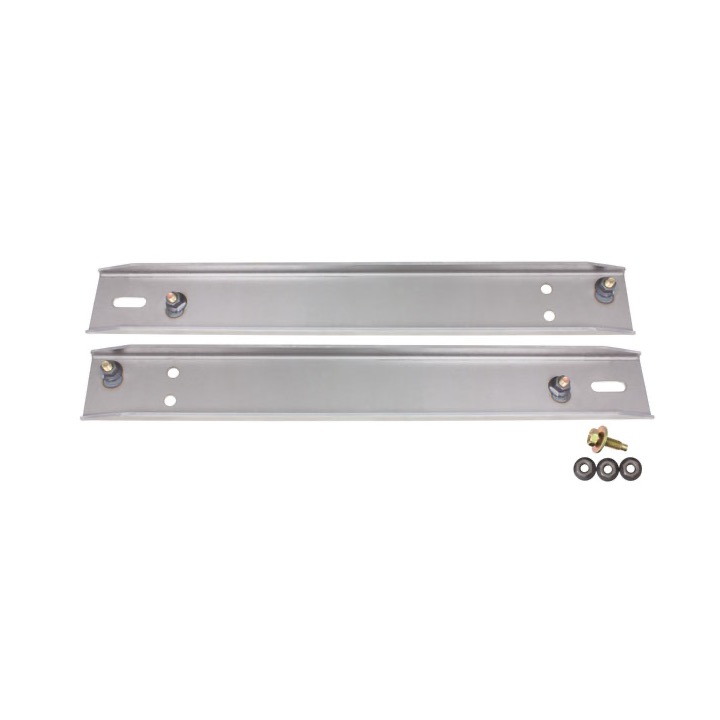
I am a chemical engineer, not mechanical engineer, so I am not versed enough to be joining all the arguments on loads and forces . However, as mentioned, a channel version would be stronger and just throwing this out there, that the aftermarket makes such a version, albeit, probably only 1/8" thick metal. See below. Ground Up (SS396.com)
Joe, Let me first say, there are few people on this board that have more respect for you than I do. But in this discussion I think you are being a little over dramatic. To the untrained eye, the diagrams you posted can seem more than they are. They do a good job showing how the components will be loaded, but they are not necessarily an accurate representation of the magnitude of deflection that might occur during an impact.. You likely constrained the fastener locations on the floor structure as well as the seat track structure. You know as well as I do, these components will not go unscathed during a dynamic load. When doing simple analysis one needs to make a few assumptions, I get it. I spend 20 years working in engineering at Beech Aircraft so I know how this works. Ideally a 3D CATIA model converted to a NASTRAN model would tell us the whole story but somethings can be deducted without all the hoopla and yes even by guys in an armchair.. .
Your second diagram we can assume represents a high speed rear impact. You know the seat back will fail and the occupant will lay backwards like he is taking a Sunday afternoon nap. This will take a significant amount of the forces that are pushing the back of the floor bracket downward. But even if it didn't I don't see the life threatening danger you have insinuated.
The third diagram we can assume represents a head-on collision. This really does not represent anything in the real world of events. The occupant is going to lift off the seat to be restrained by the seat belt. This would likely result in some downward force to the front of the brackets, but I don't see any load application to the seat that would pull the aft end of the bracket skyward in the magnitude you depict.
I used 1/4" steel because I didn't like any of the options offered by the aftermarket suppliers. These things are stout. I contend my brackets offer a factor of safety well beyond those aftermarket pieces. You would think that the legal department of those suppliers would have some justification for putting thinner brackets on the markets. Frankly I don't care because I didn't put them in my car. I willing accept the risk because of the benefit it provides me.
tc
You're focused on a collision. I'm actually more focused on fatigue failure. Every time you sit in the seat, every time you lean back, every time you turn around to back up, you flex that leaf spring. Yeah, obviously the crude sketches I made are exaggerations. Even real structural analysis software shows exaggerated deflections to make it easier to see. Will you reach the fatigue limit in the lifetime of the car? I have no idea. Again, as a structural engineer, not my first design choice. Thicker is rarely better. Smart section design is always better. 5/8" tabs that aren't even connected are even worse. Those 1/8" channels are a far better design than any I've ever seen. Those actually have some structural design smarts behind them. My only concern would be tear-out strength where the OEM track bolts to the channel, but frankly the OEM tracks aren't appreciably thicker, and washers solve that problem.
Mechanical engineer working in automotive chiming in.
Joe is correct, as usual. The floorpan is there just to be the floor; it's the reinforcements under them to which the oem nuts are in. In the real world, you have to worry about torque in 3 axes, and force in 3 directions. When something is directly bolted to something else adequately, you can control the force against the bolt (axial) and shear (the other two axes). You can, via the clamping force, restrain all torques except around the axis of the bolt, and you'd need another fastener for that, both of which would control each other in that axis.
We'll use automotive dimensions, length, width, and height. When you place a strap that moves the seat point behind the floormember, for all bolts, you are still containing force in the L direction, especially for acceleration in the direction of travel. However, braking depends on the stiffness of the strap fighting the torque moment of you being above the seat rails, force going forward, and that lever arm can put a torque CCW around the W axis. Sideways hits could clock all "tab style" straps in the direction of travel, although it's better if the straps are connected from to back, like some of the above to fight that. A force downwards will make your seat rails fight the unreinforced floor, and upward is that same CCW around the W axis torque moment. In summary, most hard hits will twist up the sheetmetal strap and cause it to fail before the bolts will.
I will disagree with Joe on one point. These cars are old, and safety is not as good as today. While I cannot guarantee that seat attachment moving brackets are safe, I don't know what percentage of wrecks that will matter. A wreck can be minor, and the seat would've stayed put under any setup. Or, a wreck can be catastrophic, and you'd have died either way. In between, where a stock seat setup would've kept you safe, and a modified setup would not; I just don't know what percentage of wrecks that would be. It is, certainly, some percentage, and it does make the car, at least theoretically, less safe. However, we ride motorcycles, so, the risk of increased injury in a certain kind of wreck, if you had it, may be worth the legroom. My only advice is make your own choice, but, if you do it to the front passenger seat, you owe it to the right of your passengers' informed choice to tell them that you did that and why it is a safety risk of at least some magnitude.
I will disagree with Joe on one point. These cars are old, and safety is not as good as today. While I cannot guarantee that seat attachment moving brackets are safe, I don't know what percentage of wrecks that will matter. A wreck can be minor, and the seat would've stayed put under any setup. Or, a wreck can be catastrophic, and you'd have died either way. In between, where a stock seat setup would've kept you safe, and a modified setup would not; I just don't know what percentage of wrecks that would be. It is, certainly, some percentage, and it does make the car, at least theoretically, less safe. However, we ride motorcycles, so, the risk of increased injury in a certain kind of wreck, if you had it, may be worth the legroom. My only advice is make your own choice, but, if you do it to the front passenger seat, you owe it to the right of your passengers' informed choice to tell them that you did that and why it is a safety risk of at least some magnitude.
Yeah, maybe, but I'll still try to maximize my chances. In any case, as I said above, I'm as much worried about fatigue failure as crash survival. I learned this in my young and stupid high school days when I just drilled the sheet metal floor pan to install Caddy power buckets in an Olds that I had. It frankly didn't take long for my fat @$$ to pull one of the fasteners through the floor.
Yeah, maybe, but I'll still try to maximize my chances. In any case, as I said above, I'm as much worried about fatigue failure as crash survival. I learned this in my young and stupid high school days when I just drilled the sheet metal floor pan to install Caddy power buckets in an Olds that I had. It frankly didn't take long for my fat @$$ to pull one of the fasteners through the floor.
Also, one could point out the likelihood of causing an accident due to a scrunched-up driving position versus the relative safety of driving in comfort.
I am a chemical engineer, not mechanical engineer, so I am not versed enough to be joining all the arguments on loads and forces . However, as mentioned, a channel version would be stronger and just throwing this out there, that the aftermarket makes such a version, albeit, probably only 1/8" thick metal. See below. Ground Up (SS396.com)
I did see these when I was considering what to do. I ruled them out because the floor pan has a joggled drop down of about 5/8" of an inch from front to the back mounting locations. These brackets are planer and really don't fit the floor pan well. They would require some spacers on the back end to square up with the floor. Unfortunately, this would also cause a noticeable forward tilt to the seat bottom that I would find unacceptable. I also wanted more than the 2 inches of leg room these provide.
The channel configuration does optimize strength while reducing weight, no one is arguing that point. However, here in Podunk Kansas we have our limitations in forming complex metal structure for "one off" production.
tc
Last edited by 4+4+2=10; Jan 12, 2022 at 08:34 PM.
I’m not a chemical, mechanical, or structural engineer. I don’t have the education to even begin to offer a relevant opinion on this discussion.
I would agree with Joe, the fatigue of the relocation brackets would be the weak link. Assuming the mounting hardware and whatever it’s attached to is solid, I would think the seat brackets themselves would fail long before the floor would.
Either way, any collision bad enough to affect the sets, floors, or mounting hardware is going to hurt pretty badly.