When you click on links to various merchants on this site and make a purchase, this can result in this site earning a commission. Affiliate programs and affiliations include, but are not limited to, the eBay Partner Network.
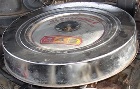
I’m almost out of my NOS stash of 63-68 front wheel dust caps. There are two types of caps made apparently. The early versions were riveted while the later ones were tack welded internally. The plastic piece is the same though. I pulled apart a good used one I had. All I did was drill out the one rivet and the metal cover pivoted out of the way and out it popped. So the question is, is there enough interest or need for the plastic piece where ur speedo cable inserts to warrant investigating making them. Of course guys would need to open theirs up and either replace the rivet or thread in a metal screw. If these could be made for under $20 any takers? Thoughts are appreciated.
Anything can be made. The hard part is the price point of the finished part and the volume of demand. I would think Fusick or someone would have investigated this part. Are there two different parts needed ?
When I got my 64 Olds, the speedo was not working. When I pulled this cap off, I found that the plastic insert was broken AND the interior cable was broken. I replaced the cable, thanks to you, deaddds, and epoxied the plastic part. Works good now!
HOWEVER, I would take a spare one if they were available for a reasonable price.
What would be fair IYO? Definitely not outsourcing this to Asia so I need to see what it would take. Like anything, the initial work up will cost the most, then it becomes a negotiation on the per piece production cost and whatever the bare minimum run is.
Well, I can likely keep repairing the one I have...my son is a whiz with his 3D printer. I was actually going to have him try to make the plastic insert to have a spare. But, nothing wrong with having a spare in the trunk toolbox. So, I'd be happy paying $40 shipped for one.
Perfect world I’d like to have these at most $15 a pop.
Okay! Make sure you leave some meat on the bone for yourself. As you know, guys don't mind paying a bit more for a quality replacement of a hard-to-find item!
The nice thing about 3d printing it is you only need to make them as you get the demand. Once you created the file for it you don't have to print it until somebody orders one. You would have to select a suitable filament.
There were reproduction sunroof gears for the 72 H/Os so equipped going for 100 a pop a couple years ago.
I would think something like that to print would take a couple hours and varies with size of material bead. Material itself also varies, but I would think that would be a few dollars in material. The issue is, the cost of the part is paying for somebody's printer, whether that be the OP owning the printer, or paying off someone's investment in theirs. Our printing shop at the plant has printers that cost 2000, and printers that cost 200,000. While I would not want to shoot it in person, I think we could probably make a revolver that would function. I think we have a couple thousand home-brewed designs doing things in the place now, mostly custom brackets. The metal printers are amazing.
Have you seen one of these printers working ? How expensive are the printers and programming software ?
Yes. I bought my printer towards the end of last year after seeing what one at work could do. Printers range from a couple hundred $ to thousands of dollars, but this project could be done with one on the lower end of the spectrum - I'm in the lower end of the distribution curve when it comes to experience and/or proficiency, but this project looks to be nearly as simple as it gets. I attached two screenshots - one is a quick model I whipped up based on the picture (aka I made assumptions on all of the dimensions, so take it for what it's worth). The slicing program (free open source) puts this job at just over 20 minutes. Material cost is estimated at $0.06, but take that w/ a grain of salt until either the existing material can be verified or a suitable selection could be made based on the application. This will mostly depend on temperature of the environment and compatibility w/ chemicals/lubricants, but worst case you are well under $0.50 per part in material costs.
Note this assumes that no post-print time would be needed for additional machining/processing steps (unlikely, but possible).
There were reproduction sunroof gears for the 72 H/Os so equipped going for 100 a pop a couple years ago.
I would think something like that to print would take a couple hours and varies with size of material bead. Material itself also varies, but I would think that would be a few dollars in material. The issue is, the cost of the part is paying for somebody's printer, whether that be the OP owning the printer, or paying off someone's investment in theirs. Our printing shop at the plant has printers that cost 2000, and printers that cost 200,000. While I would not want to shoot it in person, I think we could probably make a revolver that would function. I think we have a couple thousand home-brewed designs doing things in the place now, mostly custom brackets. The metal printers are amazing.
"A while back", a news program had an interview with someone at an auto manufacturer in an "experimental department" that was testing 3D printers and parts manufacturing. I had the impression it was GM. They claimed the costs of special tooling, fixtures and machinery were almost eliminated by using 3D printers. This sounds great, right ? They did lightly mention that 3D printers were slow and "many more" printers would be needed to meet production schedules. "Many more" was never defined. Running changes to parts would be rapid by only changing the printer program after the last part was completed.
I think we are a ways from seeing the tooling made on 3D printers, and a very long time from seeing parts themselves made on printers. I think their biggest application in car parts would be trim and wire harness bracketry, but those brackets, once designed and the dies are made, are stamped out about one every 5 seconds when a 4 stage press is running. I think 3d printing lends itself to small batch jobs where economies of scale do not work. And prototyping, which is what the machines were originally called, 3D prototyping machines.
I think we are a ways from seeing the tooling made on 3D printers, and a very long time from seeing parts themselves made on printers. I think their biggest application in car parts would be trim and wire harness bracketry, but those brackets, once designed and the dies are made, are stamped out about one every 5 seconds when a 4 stage press is running. I think 3d printing lends itself to small batch jobs where economies of scale do not work. And prototyping, which is what the machines were originally called, 3D prototyping machines.
I think it was making prototype parts at the time, but "they" were trying to "think outside the box".
Yes. I bought my printer towards the end of last year after seeing what one at work could do. Printers range from a couple hundred $ to thousands of dollars, but this project could be done with one on the lower end of the spectrum - I'm in the lower end of the distribution curve when it comes to experience and/or proficiency, but this project looks to be nearly as simple as it gets. I attached two screenshots - one is a quick model I whipped up based on the picture (aka I made assumptions on all of the dimensions, so take it for what it's worth). The slicing program (free open source) puts this job at just over 20 minutes. Material cost is estimated at $0.06, but take that w/ a grain of salt until either the existing material can be verified or a suitable selection could be made based on the application. This will mostly depend on temperature of the environment and compatibility w/ chemicals/lubricants, but worst case you are well under $0.50 per part in material costs.
Note this assumes that no post-print time would be needed for additional machining/processing steps (unlikely, but possible).
Very interesting. Thank you. How is the part strength compared to the OEM parts ?
Very interesting. Thank you. How is the part strength compared to the OEM parts ?
It's safe to say it will be weaker than the original part - assuming the original was injection molded whereas the printed version will have a potential for weakness at each of the interacting layers. It's not a perfect analogy but I think of it similar to making a 3"x3" cube by casting vs by welding. The welded version will have the potential for weaknesses (occlusions, etc...) at each one of the adjacent ribbons of weld. A really good welder can make a virtually perfect cube. A 3d printer that is optimally set up can likewise minimize weaknesses.
That said, an alternate (possibly more pertinent) question is how does the strength compare to the design/system requirements? Or, how long will the part last in service compared to what is required? For example, if an OEM part lasts 100k miles on cars that at the time were being driven up to and past 100k miles, but a printed part will last only 50k on a car that will likely see less than 1500 miles per year, is the new part life acceptable? .