


How to read the date on tire sidewalls?


Thread Starter
Moderator
Joined: Jun 2006
Posts: 511
How to read the date on tire sidewalls?
Surfing Craigslist I picked up a set of T/A's on SSII rims complete with center caps and trim rings. The tires have 80-90% tread but are likely old. I know there's a date code formed in the sidewall. Can somebody tell me where to look and how to read it?
John
John

Just an Olds Guy
Joined: Jul 2008
Posts: 24,528
From: Edmonton, AB. And "I am Can 'eh' jun - eh"

stetzie
Joined: Dec 2010
Posts: 207
From: New Lisbon, Wisconsin
When it comes to determining the age of a tire, it is easy to identify when a tire was manufactured by reading its Tire Identification Number (often referred to as the tire’s serial number). Unlike vehicle identification numbers (VINs) and the serial numbers used on many other consumer goods (which identify one specific item), Tire Identification Numbers are really batch codes that identify the week and year the tire was produced.
The U.S. Department of Transportation (DOT) National Highway Traffic Safety Administration (NHTSA) requires that Tire Identification Numbers be a combination of the letters DOT, followed by ten, eleven or twelve letters and/or numbers that identify the manufacturing location, tire size and manufacturer's code, along with the week and year the tire was manufactured.
Tires Manufactured Since 2000
Since 2000, the week and year the tire was produced has been provided by the last four digits of the Tire Identification Number with the 2 digits being used to identify the week immediately preceding the 2 digits used to identify the year.
Example of a tire manufactured since 2000 with the current Tire Identification Number format:
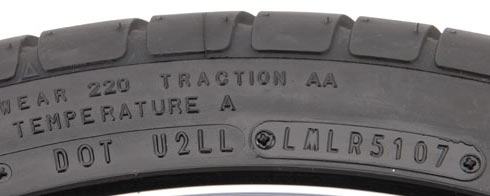 In the example above:
DOT U2LL LMLR 5107
51 Manufactured during the 51st week of the year 07 Manufactured during 2007
While the entire Tire Identification Number is required to be branded onto one sidewall of every tire, current regulations also require that DOT and the first digits of the Tire Identification Number must also be branded onto the opposite sidewall. Therefore, it is possible to see a Tire Identification Number that appears incomplete and requires looking at the tire’s other sidewall to find the entire Tire Identification Number
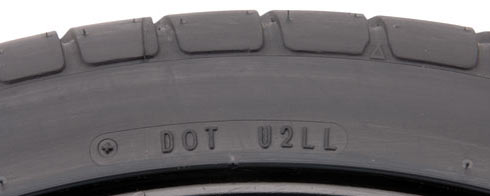 The use of a partial Tire Identification Number on the one sidewall (shown above) reduces the risk of injury to the mold technician that would have to install the weekly date code on the top sidewall portion of a hot tire mold.
Tires Manufactured Before 2000
The Tire Identification Number for tires produced prior to 2000 was based on the assumption that tires would not be in service for ten years. While they were required to provided the same information as today’s tires, the week and year the tire was produced was contained in the last three digits. The 2 digits used to identify the week a tire was manufactured immediately preceded a single digit used to identify the year.
Example of a tire manufactured before 2000 with the earlier Tire Identification Number format:
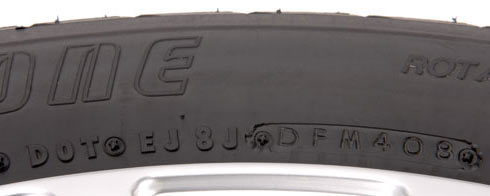 In the example above:
DOT EJ8J DFM 408
40 Manufactured during the 40th week of the year 8 Manufactured during the 8th year of the decade
While the previous Tire Identification Number format identified that a tire was built in the 8th year of a decade, there was no universal identifier that confirmed which decade (tires produced in the 1990s may have a small triangle following the Tire Identification Number to identify the decade).
And finally, hold on to your sales receipt. Most tire manufacturer's warranties cover their tires for four years from the date of purchase or five years from the week the tires were manufactured. So if you purchase new tires that were manufactured exactly two years ago they will be covered for a total of six years (four years from the date of purchase) as long as you have your receipt. If you lose your receipt, your tires' warranty coverage will end five years from the week the tire was produced (resulting in the tire manufacturer's warranty coverage ending only three years from the date of purchase in this example).
Hope this helps.
stetzie

Thread
Thread Starter
Forum
Replies
Last Post
1320dragmonza
Tech Editor's Desk
4
Aug 17, 2013 04:44 PM


