


Different castings on C heads


Thread Starter
Moderator
Joined: Sep 2006
Posts: 14,244
From: Medford, Oregon
Different castings on C heads
I have a question about C heads. I've seen them with both small oval holes for the heat crossover and large rectangle holes like other heads. Anybody know why the factory cast some with the small ones and large rectangle on all the other heads? John
P1010089-2.jpg
P1010089-2.jpg

Old(s) Fart
Joined: Mar 2007
Posts: 50,539
From: Northern VA


Thread Starter
Moderator
Joined: Sep 2006
Posts: 14,244
From: Medford, Oregon
The small crossovers are C's that came off a 1968 Toro engine. I have seen at least one other set that I pulled a set off a 1967 425 engine. They only have a large C in the casting, is the Ca like the Ga and Ka heads with a small capitol letter down low on the right? Here's the casting letter and the casting numbers. The numbers look to be the same as well.
P1010090-2.jpg
P1010091-2.jpg
John
P1010090-2.jpg
P1010091-2.jpg
John


Registered User
Joined: Mar 2008
Posts: 4,015
Later lettered heads have the big hole so I expect the C heads with the big hole are late 60s. The C heads I have came off 67s mostly and they have the small hole. I guess the factory went to the big hole for easier removal of the sand core.

Registered User
Joined: Oct 2010
Posts: 1,213
From: Dover, Ohio
I stand corrected --- I just rechecked my C heads from the LS 400 and they do have the small holes too! Now you got me curious to check my Bs, Es, and Gs that i also have on the shelf!!
Last edited by Chesrown 67 OAI; Oct 2, 2013 at 02:46 PM.
Old(s) Fart
Joined: Mar 2007
Posts: 50,539
From: Northern VA

Registered User
Joined: Jul 2009
Posts: 5,155
From: Birmingham,Alabama
I went back and checked an earlier parts book on WAC and it has heads listed as far back as 65 with hardened seats. There is a 230991 part # for 67-69 heads with hardened seats on irrigation engines. So I guess that shows that hardened seats were used before 71. Did the hardened seat heads find their way onto passenger cars,your guess is as good as any.
Last edited by 66-3X2 442; Sep 27, 2013 at 08:16 AM.

Registered User
Joined: Jul 2009
Posts: 5,155
From: Birmingham,Alabama
 I love investigating these abnormalities found with these cars.
Last edited by 66-3X2 442; Sep 27, 2013 at 08:27 AM.
Registered User
Joined: Jul 2012
Posts: 2,990
From: Vancouver BC
X2 early C heads small heat riser late C heads large heat riser

Registered User
Joined: Sep 2013
Posts: 2,882
nothing special about the two different size heat crossover sizes....all early heads A B and early C's had small ones. so olds engineers in there infinite wisdom descided to supply more heat to the intakes in later C heads, and all heads besides the partially blocked W castings ..funny thing is all small blocks from #1 onward had the larger hole.
as far as the manual having two different part #'s for C heads i think that would be because big or small int valve..
as far as the manual having two different part #'s for C heads i think that would be because big or small int valve..

Banned
Joined: May 2013
Posts: 162
From: Columbus Nebraska
I have a pair of CA heads that have the larger hole. All my other C heads have the small hole. I did notice that on the block side of the head on the left side my C's have 548 and the CA's have 48A. They look like big valve heads. I will take them to my machinist and have them checked for hardened seats tomorrow (Sat).
Is there any way of finding a year code on the C's besides the crossover hole?
Mike
Is there any way of finding a year code on the C's besides the crossover hole?
Mike
Registered User
Joined: Jul 2009
Posts: 5,155
From: Birmingham,Alabama
I have a pair of CA heads that have the larger hole. All my other C heads have the small hole. I did notice that on the block side of the head on the left side my C's have 548 and the CA's have 48A. They look like big valve heads. I will take them to my machinist and have them checked for hardened seats tomorrow (Sat).
Is there any way of finding a year code on the C's besides the crossover hole?
Mike
Is there any way of finding a year code on the C's besides the crossover hole?
Mike
See if the seats are hardened by heat or have inserts. What I mean by heat is,the pocket and the seat area itself will have a blue look like it was heat treated. This may help us with this discussion.
Thanks
Mike
Banned
Joined: May 2013
Posts: 162
From: Columbus Nebraska
Mike
He was gone on Saturday to a wedding.
Took them in today and he said they didn't have inserts.
He said that they might be heat set. I told him to clean and check to see if they were hardened.
He said the hardness would only be about 5 thousandths deep and would need to be cut to keep the hardened seats back in.
I told him just check one seat that looks bad and don't put any in.
Mike
He was gone on Saturday to a wedding.
Took them in today and he said they didn't have inserts.
He said that they might be heat set. I told him to clean and check to see if they were hardened.
He said the hardness would only be about 5 thousandths deep and would need to be cut to keep the hardened seats back in.
I told him just check one seat that looks bad and don't put any in.
Mike

Registered User
Joined: Feb 2010
Posts: 1,587
From: West Michigan
I guess I'm not too surprised to see two supposedly identical heads with a non-identical feature. The size of the crossover passage was probably considered non-critical.
In a similar vein, I have seen two different variants of the 404632 aluminum thermostat housing. The critical features are identical (location and size of the holes, etc.) but the non-critical features -- including the location of the casting number -- are different.
In a similar vein, I have seen two different variants of the 404632 aluminum thermostat housing. The critical features are identical (location and size of the holes, etc.) but the non-critical features -- including the location of the casting number -- are different.
Tastefully Hooped
Joined: Sep 2013
Posts: 131
From: SoCal
The small crossovers are C's that came off a 1968 Toro engine. I have seen at least one other set that I pulled a set off a 1967 425 engine. They only have a large C in the casting, is the Ca like the Ga and Ka heads with a small capitol letter down low on the right? Here's the casting letter and the casting numbers. The numbers look to be the same as well.
John
John
Tommy
Registered User
Joined: Oct 2010
Posts: 1,213
From: Dover, Ohio

Trying to remember member
Joined: Oct 2005
Posts: 4,112
From: Ohio

Engine Builder
Joined: Jan 2010
Posts: 552
From: Louisville, ohio
This looks to be even smaller crossover hole than the small one in the pic to start the thread.
IMG_20131002_165405_326_zps583a3161.jpg
All heads have the 548, which is last 3 numbers of the part number, cast on the bottom along with the day number of year which seems to usually be in the 200 to 299 range on all the C heads I have here. And then a 2 digit which I believe is the number for the worker who layed up the cores in the foundry.
IMG_20131002_165420_443_zpsb970516b.jpg
IMG_20131002_165424_685_zpsc44aaf96.jpg
IMG_20131002_165430_269_zps67033fed.jpg
I've found no rhyme or reason as to which cross over port shows up on which motors, 2bbl, 4bbl, Toro, or 442. And I've taken a lot of them apart. Without knowing you guys had this thread going I had text Tweed early this morning asking if there was a way to determine the year of the head. Obviously there appears not to be.
IMG_20131002_165405_326_zps583a3161.jpg
All heads have the 548, which is last 3 numbers of the part number, cast on the bottom along with the day number of year which seems to usually be in the 200 to 299 range on all the C heads I have here. And then a 2 digit which I believe is the number for the worker who layed up the cores in the foundry.
IMG_20131002_165420_443_zpsb970516b.jpg
IMG_20131002_165424_685_zpsc44aaf96.jpg
IMG_20131002_165430_269_zps67033fed.jpg
I've found no rhyme or reason as to which cross over port shows up on which motors, 2bbl, 4bbl, Toro, or 442. And I've taken a lot of them apart. Without knowing you guys had this thread going I had text Tweed early this morning asking if there was a way to determine the year of the head. Obviously there appears not to be.
Registered User
Joined: Oct 2010
Posts: 1,213
From: Dover, Ohio
This looks to be even smaller crossover hole than the small one in the pic to start the thread.
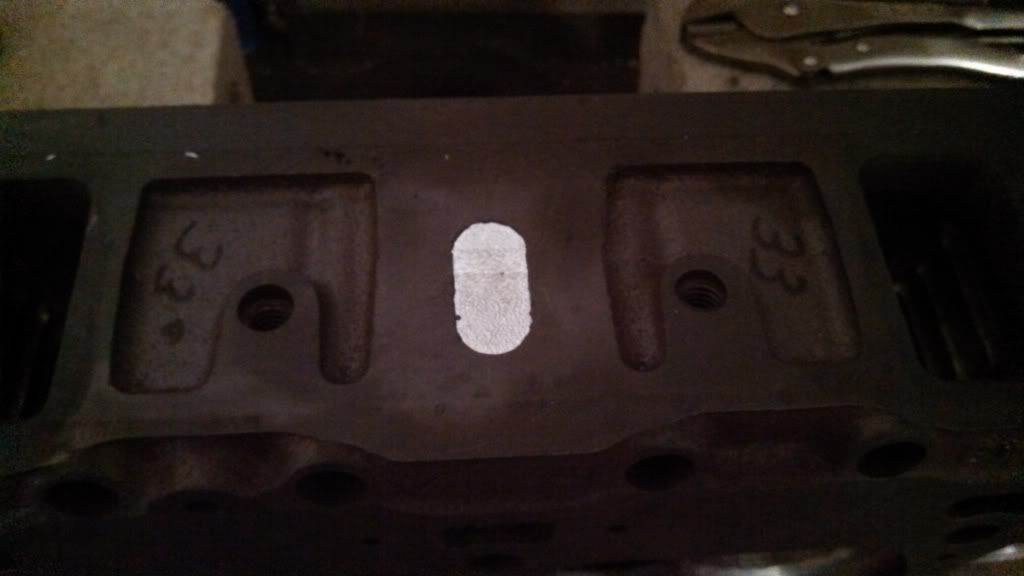
All heads have the 548, which is last 3 numbers of the part number, cast on the bottom along with the day number of year which seems to usually be in the 200 to 299 range on all the C heads I have here. And then a 2 digit which I believe is the number for the worker who layed up the cores in the foundry.
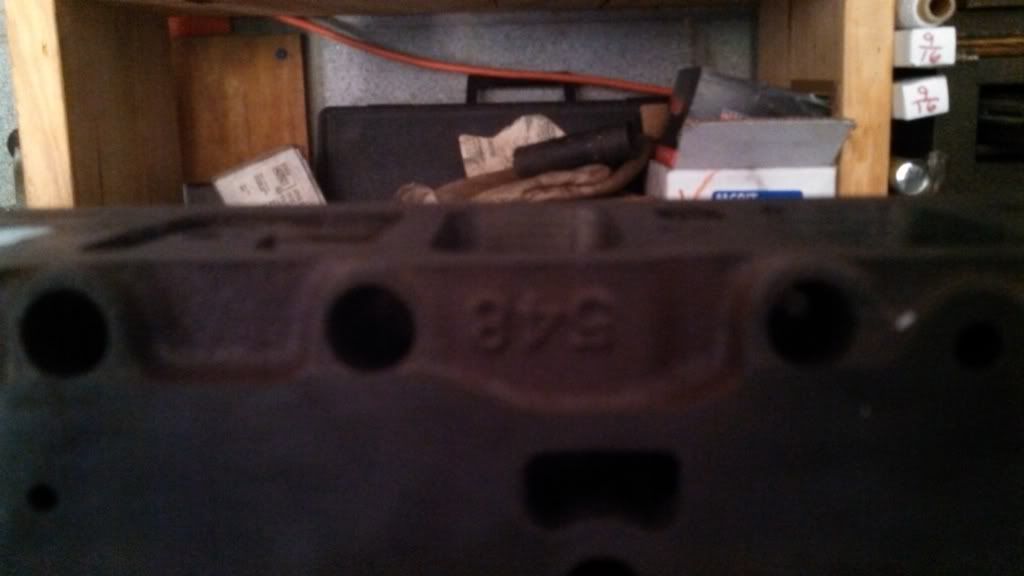
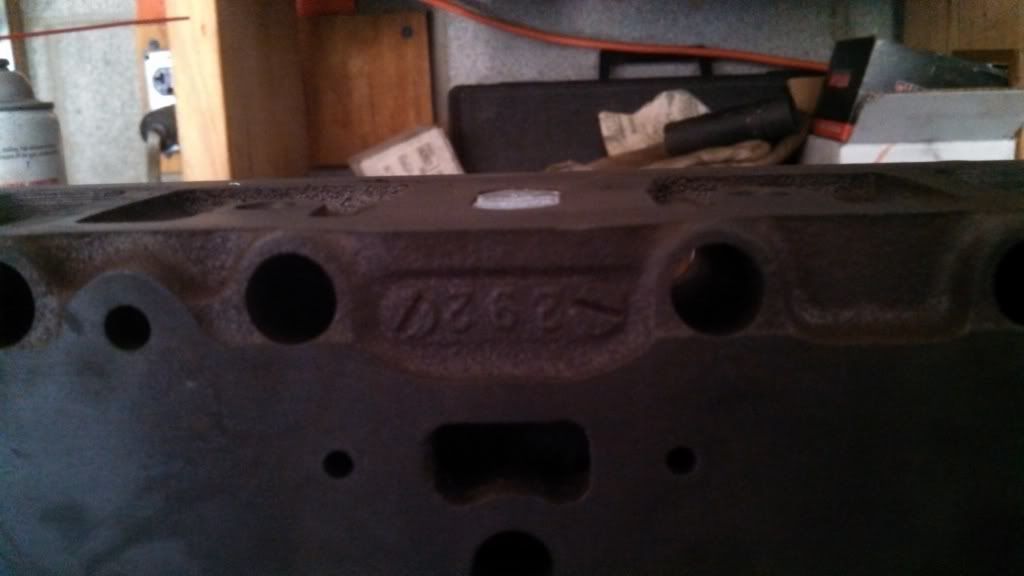
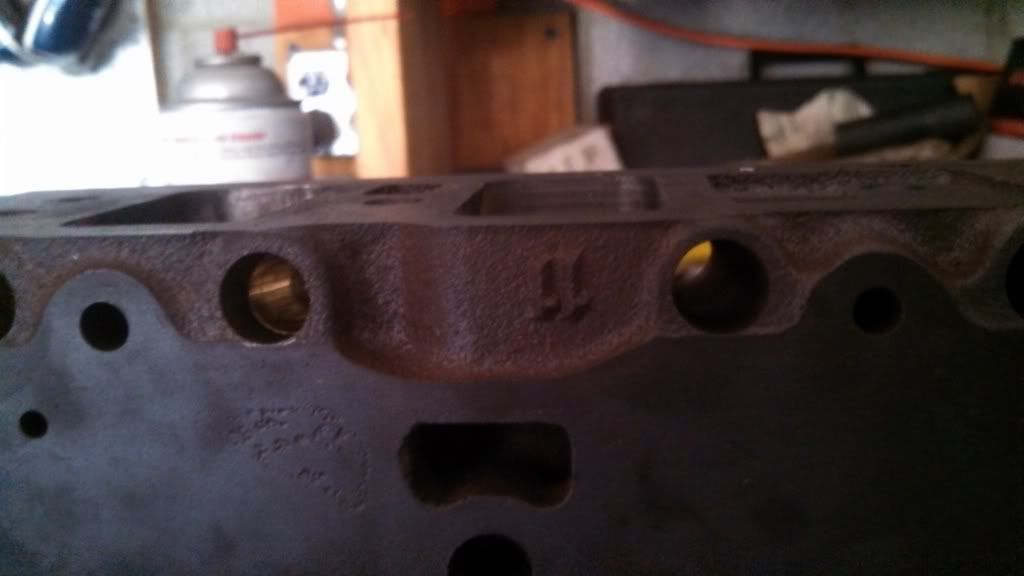
I've found no rhyme or reason as to which cross over port shows up on which motors, 2bbl, 4bbl, Toro, or 442. And I've taken a lot of them apart. Without knowing you guys had this thread going I had text Tweed early this morning asking if there was a way to determine the year of the head. Obviously there appears not to be.

All heads have the 548, which is last 3 numbers of the part number, cast on the bottom along with the day number of year which seems to usually be in the 200 to 299 range on all the C heads I have here. And then a 2 digit which I believe is the number for the worker who layed up the cores in the foundry.


I've found no rhyme or reason as to which cross over port shows up on which motors, 2bbl, 4bbl, Toro, or 442. And I've taken a lot of them apart. Without knowing you guys had this thread going I had text Tweed early this morning asking if there was a way to determine the year of the head. Obviously there appears not to be.
The whole casting number is 394548 -- its just that 394 in on one side of the port and the 548 on the other. As for julian dates? I have C heads with 2 digit dates ( 18) up to 3 digits in the mid to high 300's ( 365 days in the year). And Yes my true real 67 W-30 heads are 341 and 342 - right in the window of when the W-30s were supposed to have been machined and filled - during the first 2 or 3 weeks in December 1968. And they have the V code on the pass side head that verifies it as a 67 application!
So, do any of you know if all of the 68 and 69 G motors had head boss stamps in their application? Then there is the burning question of where did the "boatload" of C heads come from that Mondello pushed for years?
Registered User
Joined: Oct 2010
Posts: 1,213
From: Dover, Ohio
Kurt -- could CFD have used different sand molds and still use the same casting number? I always thought there was a number change of some sort involved when they started using a different mold? Such as the 11 Smitty shows in one of his pix here? IMWTK!
Tastefully Hooped
Joined: Sep 2013
Posts: 131
From: SoCal
Trying to remember member
Joined: Oct 2005
Posts: 4,112
From: Ohio
I'd like to add my guesses to make them larger was to get more heat to the manifold and/or reduce weight.
To want more heat there is not as crazy as it may sound and remember they were having to run in northern winter climates and needed the heat to some degree. This was just preceding the end of the divorced choke, so all of this may be related.
All guesses here.
But if the intakes all have the same holes (and they are all like the smaller head holes, heat to the intake would not really be a factor.
Technically, it is a "pattern" id number, not a "mold" number. (The mold is made of sand and is expended every time a casting is made). We already know as fact that the engines have pattern numbers on them. GM even inadvertently refers to it as the "mold number" in a bulletin, but it doesn't really matter what you call it, as long as you what it is and what it means.
There can even be multiple revisions to the casting and that would not necessarily change the casting number. But they do need some form of identification for the revision.
That all said, they most certainly ran more than one pattern at a time. And those *theoretically* identical patterns would carry a mold/pattern number to distinguish it from the other castings. And that number was only used for tracking if necessary. The *casting number* would be the same, because the application was the same. Simply put, it goes the same place no matter which of the multiple patterns it came from.
To keep this from being too long an answer, suffice to say there are good engineering protocols that dictate these methods of id.
Banned
Joined: May 2013
Posts: 162
From: Columbus Nebraska
Well guys I got the CA head back. It DOES NOT have hardened seats.
Both heads have a casting dates of 114 and have the large cross over.
And are large valve heads.
I put a E head right next to the CA head and the CA head cross over inside looked to have the floor down farther than the E. ? I couldn't find a 68-69 C head yet in my stash.
The CA is 3/8 of an inch tall that are in a straight line, cast in.
I have a pair of small cross over C heads that have a date of 363 and 4.
So those are a 1967 model year head.
All my intakes including after market alum. and factory L69 3x2 have the large cross overs.
Mike
Both heads have a casting dates of 114 and have the large cross over.
And are large valve heads.
I put a E head right next to the CA head and the CA head cross over inside looked to have the floor down farther than the E. ? I couldn't find a 68-69 C head yet in my stash.
The CA is 3/8 of an inch tall that are in a straight line, cast in.
I have a pair of small cross over C heads that have a date of 363 and 4.
So those are a 1967 model year head.
All my intakes including after market alum. and factory L69 3x2 have the large cross overs.
Mike
Registered User
Joined: Jul 2009
Posts: 5,155
From: Birmingham,Alabama
Well guys I got the CA head back. It DOES NOT have hardened seats.
Both heads have a casting dates of 114 and have the large cross over.
And are large valve heads.
I put a E head right next to the CA head and the CA head cross over inside looked to have the floor down farther than the E. ? I couldn't find a 68-69 C head yet in my stash.
The CA is 3/8 of an inch tall that are in a straight line, cast in.
I have a pair of small cross over C heads that have a date of 363 and 4.
So those are a 1967 model year head.
All my intakes including after market alum. and factory L69 3x2 have the large cross overs.
Mike
Both heads have a casting dates of 114 and have the large cross over.
And are large valve heads.
I put a E head right next to the CA head and the CA head cross over inside looked to have the floor down farther than the E. ? I couldn't find a 68-69 C head yet in my stash.
The CA is 3/8 of an inch tall that are in a straight line, cast in.
I have a pair of small cross over C heads that have a date of 363 and 4.
So those are a 1967 model year head.
All my intakes including after market alum. and factory L69 3x2 have the large cross overs.
Mike

Thread
Thread Starter
Forum
Replies
Last Post
2blu442
General Discussion
12
Jun 27, 2014 08:20 PM


