


30 amp A/C fan fuse

Thread Starter
Registered User
Joined: May 2010
Posts: 1,079
From: Raleigh, NC
30 amp A/C fan fuse
It has been 101 degrees the last couple of days and when running my A/C it began to cut off for no reason then come back on after 10-20 seconds and be OK for a few minutes then cut off again. I shut off the A/C until I got home and checked it. It appears the inline 30amp fuse (A/C power feed from the Horn Relay) had begun to melt! Oddly enough it has melted in such a way as to complete the circuit so the A/C is working. Now I know it's been crazy hot but is this unusual? Aside from replacing it should I suspect an overload?

Registered User
Joined: Mar 2010
Posts: 42
Usually too large a load will just blow the fuse. When I've come across a melted fuse, it's almost always been because of a loose connection in the fuse terminals, or the wire going into it. If it's not corroded or burnt, tighten it carefully and put a dab of dielectric grease on the tips of the fuse.

Just the facts...
Joined: May 2008
Posts: 1,259
From: THE GREAT WIDE-OPEN
first, i would replace the damaged wire with a wire 1 gauge thicker, ie. replace a 14 gauge with a 12 gauge wire. much of the factory wiring was "just good enough", do it "one better". retain the 30 amp fuse for the circuit.
next, check/lubricate your blower motor bushings, dry bushings will cause excessive current draw which will make the wire carry a little more current than it was originally designed for, and the fuse will not blow with a slight overload. after you replace the wire with a thicker one, you will probably notice an increase of your high blower speed, more-so after you oil the bushings. the motor bushings are surrounded by a felt "wick", lightly saturate it with a light electric motor oil.
bill
next, check/lubricate your blower motor bushings, dry bushings will cause excessive current draw which will make the wire carry a little more current than it was originally designed for, and the fuse will not blow with a slight overload. after you replace the wire with a thicker one, you will probably notice an increase of your high blower speed, more-so after you oil the bushings. the motor bushings are surrounded by a felt "wick", lightly saturate it with a light electric motor oil.
bill

Registered User
Joined: Feb 2008
Posts: 11,798
From: Plano, TX
The stock wiring for that wiring should be either 10 or 12 gauge.
I found a decent BUSS brand black fuseholder that had 12 ga wire at Auto zone. 10 would have been better but I could not find one with 10. A wateproof one would be ideal. I did seal the ends as best I could.
Be sure to solder all wire connections and insulate with heat shrink tubing.
Below (at very bottom) is my new A/C blower high-speed feed….

Near my (sliced) finger is a metal sleeve (cut from a cheap crimp terminal) that was soldered on. The other end soldered on to the wiring stub already on the car. It was insulated with two layers of heat shink tubing. Use a hot iron and rosin core solder for a solid joint.
On the air cleaner is an example of the WRONG way to do it:
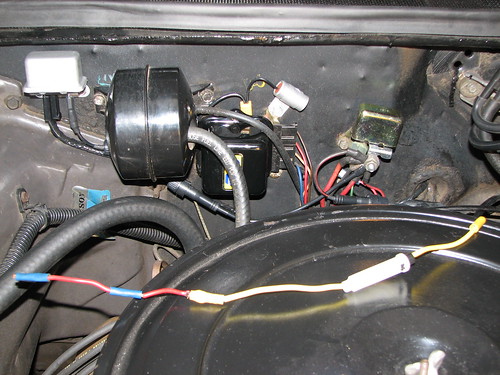
Every crimp joint was burned and discolored.
I found a decent BUSS brand black fuseholder that had 12 ga wire at Auto zone. 10 would have been better but I could not find one with 10. A wateproof one would be ideal. I did seal the ends as best I could.
Be sure to solder all wire connections and insulate with heat shrink tubing.
Below (at very bottom) is my new A/C blower high-speed feed….
Near my (sliced) finger is a metal sleeve (cut from a cheap crimp terminal) that was soldered on. The other end soldered on to the wiring stub already on the car. It was insulated with two layers of heat shink tubing. Use a hot iron and rosin core solder for a solid joint.
On the air cleaner is an example of the WRONG way to do it:
Every crimp joint was burned and discolored.
Thread Starter
Registered User
Joined: May 2010
Posts: 1,079
From: Raleigh, NC
Just got a replacement so I think I will just replace it with the correct appearing style since no other evidence of overheating is present. The part that melted is just a spot about the size of an eraser head right where the removable 'cap' is. I'll try to attach a picture but if it doesn't work it is about 2" long white plastic tube and holds a 30amp glass fuse with a molded end and a removable end. The removable end is spring loaded against the fuse inside.

Oldsdruid
Joined: Dec 2007
Posts: 10,629
From: Southside Vajenya
A beige one in place sounds like it had already been replaced. These things were almost always completely enclosed in a rubber boot with a lip seal where the halves joined together. Most of them were short 30A fuses, I think they were a time delay type. Those rubber boots are always a PITA to get apart. I've gotten to where I say screw originality in favor of function.
Thread Starter
Registered User
Joined: May 2010
Posts: 1,079
From: Raleigh, NC
I guess I assumed it was an original style because my '71 Chevelle w/ factory A/C had the same setup (except it ran along the firewall). It, too, being almost 40 years old, was probably replaced along the way also so I guess I'm not really not sure.

Registered User
Joined: Feb 2010
Posts: 1,587
From: West Michigan
The original fuse was real tiny, 3/8" long, if I remember correctly. It's usually impossible to find anyone who stocks it, but you can still order one through an electronics supply house. Bussman makes it. You'll probably have to buy a pack of 10.
Of course, if you don't have the original harness, there's no reason you'd want the original fuse. The fuse holder in the original harness is moulded, probably no more than an inch long. While it looks like it's sealed pretty good, most of them are pretty corroded inside, which explains why so many have been replaced.
I agree that if yours is melting, there must be too much corrosion (= resistance) in the holder. Replace it.
Incidentally, even when everything's working right, these 30A fuses are infamous for blowing. My personal theory is that they are most likely to blow if you leave the switch on the high-speed setting when you park the car. The next time you turn on the ignition, the blower motor sucks a HUGE spike of current as it starts up. (DC motors so this when starting from a dead stop.) You are much less likely to blow the fuse if you start the blower on a lower speed (which means there will be a resistor in series with it), then move it to the highest setting.
Of course, if you don't have the original harness, there's no reason you'd want the original fuse. The fuse holder in the original harness is moulded, probably no more than an inch long. While it looks like it's sealed pretty good, most of them are pretty corroded inside, which explains why so many have been replaced.
I agree that if yours is melting, there must be too much corrosion (= resistance) in the holder. Replace it.
Incidentally, even when everything's working right, these 30A fuses are infamous for blowing. My personal theory is that they are most likely to blow if you leave the switch on the high-speed setting when you park the car. The next time you turn on the ignition, the blower motor sucks a HUGE spike of current as it starts up. (DC motors so this when starting from a dead stop.) You are much less likely to blow the fuse if you start the blower on a lower speed (which means there will be a resistor in series with it), then move it to the highest setting.
Registered User
Joined: Feb 2008
Posts: 11,798
From: Plano, TX
Well if the fuses were that short and special, then I can see why so many holders were replaced, since the fuses were so hard to find!
Blackgold, i agree with your theory - do not start the car with fan on high. (It will also give you more cranking power.) Motors in need of lube will cause even more current draw as mentioned already.
I need to research to see if these are supposed to be delay fuses - that would make a big difference on reliability...
Blackgold, i agree with your theory - do not start the car with fan on high. (It will also give you more cranking power.) Motors in need of lube will cause even more current draw as mentioned already.
I need to research to see if these are supposed to be delay fuses - that would make a big difference on reliability...
Oldsdruid
Joined: Dec 2007
Posts: 10,629
From: Southside Vajenya
Mike, fix yours the way Rob has his and you'll be good to go. I never understood the reasoning behind the short rubber fuse holder. If it was to seal it up and prevent corrosion, as Brian pointed out it didn't. That's why I don't even fool with them anymore if it goes bad. Replace it with a good inline holder and be done with the problem.
Pontiac had a dealer fix on these things in the 60s that incorporated TWO inline fuse holders in parallel. Pontiac's A/C compressor clutches back then were powered directly off the alternator and used a relay to avoid having all the clutch hold-in current going thru the control head. They also had an A/C clutch cut-out in the ignition switch to shut off the clutch load during engine cranking- guess they figured Pontiac owners didn't want to be bothered shutting off the A/C when the car was off.
Their original design also used a single short rubber fuse holder and the vast majority got "fixed" pretty quick after the first couple times that fuse blew.
You would not believe some of the "ingenuity" I've seen on mid 60s Pontiac A/C wiring. I think the best was the 4-gage ground wire from the compressor clutch to the car frame when we redid my buddy's 64 GP underhood. I think someone had cut a piece off a cheap set of jumper cables, because there were no terminals on either end- the clutch end was twisted into the existing 12-gage ground with a wire nut, and the frame end was just clamped under a bolt and washer.
We did a proper fix on it with 2 new fuse holders at the alternator, and a short length of black 10 gage wire on the clutch ground connection to the compressor bracket. That and new battery cables made the grounding work right, and made the car look oh so much nicer underhood.
We got into some underdash work on that GP too, where someone had buggered an aftermarket power antenna into it and in the process disabled the reverb.
Restoring wiring has always been one of my favorite parts of old car work. I keep a plastic box full of uninsulated splices and shrink wrap, factory style terminals and insulators, and assorted wire colors/gages that duplicate GM wire color coding.
Pontiac had a dealer fix on these things in the 60s that incorporated TWO inline fuse holders in parallel. Pontiac's A/C compressor clutches back then were powered directly off the alternator and used a relay to avoid having all the clutch hold-in current going thru the control head. They also had an A/C clutch cut-out in the ignition switch to shut off the clutch load during engine cranking- guess they figured Pontiac owners didn't want to be bothered shutting off the A/C when the car was off.
Their original design also used a single short rubber fuse holder and the vast majority got "fixed" pretty quick after the first couple times that fuse blew.
You would not believe some of the "ingenuity" I've seen on mid 60s Pontiac A/C wiring. I think the best was the 4-gage ground wire from the compressor clutch to the car frame when we redid my buddy's 64 GP underhood. I think someone had cut a piece off a cheap set of jumper cables, because there were no terminals on either end- the clutch end was twisted into the existing 12-gage ground with a wire nut, and the frame end was just clamped under a bolt and washer.
We did a proper fix on it with 2 new fuse holders at the alternator, and a short length of black 10 gage wire on the clutch ground connection to the compressor bracket. That and new battery cables made the grounding work right, and made the car look oh so much nicer underhood.
We got into some underdash work on that GP too, where someone had buggered an aftermarket power antenna into it and in the process disabled the reverb.
Restoring wiring has always been one of my favorite parts of old car work. I keep a plastic box full of uninsulated splices and shrink wrap, factory style terminals and insulators, and assorted wire colors/gages that duplicate GM wire color coding.
Registered User
Joined: Feb 2008
Posts: 11,798
From: Plano, TX
Interesting wiring hacking tales you gave - I can understand the reasons behind many car fires. Mine was almost one of them a few years back thanks to some numbnut's mis-hacks!
Thread Starter
Registered User
Joined: May 2010
Posts: 1,079
From: Raleigh, NC
Thanks for everybody's input. I replaced the section today and once I unwrapped the old one it was clear someone had installed that section sometime along. Anyway I crimped/soldered/heatshrunk all my connections and taped it up to 'match' the original harness wrap and I'm 'good to go'. Incidently, I inspected the wire all the way back to the 'pigtail' that plugs into the relay behind the booster and there was no evidence of melting/overloading so I think it was just a tired fuse holder. Also I always make it a practice to shut everything off before turning off and/or starting any vehicle. More people should be aware of this. Thanks again for the help!

Registered User
Joined: Jan 2009
Posts: 4,086
From: Too close to Toronto!!
One other thing you might consider is using those plug in cct breakers that fit into the fuse panel...they have el shaped metal legs...the earlier ones have metal cases and the later ones have diamond shaped plastic housings...I use one size lower than what I am replacing...a 25 amp breaker in place of a 30 amp fuse...try that...
Registered User
Joined: Feb 2010
Posts: 1,587
From: West Michigan
Yes, I believe it's in the Chassis Service Manual that I've seen this fuse described as "slow-blow". (Might be the owner's manual) Unfortunately, the fuses I said are still available are not slo-blo. However, the big surge only happens as I described, so if you blower motor bearings are in good shape, and you remember not to leave it on high, I doubt you'll have a problem.

Thread
Thread Starter
Forum
Replies
Last Post
Oldscutty72
Electrical
7
Dec 28, 2015 01:56 PM


