When you click on links to various merchants on this site and make a purchase, this can result in this site earning a commission. Affiliate programs and affiliations include, but are not limited to, the eBay Partner Network.
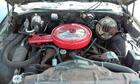
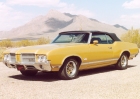
I’ve acquired a 1972 Cutlass Supreme Convertible that appears to have been made into a 442\w-30 Clone and I’m working on identifying the engine\transmission on it. Car runs, drives, and looks great and impresses me with the power and torque. I believe that the original engine and transmission were replaced around 1982 with an Oldsmobile 403 & Muncie 4 speed transmission according to a receipt found in the paperwork. It appears to have big block heads on it as well from the casting marks. Was this a common practice back n the day? I’m assuming it was built for speed and performance?
557265 is a 1977-79 403 short block. The B heads are 1966 big block. What you don't know without opening up the motor is what (if anything) was done to raise compression given the 80+ cc chambers in those heads. Hopefully that intake was port-matched to the larger ports in the BBO heads, but again, you have no way of knowing without taking the motor apart. Given the mix-and-match pieces, the motor has obviously been apart before.
557265 is a 1977-79 403 short block. The B heads are 1966 big block. What you don't know without opening up the motor is what (if anything) was done to raise compression given the 80+ cc chambers in those heads. Hopefully that intake was port-matched to the larger ports in the BBO heads, but again, you have no way of knowing without taking the motor apart. Given the mix-and-match pieces, the motor has obviously been apart before.
Thank you for your response! The way it starts and runs, I’ll assume it was built correctly. The receipt is from a reputable machine shop that ended up becoming a School (Samtech.edu) in Houston, so I may stop by there and see if they have any history on it.
The transmission case is a 1970 and is coded as an M20. "P0K24A"
You would have to clear some more goo away to see if it's stamped with a VIN. Either way it's not the original trans for the car, though it could be an original 4spd car.
Car runs, drives, and looks great and impresses me with the power and torque.
I’m assuming it was built for speed and performance?
That's what matters and I would say yes with regards to the mods that were done. The knock on 403s for the high performance minded is the heads and the siamesed blocks. Looks like someone tried to address part of the concern.
Olds 403s are better than most believe but they are best left to range in the stockish power production area as is. With true dual exhaust they are close to a 1974 455s power output. A gentleman on Curbsides blog, did exactly that to his and tuned it accordingly and saw 185 hp to the wheels on an actual dyno. May not seem overly impressive but thats its stock flywheel net rating. And 40 hp more than the first 403 442 showed in its original road test. Still a far cry from a 1972 W30, which shows around 265 rear wheel hp when new. Figure you may be somewhere in-between.
Thank you for your response! The way it starts and runs, I’ll assume it was built correctly. The receipt is from a reputable machine shop that ended up becoming a School (Samtech.edu) in Houston, so I may stop by there and see if they have any history on it.
I bet it was, and very cool that the shop is still around in one form or the other.
You can figure out how robust the engine actually is with a solid quarter mile pass or on a wheel dyno. The later of which can be used to calculate 1/4 mile capability if you don't care to race her. Oldsmobile's production high water mark is around 300 wheel hp, Joe Ps 1969 H/O showed that in the original Car Life Magazine test. My 69 350 shows around 200 wheel hp at the track.
Interesting it shows 180 hp as that was the single exhaust rating, and the dual exhaust rating with the exact same engine was 200 hp.
What about that strikes you as interesting, Kenneth? It's my understanding that as W-29 reverted to a trim and handling option for '72, the 4-4-2 package was available with the base V-8. Or is it just the fact of dual exhaust adding 20 HP, which seems perfectly plausible to me.
So the VIN engine decode shows either single exhaust or dual exhaust? I am unfamiliar with the later year VIN information. Stuff like that was on the build sheet in earlier years.
So the VIN engine decode shows either single exhaust or dual exhaust? I am unfamiliar with the later year VIN information. Stuff like that was on the build sheet in earlier years.
Yes, on the 1972 cars the VIN code for the engine was very specific, apparently due to emissions requirements. All A-body 455s were dual exhaust that year, so only the 350 motors had different letter codes for single vs dual. I find it more interesting that the engine codes didn't differentiate between AT and MT, since the cams were different.