When you click on links to various merchants on this site and make a purchase, this can result in this site earning a commission. Affiliate programs and affiliations include, but are not limited to, the eBay Partner Network.
My neighbor has a 01 Silverado, 4x4 extended cab. He has had occasional issues with the fuel pump, smack the gas tank with a rubber mallet gets the truck started. Last week, a brake line to the rear end rusted out. Since the fuel tank is full, I decided to remove the bed to make access to the fuel pump and brake lines easier.
To put it politely, this truck is a rust bucket!!! Everything I have done to this truck over the years has required a torch. He had a friend “paint” the truck a few years ago, he put cab corners and rockers on it, obviously he had the bed off as well. I say obviously because 3 of the 8 bolts holding the bed on were torched off, I snapped off 2 bolts, leaving only 3 to hold it together. Not nearly good enough! By welding nuts onto the remains of the cut bolts, and dome persuading from the smoke wrench, I got the remains of the 4 bolts out. I cut a hole in the bed floor and welded a nut in place for the remaining bolt, so that problem is solved.
My question: this truck is parked in a heated garage. It’s also a daily driver. I’m curious if the constant thawing of the snow, ice and salt gas contributed to the “tin worms” taking up residency. I base this theory on my daily drivers have never been garage kept, are older, just as much mileage, and don’t have nearly the rust issues. The daily drivers get covered in snow and ice, and remain that way until it thaws.
Are your daily drivers Chevy/GMC trucks? I'm in Michigan (we like salt too), and it has been my observation that the GM twins rust more than the other brands.
Driving the truck in the cold and parking it in a heated garage creates moisture/condensation which helps any salt on it do more damage. It would be better to leave it outside or not heat the storage area.
I agree that the salt is less reactive when it stays frozen. This is a tough battle to win. The only chance tends to be a THOROUGH rustproofing job - underside, cavities, doors, gate, backside of bumpers, everything, when brand new and then touch it up as necessary. This requires disassembling some trim, access panels, detaching wheel liners and so on. Not many are capable of, or willing to perform this work, especially on a new vehicle that might cost as much as a small house. R&I some of the vulnerable mounting bolts (bed & cab) & slather them with anti seize or bearing grease. Who the heck wants to go through something like that on a new vehicle?!? Certainly only a rare few! But if you plan to keep it long term…
Running a body shop, I would say we saw the least rocker problems on Fords, GM & MOPAR were bad! IIRC we did rockers, all 3 layers on a GM that was 7 years old, it was expensive. Ford pulls back to even on beds but only by a little. MOPAR was the leader on doors. GM rear bumpers seemed worse than others. I would put cab corners at a dead heat.
In Climates where extensive salt(ish) products are used, I’m convinced that you can play, but you can’t win, unless you go to extreme lengths very early in the truck’s life or have some luck on your side if you keep them long term.
Are your daily drivers Chevy/GMC trucks? I'm in Michigan (we like salt too), and it has been my observation that the GM twins rust more than the other brands.
My 06 Ram was a daily up until 8 years ago. One side of the truck needed repairs after collision damage, I paid to have the other side repaired (cab corner and rocker, along with some work on both wheelhouses) and painted.
My son drives a 08 avenger, my daily now is a neon. All the rust combined in my fleet doesn’t equal what’s on the Silverado. I was really shocked how crusty it is.
I agree that the salt is less reactive when it stays frozen. This is a tough battle to win. The only chance tends to be a THOROUGH rustproofing job - underside, cavities, doors, gate, backside of bumpers, everything, when brand new and then touch it up as necessary. This requires disassembling some trim, access panels, detaching wheel liners and so on. Not many are capable of, or willing to perform this work, especially on a new vehicle that might cost as much as a small house. R&I some of the vulnerable mounting bolts (bed & cab) & slather them with anti seize or bearing grease. Who the heck wants to go through something like that on a new vehicle?!? Certainly only a rare few! But if you plan to keep it long term…
Running a body shop, I would say we saw the least rocker problems on Fords, GM & MOPAR were bad! IIRC we did rockers, all 3 layers on a GM that was 7 years old, it was expensive. Ford pulls back to even on beds but only by a little. MOPAR was the leader on doors. GM rear bumpers seemed worse than others. I would put cab corners at a dead heat.
In Climates where extensive salt(ish) products are used, I’m convinced that you can play, but you can’t win, unless you go to extreme lengths very early in the truck’s life or have some luck on your side if you keep them long term.
I have lots of anti seize, anytime I remove a bolt on my cars, it gets cleaned and coated before it goes back in!!
Driving the truck in the cold and parking it in a heated garage creates moisture/condensation which helps any salt on it do more damage. It would be better to leave it outside or not heat the storage area.
I used to work in a factory that placed parts in an "oven" that heat and humidity could be controlled. The purpose was to detect corrosion under a protective paint coating. I think the temp was about 120 degrees, never asked the humidity. I asked why they did it and was told it was to detect corrosion more quickly than left out in the air.
So, I am thinking the heated garage helps the rust to occur and progress faster than if left outside in the cold.
Never put a salted frozen vehicle into a heated garage. The heat accelerates the oxidation.
Anything that lives in a humid, damp, wet, salty environment needs to be treated with a corrosion retardant such as Krown, LPS, Corrosion Free, Fluid Film, or similar...NOT ZIEBART. Tar belongs on the driveway not your undercarriage.
How can anyone take a $60-80-100K truck out into a corrosive environment without treating it. Trucks and cars are just too expensive to sacrifice. Within 5 years a vehicle will be rusted. Not through the fenders yet, but gone enough to not come back.
You will double triple its life and trade value by treating it. Brake fuel lines stay nice. No crust. My truck is worth more than I paid for it.
The Krown has preserved it. Its not 100% desert spotless but there's zero rot.
This 2011 was driven daily until 2019, in salt. 95K miles. Its my huntin haulin babe trollin feel good driving a real freeman truck truck.
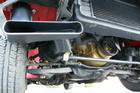
Freshly Krowned: Note the condition of all the fasteners and the Ford plastic rear well liners. Those wells go a long way of diverting the **** from the underside of the box.
Yes, I live in the Toronto area. We love salt!!! Used to live 5 hours north, in Sudbury Ont.,(hunting fishing land), my father never parked in the garage in the winter, always outside even in -40 f. We had neighbors that parked in the garage, those cars rotted out, my dad's always looked new. He worked for the hiway department and did a ton of miles each year. In the 50's they were testing rust preventative products for the government vehicles, oil 🛢 based, yearly applied products were the best. Any product that held moisture against the metal, (tar), was worst.
My brother-in-law is a big Chevy guy and farms for a living so he's had one version or another of a Chevy truck as long as I've known him. He currently has two 2500 trucks - one is gas and is for daily farm work and the other is a Dmax that he keeps clean. We rarely, if ever, see salt on the roads in NC but the rockers and cab corners on both of his trucks have been rotting away for several years now. They're both of the 2005-ish vintage. He has a friend who runs the parts department in the local Chevy dealership and he has said several times that GM had real rust problems on that vintage truck.
Never put a salted frozen vehicle into a heated garage. The heat accelerates the oxidation.
Anything that lives in a humid, damp, wet, salty environment needs to be treated with a corrosion retardant such as Krown, LPS, Corrosion Free, Fluid Film, or similar...NOT ZIEBART. Tar belongs on the driveway not your undercarriage.
How can anyone take a $60-80-100K truck out into a corrosive environment without treating it. Trucks and cars are just too expensive to sacrifice. Within 5 years a vehicle will be rusted. Not through the fenders yet, but gone enough to not come back.
You will double triple its life and trade value by treating it. Brake fuel lines stay nice. No crust. My truck is worth more than I paid for it.
The Krown has preserved it. Its not 100% desert spotless but there's zero rot.
This 2011 was driven daily until 2019, in salt. 95K miles. Its my huntin haulin babe trollin feel good driving a real freeman truck truck.
Freshly Krowned: Note the condition of all the fasteners and the Ford plastic rear well liners. Those wells go a long way of diverting the **** from the underside of the box.
One of the first things I did when I bought my truck was spray a bunch of 3M internal panel treatment. I took a few of the screws out that held the sill plates in place. Same thing with any open access holes in floor braces or body mounts.