When you click on links to various merchants on this site and make a purchase, this can result in this site earning a commission. Affiliate programs and affiliations include, but are not limited to, the eBay Partner Network.
Good lord, either you guys have some wildly inaccurate speedometers/odometers, fuel leaks, or a badly tuned engines. I can get 15mpg pretty easy with either my 81 455 powered 81 gmc, or the 69.
Before doing anything, verify the speedo is correct. You can download a speedo app on your phone, or use the mile markers on the interstate. You may find the mileage is better than you calculated.
Once the odometer is accurate, or you know how to accurately determine mileage, then you can start trying to improve it.
Fill the tank, record the current odometer reading, drive the car until it the tank is close to empty and then refill. Note how many gallons it took to fill the tank. Divide the miles driven by the gallons, that’s your current mpg.
Does your distributor have vaccum advance? Is it functional? If not, you are missing out on some economy. How is the tune on the carb? Most aftermarket carbs are calibrated pig rich, more than likely you will need to play around with the carb to get it dialed in.
wow you are getting 15 mpg ? Good for you.
im about half that.
this is why I posted the question to see where I’m at compare to others
I do have a heavily built engine
seems like the answers on mpg are all over from 6-15 mpg. Quite the spread
Well, at least you're taking it well. If my 455 could only manage 10-11 mph, I'd be pretty upset.
Or it could just be that it is tuned to my performance preference. It will smoke the tires all the way through second gear. It runs like a top and the plugs are spot on every time i check them.
Or it could just be that it is tuned to my performance preference. It will smoke the tires all the way through second gear. It runs like a top and the plugs are spot on every time i check them.
Seems like if it runs that well, you'd be able to go faster than 10-11 MPH.
Watched some videos on tuning a double pumper Holley
after setting the floats which were ok anyways I adjusted the 2 mixtures screws
the one on the passenger side was 2 turns off the other side. Adjusted both the same
Good lord, either you guys have some wildly inaccurate speedometers/odometers, fuel leaks, or a badly tuned engines. I can get 15mpg pretty easy with either my 81 455 powered 81 gmc, or the 69.
Before doing anything, verify the speedo is correct. You can download a speedo app on your phone, or use the mile markers on the interstate. You may find the mileage is better than you calculated.
Once the odometer is accurate, or you know how to accurately determine mileage, then you can start trying to improve it.
Fill the tank, record the current odometer reading, drive the car until it the tank is close to empty and then refill. Note how many gallons it took to fill the tank. Divide the miles driven by the gallons, that’s your current mpg.
Does your distributor have vaccum advance? Is it functional? If not, you are missing out on some economy. How is the tune on the carb? Most aftermarket carbs are calibrated pig rich, more than likely you will need to play around with the carb to get it dialed in.
Exactly. My 11 second car will get 12-13 if driven extremely conservatively. The stockish big block would get 15 on the highway with 3.50 gears and no OD.
If you guys are actually getting 7-8 mpg, I'd say your tune is so far out that your definitely leaving power on the table.
Exactly. My 11 second car will get 12-13 if driven extremely conservatively. The stockish big block would get 15 on the highway with 3.50 gears and no OD.
If you guys are actually getting 7-8 mpg, I'd say your tune is so far out that you’re definitely leaving power on the table.
keep in mind this is not a stock 455
this engine is built
My '70 442 had a low compression '72 455 installed and a mild 214/225 cam with Turbo 400 and 3.23 rear gears and stock size tires. The exhaust system was stock type duals with W and Z manifolds.
Rochester 4bbl. It got around 14 on the highway and 11-12 around town. I could use 87 octane if driven easily.
Start over from Square 1. Get the base timing set with no vacuum advance. Back the idle set screw out until the screw doesn't have any effect on position. Turn all idle mixture screws in until they bottom out, then back them out 1 1/2 turns. Adjust idle mixture to achieve highest vacuum with a gauge. Adjust idle speed. Finally, set total advance, and it should be a good baseline to start working on part throttle response. An AFR gauge will help a bunch there, however Holley told me not to use it for idle adjustments.
At the risk of being insensitive, you’re retarded!
By about at least 15* for starters. Many HEI users are 18-22* advanced at idle (base, no vac) and 34-36* all in mechanical (base + mech, no vac). Will your engine accept that timing? Only one way to find out. Hot starts and pre ignition will be indicators if it is unhappy.
Leave the vac adv plugged until all the other timing is straightened out. Start at 10* btdc at idle, have a friend help you graph the mech advance curve in increments, 500 rpm steps are ok though I like 200. One of you work the light, the other controls engine rpm and holds it steady while you read & record it while communicating in very loud voices. Do it in steps until the advance no longer increases. For basic safety, the guy with the light should stay out of the line of the fan in case something fails, however unlikely that is.
Now you will know your basic numbers & it will indicate what, if anything, you need to do. I’m looking for any advance graphs that I have & will post. At the moment I only have basics of what I run on the blue car. A “regular” HEI may not be able to match these simple specs, the advance mechanisms are different, mine is a REALLY adjustable setup that is no longer even available.
Those numbers are not a map, my advance maps for different cars are written on scraps of paper & tape, stuck on work bench & tool box, I’ll post some tomorrow if no one posts some in the meantime. Here’s some meat to chew, fwiw, I usually use curves like the 2 bottom graphs, mostly the last one (bottom right) even on grocery getters. I like it all in early as long as the engine likes it.
The other way you can do the basics of getting timing in line is to time the engine to 36* (no vac) at the rpm that mechanical advance has stopped advancing. You can figure that out “now” or after mapping the advance. That puts your total timing (base + mech, no vac) where it ultimately should be, you can now see where your base timing ends up to achieve that total, the difference is the amount of mechanical advance. If the engine responds positively you can quit at this point, or you can optimize the curve to get the mech advance in early (by 3000 if not lower) & potentially a quicker rate, which will require available kits to adjust it. There are loads of threads & articles on this subject, lean towards HEI focused articles for details & numbers, they’re different from points distributors in numbers, though the same exact principles.
After all that is done, then deal with adding vacuum and deciding whether to allow vac at idle (manifold vac) or only off idle (ported vac). FWIW, I usually use ported vac but do find some engines that are well served on manifold vac.
There are adjustable vacuum advance kits available if your distributor is orig GM or not equipped that way.
I hope this isn’t too garbled, I’m just spewing stream of thought. There’s a lot to it but not necessarily needing to be complicated.
At the risk of being insensitive, you’re retarded!
By about at least 15* for starters. Many HEI users are 18-22* advanced at idle (base, no vac) and 34-36* all in mechanical (base + mech, no vac). Will your engine accept that timing? Only one way to find out. Hot starts and pre ignition will be indicators if it is unhappy.
Leave the vac adv plugged until all the other timing is straightened out. Start at 10* btdc at idle, have a friend help you graph the mech advance curve in increments, 500 rpm steps are ok though I like 200. One of you work the light, the other controls engine rpm and holds it steady while you read & record it while communicating in very loud voices. Do it in steps until the advance no longer increases. For basic safety, the guy with the light should stay out of the line of the fan in case something fails, however unlikely that is.
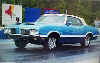
Now you will know your basic numbers & it will indicate what, if anything, you need to do. I’m looking for any advance graphs that I have & will post. At the moment I only have basics of what I run on the blue car. A “regular” HEI may not be able to match these simple specs, the advance mechanisms are different, mine is a REALLY adjustable setup that is no longer even available.
Those numbers are not a map, my advance maps for different cars are written on scraps of paper & tape, stuck on work bench & tool box, I’ll post some tomorrow if no one posts some in the meantime.
The other way you can do this is to time the engine to 36* (no vac) at the rpm that mechanical advance has stopped advancing. You can figure that out “now” or after mapping the advance. That puts your total timing (base + mech, no vac) where it should be, you can now see where your base timing ends up to achieve that total. If the engine responds positively you can quit at this point, or you can optimize the curve to get the mech advance in early (by 3000 if not lower), which will require available kits to adjust it. There are loads of threads & articles on this subject, lean towards HEI focused articles for details & numbers, they’re different from points distributors in numbers, though the same exact principles.
After all that is done, then deal with adding vacuum and deciding whether to allow vac at idle (manifold vac) or only off idle (ported vac). There are adjustable vacuum advance kits available if your distributor is orig GM or not equipped that way.
I hope this isn’t too garbled, there’s a lot to it but not necessarily needing to be complicated.
….
Thanks for the great write up
I will try and take some of your suggestions. I’m not super familiar with all this but I think I will try to advance timing a bit
I don’t want to damage anything either
all spark plugs looked good and gapped to .30. -.35
when I got the car the vaccum to Hei was plugged
I ran a new line and plugged it in
Idles much better
Check back in my post, I’ve been adjusting it! If there is nothing “wrong” other than timing just being out of whack, you will notice a very positive change. As I think I said, do some searching for good articles on all this, many can write far better than I can!
I filled it to 65 litres so I’m assuming it had 4/5 litres left in tank so 70 litre tank
I’m in Canada so everything is in litres but I have a auto meter guage set up so those are in
miles
Now that’s all city drinving
City driving, I’d consider that typical.
Is the speedometer accurate? If do, fill it up, note the mileage. Drive the car, refill the tank noting both the mileage and the gallons used. Divide miles by gallons, that’s your average.
I have owned lots of 455 powered G body’s, the last one had a 2004r and 3.73 gears, it would get 15mpg pretty easily. I’m sure the Q-Jet, overdrive and lockup converter had a lot to do with that.
Before getting too worked up, see what it actually gets on the highway. Is the vacuum advance functional? How is the tune? Once you have that information, you can start playing around with things and see if you can improve the numbers. Just take detailed notes, and don’t change too many things at once.
Are you comparing an old tech V8 to a newer EFI’d V8?
Sorry Cutlassefi I just came across this thread again and your post.
Yes, I was comparing it to cold starts on a 2004 LS1 GTO, 350 CID port fuel injection. (My memory was telling me it was a Challenger but the fog eventually cleared...)
So while it is newer it is also quite old. But it's what I came across years back that fit the bill because of engine size and the fact that the cars own computer provides the idle consumption information. I don't want to take away from 79cut's thread so may open a new one and post GTO owners findings from 2005. But here is just one for good measure.
"Dec 15, 2005
#5
My '04 GTO's mileage gague switchs from miles/gallon to gallons per hour at idle or very very low speeds. LS1 engine. Reads 0.7-0.8 gallons/hour when warm. Reads about 1.1gal/hour when you first start it up on a cold day." 73k5blazer
Sorry to digress 79cut. "thats 8.3 mpg pretty bad"
As I mentioned previously your mileage is within the range... A lot goes into mpg readings, as mentioned by fellow members. If my 69 takes 1 hour to travel 15 miles in brutal traffic (yes It's happened many a time). She's eating more than double the fuel it would use to travel 15 miles at 60 mph on a wide open highway (have done that as well many times). I've seen 15 mpg in Jersey back and forth to the race tracks. And I've seen as bad as 8.62 in stand still traffic over several days (i keep a diary). Decent city traffic combined around 12.5. At the same time I can idle away 2 gallons between fill-ups (12, 5 minute warm-ups). Depending on how often I use her. Also if I get on her obviously fuel consumption is going to be horrendous. When going to the track she is babied. Trying to keep rpm around 2000. I don't want the car spent by the time I get there. Of course your engine is bigger, stronger, worked, and hungrier... Another thing to keep in mind is full is not always the same. My 69 can vary 1 gallon + from when the pump handle pop stops. That can be from barely on the ridges in the fill tube to above the ridges in the fill tube.
And my Olds, apples to oranges I know but they both guzzle. According to the notes I have between my last 3 fill-ups I went 101 miles and saw 12.6 mpg and then 157 miles and saw 10.09 mpg. All 3 fill-ups were to same location in fill tube. Old school 4bbl V8s eat gas, muscle era 350s and up are not about economy....
And my Olds, apples to oranges I know but they both guzzle. According to the notes I have between my last 3 fill-ups I went 101 miles and saw 12.6 mpg and then 157 miles and saw 10.09 mpg. All 3 fill-ups were to same location in fill tube. Old school 4bbl V8s eat gas, muscle era 350s and up are not about economy....
I have never done done a test on idle but I’ll take your word from it
mind you I just got the car and really it’s idled more than I have driven it trying to get it to where I want it
I just have to confirm timing and if that’s ok it is what it is
but these things do very from different cars different engines I guess seing the posts done get 8 done get 15 mpg
I know everything has been modified on my engine rebuilt from a shop 12 years ago
I have a '66 98 convertible with 425/455 and a '66 Stafire with a '70 455. Both cars have HEI's, both have 800cfm qjets and are fairly stock engines with fairly stock cams. I pay attention to maintenance like you'd expect - oil, plugs, cap & rotor, clean carbs, etc... Both of my cars have 3.23:1 rear ends and TH-400's. Not hot rods, but a little off the line snap. Both cars have 15" wheels. The 98 is 15x7, the Starfire is 15x8 - the 98's skirts being the limiting wheel width factor. I think the 98 has 275 series (taller) tires and the Starfire has 245 series (shorter) tires. Both ride nicely.
What little I know:
My mathematician Dad calculated a great many things. In the 80's, as a teenager, I asked him "Dad what kind of MPG does the 98 convertible get?" He said "That's one number I've never calculated". His gentle way of saying I might not want to know.
40 years later with many Oldsmobile big block miles under my belt (for arguments sake let's say 200,000 or so). I can report a couple of things
1) Around town mileage from 8-11 is normal, if the carb is clean, the carb mixture is right across idle/midrange/WOT and if the distributor/wires/plugs are in good shape.
2) On the freeway at 65mph I've seen 14.5-15mpg at 55-70 mph consistent for a few hours
3) Open up the back barrels of the qjet and all bets are off. Around town you can push the mpg to 6 and on the freeway to 11-12 easy just by putting your foot in it.
Personally, I don't keep a big block Olds to keep tabs on mpg. It won't ever be good by modern standards. Ever. But they sure are fun to drive. Especially when you put your foot in it with 3.23 gears!
While I agree a 455 will NEVER get great mileage, I would think any reasonably well tuned big block with streetable gears should be able to get 13-14 plus highway mileage.
In my opinion, the people who brag the mid car passes everything but a gas station suggest the following: they have no clue how to tune a car, or no idea how to do simple math, or have a inaccurate odometer, or are leaking fuel. Or maybe a combination of all.
How much power does it really take to keep a car at highway speed? I’m guesimating 50-60 at most. How much fuel does a 455 need to make the needed power?
So I finally got my timing more advanced
I initially thought I was running a bit retarded at idle but I had 0 degrees and 20 degrees at 3-4000 rpm
bumped it up to 8 degrees advance idle and that got me 34 degrees at 3-4000 rpm
I tried going a bit more but engine didn’t like that so much. Didn’t sound right