When you click on links to various merchants on this site and make a purchase, this can result in this site earning a commission. Affiliate programs and affiliations include, but are not limited to, the eBay Partner Network.
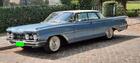
'59 394cui rocket - how much timing with manifold vacuum and engine running rough?
Hello folks, I've got 2 questions about timing and an idle problem. Let's start with the really hot iron... What do you think/know is the ideal/acceptable timing for a '59 394cui rocket with the vacuum advance canister connected to manifold vacuum? I'm a bit confused and down below I'm explaining why.
A while ago, I changed the original Rochester carb to an Edelbrock 1906 and I also installed a 1/2 inch spacer. At first, I used ported vacuum and adjusted the initial timing to 7° BTDC, then I switched to manifold vacuum because all GM cars at that time used manifold vacuum for their vacuum advance canisters. When I switched to manifold vacuum, my timing at idle jumped from 7° to 30°, so the vacuum canister pulls 23° which is a lot in my opinion. Some guys at car meetings told me that's normal for old vacuum advance canisters, they usually are more "spicy". I still have the original canister, at least I think so, it's not adjustable and it looks old. I played around with the timing while the canister was still connected to manifold vacuum and I adjusted it to 20° at idle. That means that my inital timing is -3° now and when I give it full throttle in neutral, it really takes a while to rev up because the initial timing is delayed so much, but on the street, it has really good throttle response and I need to use less throttle overall to accelerate and maintain a certain speed. The book says to adjust the timing to 5° BTDC with the vacuum advance disconnected at 850 RPM, but the book doesn't say anything about the timing with the canister being connected to manifold vacuum. Eventhough the idle was higher/the engine was more happy with 30° at idle, I adjusted the timing to 20° because I really don't want too much timing, espacially due to the fact that rocket engines have aluminum pistons and my engine is also worn. The highest compression I measured was 8,8 bars / 128psi and lowest was 7,5 bars / 109 psi. Cylinder walls have scars, some pistons have a moon-like surface and one piston is missing a small piece on the edge. At idle, the engine pulls 20 inHg and it doesn't jump up and down. So I guess the engine is still good enough.
Maybe I'm a bit too careful and ~30° was absolutely normal in the 50's? I live in Germany and I can't get any fuel that has less than 95 octane and I always give it 98 octane fuel + a lead additive. So in theory, you can get away with more timing here because the fuel in general is less prone to detonation. Down below are 2 images of a spark plug after I drove some miles with 30° at idle / 7° initial + 23° vacuum advance. The electrode looks like a bit too much timing, the carbon is burned off to the point where the electrode is connected to the thread. Or maybe that's ideal? I'm only 22 so keep in mind that it's impossible for me to have +30 years of experience. The spark plugs show no signs of detonation. Hearing detonation is a bit difficult for me because the exhaust manifolds are leaky and during acceleration it's always noisy. I don't want to leave power and fuel economy on the table but at the same time, I don't want to do harm to the rocket. A catastrophic engine failure is something that has only happened in my nightmares so far. I already got some improvement in fuel economy. 10 mpg to 11,4 mpg. That's an improvement of ~12,3%! :-D
There's also a weird problem going on with the engine and playing with the carb and timing didn't change anything. When I drive for a while and the engine is really warm, it runs rough at idle sometimes, espacially when I let off the brake and let the car roll and in neutral. It's really bad in the 500'ish range. E.g. when I'm driving in Berlin and I stop at a red light, the engine runs smooth in gear at 460 RPM, there's only a little roughness, but that engine is 66 years old and has some wear and tear, so that's OK. When the light turns green and I stop at the next red light, the engine runs rough, things are vibrating and at the next red light everything's alright again. It's always a back and forth. I adjusted the idle mixture screws to highest vacuum reading and highest and most stable idle possible. I also checked for vacuum leaks, nothing. Motor mounts are new. That car is moody like my grandpa! Maybe I closed the transfer slots too much or spark plugs have the wrong heat range? Perhaps it has something to do with the heat crossover? Or should I completely remove the idle mixture screws and let it suck as much as it wants? ;-)
Also, what do you think about the overall condition of the spark plug?
Here's more information: I adjusted the dwell to 31° and it's stable when I rev it, ignition coil, distributor cap and rotor are brand new, I replaced the wires for the ignition system, spark plug cables are also new.
I hope you can share some tips, tricks and knowledge with me! :-)
It's normal for the timing to be 30* at idle with the vacuum advance connected to manifold vacuum. First you need to set your dwell angle on the points to 30* or a .016 gap with wear pad sitting on one of the 8 high spots of the distributor cam. Then disconnect the vacuum advance and plug the hose and adjust the timing to 5* with the engine running at around 500-600 rpm. Then plug the vacuum advance back in with no further timing adjustments. When you reconnect the vacuum advance the timing will advance and the idle speed will increase. Again leave the timing alone and adjust the idle speed back down to 500-600 Rpm.
Remember vacuum advance drops out at wide open throttle (gas pedal to the floor). You need to make sure that the carb butterflys in the base plate are fully open when the gas pedal is pushed to the floor. Also that the linkage to the transmission is functioning properly with the new carb.
It's normal for the timing to be 30* at idle with the vacuum advance connected to manifold vacuum. First you need to set your dwell angle on the points to 30* or a .016 gap with wear pad sitting on one of the 8 high spots of the distributor cam. Then disconnect the vacuum advance and plug the hose and adjust the timing to 5* with the engine running at around 500-600 rpm. Then plug the vacuum advance back in with no further timing adjustments. When you reconnect the vacuum advance the timing will advance and the idle speed will increase. Again leave the timing alone and adjust the idle speed back down to 500-600 Rpm.
Remember vacuum advance drops out at wide open throttle (gas pedal to the floor). You need to make sure that the carb butterflys in the base plate are fully open when the gas pedal is pushed to the floor. Also that the linkage to the transmission is functioning properly with the new carb.
Dwell is perfect and the butterflys are fully opening but the transmission is shifting a bit later than before. Also, the shift from first to second gear is really quick and quite rough, but maybe that's due to wear and tear. So far, I have compensated that by letting off the gas at 10mph-15mph because then it shifts and shifts super smooth. All the other gears shift smooth as well and I don't need to get off the gas. I think I'll give it a try and adjust the linkage. Is just need to figure out in which way I need to turn that nut-thing on the linkage.
Dwell is perfect and the butterflys are fully opening but the transmission is shifting a bit later than before. Also, the shift from first to second gear is really quick and quite rough, but maybe that's due to wear and tear. So far, I have compensated that by letting off the gas at 10mph-15mph because then it shifts and shifts super smooth. All the other gears shift smooth as well and I don't need to get off the gas. I think I'll give it a try and adjust the linkage. Is just need to figure out in which way I need to turn that nut-thing on the linkage.
Thanks for responding.
What you need to do is toss that Edelbrock carb in the trash can.
Then re-install the Rochester and all the correct trans to throttle linkage.
A mis matched or mis adjusted trans linkage can lead to transmission failure.
What you need to do is toss that Edelbrock carb in the trash can.
Then re-install the Rochester and all the correct trans to throttle linkage.
A mis matched or mis adjusted trans linkage can lead to transmission failure.
I'll keep the Edelbrock on there. I had a lot of issues with the old Rochester, rebuilding didn't help and I'm more happy with the Edelbrock. The Rochester is sitting in a shelf and that's the best place for it for me. I don't see how my mis adjusted linkage can lead to a transmission failure but I'll do some research about it.
If you insist on using the Edelbrock, then you must "engineer" the linkage so that the throttle arm on the side of the trans is all the way to the rear (against the internal stop).
when at wide open throttle.
And that the arm is all the way forward when at warm idle.
These automatic transmissions get their information on when to shift from three sources.
The engine speed from the front pump.
The road speed from the governor.
And the throttle position from the throttle linkage.
If the trans doesn't shift at the proper time, it causes excessive wear on the clutches.
Last edited by Charlie Jones; May 7, 2025 at 06:36 AM.
If you insist on using the Edelbrock, then you must "engineer" the linkage so that the throttle arm on the side of the trans is all the way to the rear (against the internal stop).
when at wide open throttle.
And that the arm is all the way forward when at warm idle.
These automatic transmissions get their information on when to shift from three sources.
The engine speed from the front pump.
The road speed from the governor.
And the throttle position from the throttle linkage.
If the trans doesn't shift at the proper time, it causes excessive wear on the clutches.
Where's the governor for the road speed located? My speedometer is completely off and maybe that plays a role as well for the hydramatic. Everything's accurate until 35 mph and when the orange pointer comes up, the speedometer goes nuts. E.g. at 50 mph my speedometer shows 75 mph and at 60 mph it shows 85 mph. Also, the odometer counts as fast as the speedometer shows the speed, so it's counting really fast.
Alright, I'll check everything as soon as I can and try to make adjustments.
The governor is in the rear of the trans, in the tail housing.
It is driven off the output shaft.
The speedometer system is completely separate from the transmission governor.
Although they are driven off the same shaft.
Olds (and Pontiac) rear axle center sections will all interchange from 1959 thru 1964.
You should check the ratio of the rear axle, and make sure that it is correct for the specified ratio offered in that model.
It's possible that someone has swapped rear axle centers for a different ratio. In the last 66 years.
The governor is in the rear of the trans, in the tail housing.
It is driven off the output shaft.
The speedometer system is completely separate from the transmission governor.
Although they are driven off the same shaft.
Olds (and Pontiac) rear axle center sections will all interchange from 1959 thru 1964.
You should check the ratio of the rear axle, and make sure that it is correct for the specified ratio offered in that model.
It's possible that someone has swapped rear axle centers for a different ratio. In the last 66 years.
Sure, it's possible that someone swapped the diff or entire rear axle and that's because the speedometer goes nuts but I think it's unlikely. I'm going to check anyways. I think it's more likely that something's wrong with the speedometer's components because the green needle is accurate and the orange and red needles are wrong. Maybe it just needs some lubrication but I think that would be to easy to fix it... it's not that easy usually. ;-;


 '59 394cui rocket - how much timing with manifold vacuum and engine running rough?