When you click on links to various merchants on this site and make a purchase, this can result in this site earning a commission. Affiliate programs and affiliations include, but are not limited to, the eBay Partner Network.
I'm pretty sure I've ID'd the 400ci engine in my '68 442 with C heads, but am having trouble decoding the VIN number stamped on the engine block pad.
The stamped number is L9E01273 (I think the zero is a '0' and not an 'O').
From the research I've done, the last six digits of the car VIN should match the digits stamped into the engine block, but the stamped numbers don't follow that theory. The car VIN number is: 344878M156115.
So I think I have a period correct 400 ci (built in Jan. '69?) but not matching numbers as the original engine, right?
I'm pretty sure I've ID'd the 400ci engine in my '68 442 with C heads, but am having trouble decoding the VIN number stamped on the engine block pad. The number cast in the engine block next to the oil filler tube is 396026 G ?
The stamped number is L9E01273 (I think the zero is a '0' and not an 'O'). The engine serial number only has 5 digits and they don't match the VIN.
From the research I've done, the last six digits of the car VIN should match the digits stamped into the engine block, but the stamped numbers don't follow that theory. The car VIN number is: 344878M156115. Its not "theory", it was actual practice.
So I think I have a period correct 400 ci (built in Jan. '69?) but not matching numbers as the original engine, right?
Thanks for any help!
I'm pretty sure I've ID'd the 400ci engine in my '68 442 with C heads, but am having trouble decoding the VIN number stamped on the engine block pad.
The stamped number is L9E01273 (I think the zero is a '0' and not an 'O').
From the research I've done, the last six digits of the car VIN should match the digits stamped into the engine block, but the stamped numbers don't follow that theory. The car VIN number is: 344878M156115.
So I think I have a period correct 400 ci (built in Jan. '69?) but not matching numbers as the original engine, right?
Thanks for any help!
Get a picture of the number if you can. That will help shed some light on what you have.
That number is not the "correct" factory stamping procedure. I thought that number or a similar one was discussed on this site and no consensus was arrived at. Its obviously not the original engine. I sent you a PM. Yes, I am in the S.E. metro area.
Thanks Ralph! I see you're also in the Twin Cities.
Here's a pic of the engine block stamping:
This is either a rebuilt or replacement engine that was not stamped per the factory requirements. If the dealership replaced the block, they were SUPPOSED to transfer the VIN derivative stamp to the new motor. Of course, that frequently did not happen. Repair shops often used their own code that was somehow tied to warranty info. A factory VIN derivative stamp is nine characters on one line and looks like this:
..... A factory VIN derivative stamp is nine characters on one line and looks like this:
Wow..obviously no gang holder involved there. Can't imagine the logistic element of whacking EVERY production engine 9 times just to put a Vin derivative on that pad. and then repeat the process on the transmission.
Wow..obviously no gang holder involved there. Can't imagine the logistic element of whacking EVERY production engine 9 times just to put a Vin derivative on that pad. and then repeat the process on the transmission.
I'm struggling with this.
Yeah, I don't understand why this one looks so crappy. Of course, that's the first image I grabbed. Most others do look like they were gang stamped with a holder.
This is either a rebuilt or replacement engine that was not stamped per the factory requirements. If the dealership replaced the block, they were SUPPOSED to transfer the VIN derivative stamp to the new motor. Of course, that frequently did not happen. Repair shops often used their own code that was somehow tied to warranty info. A factory VIN derivative stamp is nine characters on one line and looks like this:
The M in this sequence does not look like the M in the other stampings, looks more like an upside down W.
This is either a rebuilt or replacement engine that was not stamped per the factory requirements. If the dealership replaced the block, they were SUPPOSED to transfer the VIN derivative stamp to the new motor. Of course, that frequently did not happen. Repair shops often used their own code that was somehow tied to warranty info. A factory VIN derivative stamp is nine characters on one line and looks like this:
Thanks Joe, that's the format I was looking for but seemed more like described as a service engine or dealer serial number.
I took a few more pics of the block casting numbers in case anyone can figure out if this is a correct era block for a '68 442?
I also popped off the intake manifold and valve covers since this is a 'mystery motor' and found someone's been in it since it has ARP head bolts, and the intake chambers look like they've been ported some.
There's a little carbon buildup on the valves, but overall it looks pretty good to me. It ran great with good oil pressure and I checked cold compression that ended up being around 120 psi after sitting for about a month.
This reference says "396026 G" is a 68-69 400 block.
wildaboutcarsonline.com/cgi-bin/pub9990262549620.cgi?fullimageflag=1&imagenumber=1 &itemid=9990378649894&categoryid=9970399476565
Quote - "The stamped number is L9E01273 (I think the zero is a '0' and not an 'O')"
Stan, your engine is either a Warranty Replacement Block or an over the counter block purchased from the Parts Department of an Oldsmobile Dealership.
L=Oldsmobile Division ( C-Chevrolet L-Oldsmobile K-Cadillac B-Buick P-Pontiac)
9=1969
E=Engine
01273= Plant Assembled Engine Sequence Number for Service Replacement or O.T.C. Blocks.
A few possible scenarios as to 'why': At some point in your 442's past, either the 'born with' engine had some serious problems while still under warranty and the Dealership replaced it or an owner of the 442 purchased the 400 CID engine and replaced it for many possible reasons - blew the original up at the track, etc.
Quote - "The stamped number is L9E01273 (I think the zero is a '0' and not an 'O')"
Stan, your engine is either a Warranty Replacement Block or an over the counter block purchased from the Parts Department of an Oldsmobile Dealership.
L=Oldsmobile Division ( C-Chevrolet L-Oldsmobile K-Cadillac B-Buick P-Pontiac)
9=1969
E=Engine
01273= Plant Assembled Engine Sequence Number for Service Replacement or O.T.C. Blocks.
A few possible scenarios as to 'why': At some point in your 442's past, either the 'born with' engine had some serious problems while still under warranty and the Dealership replaced it or an owner of the 442 purchased the 400 CID engine and replaced it for many possible reasons - blew the original up at the track, etc.
Do you have any source material that documents your decoding of that number. I've never seen that information before. Every service replacement block or engine I've ever seen has a blank pad.
Quote - "The stamped number is L9E01273 (I think the zero is a '0' and not an 'O')"
Stan, your engine is either a Warranty Replacement Block or an over the counter block purchased from the Parts Department of an Oldsmobile Dealership.
L=Oldsmobile Division ( C-Chevrolet L-Oldsmobile K-Cadillac B-Buick P-Pontiac)
9=1969
E=Engine
01273= Plant Assembled Engine Sequence Number for Service Replacement or O.T.C. Blocks.
A few possible scenarios as to 'why': At some point in your 442's past, either the 'born with' engine had some serious problems while still under warranty and the Dealership replaced it or an owner of the 442 purchased the 400 CID engine and replaced it for many possible reasons - blew the original up at the track, etc.
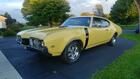
The nostalgic side of me likes that version of the story because it would make the engine at least 'period correct' and I've heard of that situation actually happening with other GM cars. The other side of me says that after 50+ years of life, it's hard to find 'untouched' cars that haven't had something done to them over the years. Like the color change to yellow that this one went through instead of the original grey with black vinyl top.
Someone's been into this engine at some point because it has ARP head bolts, and I'm going to pull the timing cover to see if I can figure out if it's an aftermarket cam as it has a little choppier idle than stock in my opinion.
The nostalgic side of me likes that version of the story because it would make the engine at least 'period correct' and I've heard of that situation actually happening with other GM cars. The other side of me says that after 50+ years of life, it's hard to find 'untouched' cars that haven't had something done to them over the years. Like the color change to yellow that this one went through instead of the original grey with black vinyl top.
Someone's been into this engine at some point because it has ARP head bolts, and I'm going to pull the timing cover to see if I can figure out if it's an aftermarket cam as it has a little choppier idle than stock in my opinion.
Thanks!
I don't think there is much doubt about your engine block being"period correct" after posting the engine block casting number. ARP head bolts are an indication they are newer and a quality replacement.
Well the mystery continues...as when cleaning up the engine today for paint I found that the car VIN number is stamped in the front of the passenger side head.
So I'm guessing the original block was blown up after being fairly new and replaced with a 1969 service block but they swapped the original heads over to it?
Here's the stamp on the head that matches the VIN exactly:
The factory never stamped a VIN derivative in that location. Whoever installed the replacement motor likely did that. The engine unit number that was stamped in that location on the head in the 1964-67 model years was NOT the VIN.
The factory never stamped a VIN derivative in that location. Whoever installed the replacement motor likely did that. The engine unit number that was stamped in that location on the head in the 1964-67 model years was NOT the VIN.
Thanks Joe. This is a 1969 engine, but it does look hand stamped so I'm guessing someone stamped that at the dealership if it was a service replacement engine. Everything else looks like it's the right engine for the car from what I can tell.