When you click on links to various merchants on this site and make a purchase, this can result in this site earning a commission. Affiliate programs and affiliations include, but are not limited to, the eBay Partner Network.
The 1966 SPECS booklet shows that the RPO N95 simulated wire wheel covers with three bar spinners were available on every A-body and B-body car that Olds built in the 1966 model year.
Here are the pics, Never cleaned them could use it,
The factory code for the wheel covers was N95, I was always interested in what effect they have on wheel balance :roluje:
I use the P02 type myself and they are made up of three parts and are quite heavy
I thought they all have the flat black paint treatment on the stainless part of the rim under the spokes. I have seen at least 3 variations of these now a 4th unless someone messed with the black paint on yours.
The top cap is a 15". The spinner sticks out significantly more than the bottom cap which is a14".
If you think the Olds or any similar wire cover of the era are heavy, they weigh 1/2 of what the Riviera SD, Vette/Impala/Monte P02s weigh. They are 8lbs. But they are balanced from the factory.
Hi Luke is this my style then the P02 Thanks for your reply john..
Here are the types of factory Oldsmobile hup caps for 1966 Here are my type P02s where I restored the chrome on the middle part.. but I sanded the original black matte base between the spokes and polished it to a shine.
Wow, Thanks you guys for all the info, pretty sure these were not messed with they look like they have never been touched, but who knows almost 60 years later, john..
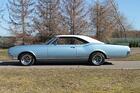
Pic of my old 66 when it was brand new (Original owner sent me pic), came with the wire hubcaps.
He told me he took them off after a couple years because they "squeaked" really really badly.
I always liked the 3 bar spinners. My 98 convertible came with the cheapest caps. I can confirm that unless you get creative about wheel width and spacing, the fake wire wheel covers won’t clear the skirts of the ‘66 98. They work great on my ‘66 Stafire, but yes, they do squeak a bit.
My wife calls them “dog killers”. Remember what happed to that poor Mustang in the Alps in Goldfinger?
These covers can be easily disassembled using a 1/4” hex head on a power screwdriver, but there are at least 2 lengths of screws which can sometimes get stuck and twist the tops off. The diecast chrome centers are secured with 4 screw and can be reused on many GM wire wheel covers like the 15” 1049B used on ‘71 Monte Carlos. That’s what I did to make my 15x8 Starfire wheels look ‘66 factory-ish.
The thing that wears out on these rather heavy hubcaps are the spring steel clips on the outer edge of the cap itself which holds them fast to the wheel. If they are loose, rusted, broken or otherwise damaged, the caps can fly off at speed with no warning. Ask me how I know… so these days I have a few spares around ready to go in case of surprise.
Most of these caps have 2 lengths of spokes which can be removed for cleaning/polishing/straightening. Once the centers are off, and the spokes are soaking in Simple Green, or you’re polishgin them with #0000 steel wool, you get curious about repainting the actual caps in flat black, or maybe a satin black per your preference. I used wide blue tape to mask off the circular edges, then just sanded and spray-bombed them.
You may also get curious about putting the caps on your buffer and really polishing them up.
To minimize the squeaks, you can tap the “ears” of the punched holes that the spokes fit into back into their punched pyramid shape to recreate holding pressure on the spokes. Looking at the cap from the back side, tap the each hole’s 4 “ears” to create pressure on the spokes. I considered using silicone sealant to glue the spokes to the caps as an anti-squeak measure, but haven’t done it yet.
Upshot is they’re heavy, can squeak, but are great for a period look. Thanks to GM, we can mix and match parts to some degree.