


Here are the dimensions of those Power Steering Pump Spacers

Thread Starter
Connoisseur d'Junque
Joined: Sep 2010
Posts: 21,183
From: The Hudson Valley
Here are the dimensions of those Power Steering Pump Spacers
So earlier today I realized that I had both spacers in my hand and a caliper on the bench, so I measured them.
This has probably been covered in another thread, but I thought I should post it clearly and explicitly.
Large spacer, goes between block and rear-projecting "wing" of pump bracket, at hole that is the frontmost of three that could hold a motor mount:
0.402" height
0.467" ID
0.816" OD
Small Spacer, goes between timing indicator and lower front hole of pump bracket, at stud that goes through the top hole of the timing indicator:
0.631" height
0.400" ID
0.563" OD
- Eric
This has probably been covered in another thread, but I thought I should post it clearly and explicitly.
Large spacer, goes between block and rear-projecting "wing" of pump bracket, at hole that is the frontmost of three that could hold a motor mount:
0.402" height
0.467" ID
0.816" OD
Small Spacer, goes between timing indicator and lower front hole of pump bracket, at stud that goes through the top hole of the timing indicator:
0.631" height
0.400" ID
0.563" OD
- Eric

Old(s) Fart
Joined: Mar 2007
Posts: 50,770
From: Northern VA
Excellent, thanks Eric.
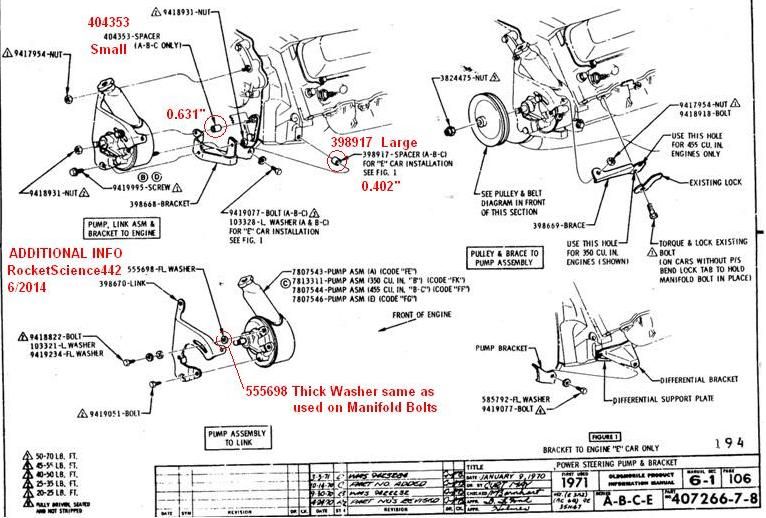
Since a picture is worth a thousand words, Eric's first spacer ("large spacer") is number 398917 on the following drawing. The second ("small spacer") is number 404353. And for those who wonder WHY Olds used spacers here, the reason is kinda shown in the drawing. The Toro differential bracket uses the same hole on the side of the block as the PS pump bracket, so for RWD cars you need spacer no. 1. The Toro front motor mount goes under the PS pump bracket at the bottom of the front cover, thus the need for spacer no. 2 on RWD cars.
There's also a little "gotcha" on 1968-70 B/C-body cars and 1973-74 Omegas. Due to the rear steer design on those cars and the forward location of the crossmember, the motor mount uses the front two of three motor mount holes on the side of the block. On those cars, spacer no. 1 is reduced in thickness by the thickness of the mounting ear on the motor mount.
wel186.jpg
Since a picture is worth a thousand words, Eric's first spacer ("large spacer") is number 398917 on the following drawing. The second ("small spacer") is number 404353. And for those who wonder WHY Olds used spacers here, the reason is kinda shown in the drawing. The Toro differential bracket uses the same hole on the side of the block as the PS pump bracket, so for RWD cars you need spacer no. 1. The Toro front motor mount goes under the PS pump bracket at the bottom of the front cover, thus the need for spacer no. 2 on RWD cars.
There's also a little "gotcha" on 1968-70 B/C-body cars and 1973-74 Omegas. Due to the rear steer design on those cars and the forward location of the crossmember, the motor mount uses the front two of three motor mount holes on the side of the block. On those cars, spacer no. 1 is reduced in thickness by the thickness of the mounting ear on the motor mount.
wel186.jpg
Registered User
Joined: May 2013
Posts: 223
From: Richardson, Texas
the thread about pulley not lining up and this previous drawing helped me figure out my PS brackets. Someone else removed the parts and I was stuck - I have the assembly manual but these drawings were not included -
THANKS JOE
THANKS JOE
Registered User
Joined: Apr 2013
Posts: 837
From: Great Lake State: SE MI
I recently installed a pump and brackets on a 455.
The most common missing part I've seen (or not seen) is the #555698 large flat washer that goes between the pump body and the bracket at the adjustment slot bolt. If you install the pump without it it will bend the bracket and the pulleys will not align properly.
Another mistake I've seen more than once is that people install a bolt where the #9419995 screw holds the two brackets together.
.
The most common missing part I've seen (or not seen) is the #555698 large flat washer that goes between the pump body and the bracket at the adjustment slot bolt. If you install the pump without it it will bend the bracket and the pulleys will not align properly.
Another mistake I've seen more than once is that people install a bolt where the #9419995 screw holds the two brackets together.
.

Registered User
Joined: Dec 2011
Posts: 7,286
THANK YOU, Doctor-chanic
Now, I wonder, why did the factory not bother to specify the ONE DAMN PIECE OF INFO on that drawing that would allow one to make such a spacer? Didn't suit their needs I guess.
Well, lo these many moons later, it DOES suit our needs. Now, any idiot can figure out what the ID should be- big enough to clear the bolt. The OD has to be small enough to serve yet big enough to work also. Large acceptable range there. Stack of washers might do the trick if need be.
In case folks are stuck sorting parts or making do with a stack of washers, I offer here for the first time ever seen, the above illustration WITH THE DAMN SPACER LENGTHS SHOWN.
You are welcome.
Share and save as you wish. Please right click and SAVE IMAGE AS on your machine so that many copies exist.
Thanks to all who contributed.
http://i19.photobucket.com/albums/b1...g?t=1403718479
14176_PSSpacers_to-11_zps6f64bc42.jpg?t=1403718479
Now, I wonder, why did the factory not bother to specify the ONE DAMN PIECE OF INFO on that drawing that would allow one to make such a spacer? Didn't suit their needs I guess.
Well, lo these many moons later, it DOES suit our needs. Now, any idiot can figure out what the ID should be- big enough to clear the bolt. The OD has to be small enough to serve yet big enough to work also. Large acceptable range there. Stack of washers might do the trick if need be.
In case folks are stuck sorting parts or making do with a stack of washers, I offer here for the first time ever seen, the above illustration WITH THE DAMN SPACER LENGTHS SHOWN.
You are welcome.
Share and save as you wish. Please right click and SAVE IMAGE AS on your machine so that many copies exist.
Thanks to all who contributed.
http://i19.photobucket.com/albums/b1...g?t=1403718479
14176_PSSpacers_to-11_zps6f64bc42.jpg?t=1403718479
Registered User
Joined: Aug 2013
Posts: 3,900
From: Central Illinois
THANK YOU, Doctor-chanic
Now, I wonder, why did the factory not bother to specify the ONE DAMN PIECE OF INFO on that drawing that would allow one to make such a spacer? Didn't suit their needs I guess.
Well, lo these many moons later, it DOES suit our needs. Now, any idiot can figure out what the ID should be- big enough to clear the bolt. The OD has to be small enough to serve yet big enough to work also. Large acceptable range there. Stack of washers might do the trick if need be.
In case folks are stuck sorting parts or making do with a stack of washers, I offer here for the first time ever seen, the above illustration WITH THE DAMN SPACER LENGTHS SHOWN.
You are welcome.
Share and save as you wish. Please right click and SAVE IMAGE AS on your machine so that many copies exist.
Thanks to all who contributed.
http://i19.photobucket.com/albums/b1...g?t=1403718479
Now, I wonder, why did the factory not bother to specify the ONE DAMN PIECE OF INFO on that drawing that would allow one to make such a spacer? Didn't suit their needs I guess.
Well, lo these many moons later, it DOES suit our needs. Now, any idiot can figure out what the ID should be- big enough to clear the bolt. The OD has to be small enough to serve yet big enough to work also. Large acceptable range there. Stack of washers might do the trick if need be.
In case folks are stuck sorting parts or making do with a stack of washers, I offer here for the first time ever seen, the above illustration WITH THE DAMN SPACER LENGTHS SHOWN.
You are welcome.
Share and save as you wish. Please right click and SAVE IMAGE AS on your machine so that many copies exist.
Thanks to all who contributed.
http://i19.photobucket.com/albums/b1...g?t=1403718479
Thread Starter
Connoisseur d'Junque
Joined: Sep 2010
Posts: 21,183
From: The Hudson Valley
The answer, of course, is that the Assembly Manual wasn't telling them how to make the parts, only which parts from which bins went where.
How to make the spacers went on a different spec. sheet to a different Division or supplier.
Considering how much information is contained in an Assembly Manual (essentially enough to construct an Oldsmobile factory), they didn't want to confuse anyone with any information that was not essential to his job.
Thanks for annotating that page - it's quite helpful.
- Eric

 . I bought some tube stock and cut my own spacers with the given dimensions!
Old(s) Fart
Joined: Mar 2007
Posts: 50,770
From: Northern VA
This info applies to EVERY 1968-1990 Olds V8 with power steering. And to avoid a follow up question, yes, "every" includes the 307s.
NOTE that the 68-70 full size cars and the 73-74 Omegas use a shorter spacer at the side of the block. This is due to the fact that those cars have the motor mounts in the forward position and the spacer needs to be thinner to account for the thickness of the motor mount. Same goes for the Toros, where the front differential bracket uses that same bolt hole.
NOTE that the 68-70 full size cars and the 73-74 Omegas use a shorter spacer at the side of the block. This is due to the fact that those cars have the motor mounts in the forward position and the spacer needs to be thinner to account for the thickness of the motor mount. Same goes for the Toros, where the front differential bracket uses that same bolt hole.




Registered User
Joined: Jun 2020
Posts: 249
From: 40 miles from Lansing
Great info, I'm a newbie, and my spacer was missing also,and was going to have to fit it by trial and error, with the dim's., much easier! going to make one for myself,(have lathe) will make a few extra's if anyone needs one, PM me.
Registered User
Joined: Nov 2011
Posts: 65
From: Northampton County, NC
I have 2 each '68 Olds 350 engines and 1 each '68 Olds 455 engine and 1 each '70 Olds 350 engine. The '68 engines had a 9/16" hex stock spacer with about 1 inch long 3/8" threads on each end. I have reproduced these spacers if anyone is interested. I am out of town and don't have my notes with me so I'm not sure of the part number.

Registered User
Joined: Dec 2022
Posts: 52
From: Scottsdale, Arizona
So earlier today I realized that I had both spacers in my hand and a caliper on the bench, so I measured them.
This has probably been covered in another thread, but I thought I should post it clearly and explicitly.
Large spacer, goes between block and rear-projecting "wing" of pump bracket, at hole that is the frontmost of three that could hold a motor mount:
0.402" height
0.467" ID
0.816" OD
Small Spacer, goes between timing indicator and lower front hole of pump bracket, at stud that goes through the top hole of the timing indicator:
0.631" height
0.400" ID
0.563" OD
- Eric
This has probably been covered in another thread, but I thought I should post it clearly and explicitly.
Large spacer, goes between block and rear-projecting "wing" of pump bracket, at hole that is the frontmost of three that could hold a motor mount:
0.402" height
0.467" ID
0.816" OD
Small Spacer, goes between timing indicator and lower front hole of pump bracket, at stud that goes through the top hole of the timing indicator:
0.631" height
0.400" ID
0.563" OD
- Eric

Registered User
Joined: Jan 2022
Posts: 112
Has anybody heard of the lower power steering bracket being bent? I am using the spacers mentioned in this thread (0.402 and 0.630) and I can’t get the lower 7/16 bolt to thread into the non-used forward “engine mount” hole on the side of the block. I tried loosening everything to no avail. Even with everything somewhat loose, the bracket seems too short to where the 7/16 bolt doesn’t even line up with a hole enough to get it to grab the first thread. The only way I can get the threads to engage is if I remove the spacer or put a washer in its place Is there a thinner spacer application?
Old(s) Fart
Joined: Mar 2007
Posts: 50,770
From: Northern VA
Has anybody heard of the lower power steering bracket being bent? I am using the spacers mentioned in this thread (0.402 and 0.630) and I can’t get the lower 7/16 bolt to thread into the non-used forward “engine mount” hole on the side of the block. I tried loosening everything to no avail. Even with everything somewhat loose, the bracket seems too short to where the 7/16 bolt doesn’t even line up with a hole enough to get it to grab the first thread. The only way I can get the threads to engage is if I remove the spacer or put a washer in its place Is there a thinner spacer application?
Registered User
Joined: Jan 2022
Posts: 112
[QUOTE=j I assume you've tried to thread the bolt into the hole by itself?[/QUOTE]
Yes, the bolt threads in fine by itself. Assuming the spacers are the right width and the bracket is not bent the only other variable would be the stud which is threaded into the top right hole of the timing pointer. Does anybody have a picture of the stud? I would like to see if I have the correct one. Am I missing anything else? In an earlier post Joe mentioned the 68 PS brackets are all the same. I don’t think I have the wrong bracket.
Yes, the bolt threads in fine by itself. Assuming the spacers are the right width and the bracket is not bent the only other variable would be the stud which is threaded into the top right hole of the timing pointer. Does anybody have a picture of the stud? I would like to see if I have the correct one. Am I missing anything else? In an earlier post Joe mentioned the 68 PS brackets are all the same. I don’t think I have the wrong bracket.
Registered User
Joined: Jan 2022
Posts: 112
Still having issues with the lower power steering pump bracket. I believe it might be bent. I tried tweaking the tabs that mount to the bolts on the front and side of the block with no luck. Any other suggestions would be appreciated. I might try to find another bracket and compare.
Last edited by Bullwinkle; Jul 12, 2024 at 10:13 AM.

Registered User
Joined: Jul 2020
Posts: 44
From: Lowell. Indiana
RWK. I have a 66 sports coupe with a 330 and AC. Do I only need the large spacer for the bottom ear of the PS Pump? I see you have two size spacers. My car has been apart for 20 years. I am making great headway since I retired. I have misplaced the spacer. Also, I will need to find a replacement 3/8 stud. How much do you want for the spacer. Thanks for your help.
John
Lowell, Indiana
John
Lowell, Indiana
Old(s) Fart
Joined: Mar 2007
Posts: 50,770
From: Northern VA
RWK. I have a 66 sports coupe with a 330 and AC. Do I only need the large spacer for the bottom ear of the PS Pump? I see you have two size spacers. My car has been apart for 20 years. I am making great headway since I retired. I have misplaced the spacer. Also, I will need to find a replacement 3/8 stud. How much do you want for the spacer. Thanks for your help.
John
Lowell, Indiana
John
Lowell, Indiana

Registered User
Joined: Jul 2020
Posts: 44
From: Lowell. Indiana
Thanks RKW…. Joe P was correct again. I did not need a spacer. Just the correct 3/8 stud and ground terminal that connects directly to the to battery provided the proper spacing for the power steering bracket ear. Thanks everyone!

Thread
Thread Starter
Forum
Replies
Last Post


