When you click on links to various merchants on this site and make a purchase, this can result in this site earning a commission. Affiliate programs and affiliations include, but are not limited to, the eBay Partner Network.
Tech Editor's DeskProjects, papers, writings, thoughts, musings of our technical editor Joe Padavano. To begin with, he will be making threads and can approve posts to it if he wishes. This can be changed in the future if it does not work out well.
I have a 1969 442 big block with air conditioning. I ordered a new mechanical fuel pump and it is much taller than the original. Which is correct for my application (taller or shorter)?
Thanks in advance!
Yeah because anything I post is incorrect.
i won’t post anymore
I have no idea what your problem is.
The OP said that RA didn't list that P/N for a 400. I said that RA is frequently incorrect. Your P/N is the correct one, and if the OP simply searches on that P/N instead of searching by application, he'll get the right part.
Chill out, dude. Not everything is about you. Unless you have an ownership position in RockAuto, this has nothing to do with you.
The OP said that RA didn't list that P/N for a 400. I said that RA is frequently incorrect. Your P/N is the correct one, and if the OP simply searches on that P/N instead of searching by application, he'll get the right part.
Chill out, dude. Not everything is about you. Unless you have an ownership position in RockAuto, this has nothing to do with you.
Just trying to help another member out by posting a part# for the guy.
There's no need to say "chill out" or "not everything is about you" for all to read
Like i said i will not post anymore
Last edited by JOHNNYOLDS442; Sep 3, 2020 at 11:13 AM.
The pumps with the taller canisters are high volume pumps. I’m not sure if there are multiple pistons, or if fuel is stored in the taller canister.
Do you have a reference for that info? Airtex says that both their short Olds pump (41567) and their tall pump (40736) are the same 40 GPH at 1800 RPM. Both are listed as 6.5 psi.
Do you have a reference for that info? Airtex says that both their short Olds pump (41567) and their tall pump (40736) are the same 40 GPH at 1800 RPM. Both are listed as 6.5 psi.
No, I don’t have any documentation, I based my reply on a verbal discussion with Airtex on the exact part numbers you mention. Way back when I was planning a fuel pump swap to fit the Edelbrock heads I called Airtex. The man I spoke to said the large canister pumps were considered high volume.
I assume there has to be a reason for the large canister. And based on personal experience, I can say the 40736 pump is enough to keep up with the fuel needs of low 12 second 66 cutlass.
No, I don’t have any documentation, I based my reply on a verbal discussion with Airtex on the exact part numbers you mention. Way back when I was planning a fuel pump swap to fit the Edelbrock heads I called Airtex. The man I spoke to said the large canister pumps were considered high volume.
I assume there has to be a reason for the large canister. And based on personal experience, I can say the 40736 pump is enough to keep up with the fuel needs of low 12 second 66 cutlass.
I agree that there should be a difference (otherwise, why have two configurations), but their published data suggests otherwise. Of course, the published data says "40 GPH min", which may just be their lazy way of using the same table for both. I'm also trying to figure out what internal differences would provide extra volume. These are diaphragm pumps, so the only way to get more volume is to either increase the stroke on the diaphragm (which is possible by changing the length of the lever arm on the diaphragm side of the rocker pivot) or by using dual diaphragms. I guess I'll have to open one up and look at it.
My other thought is maybe the larger canister is a like a storage “tank”, which I guess technically wouldn’t make it high volume as much as a reserve. I’m guessing you could fill the float bowl of a Q-Jet 2 or 3 times with the fuel contents of the canister.
Or, as you suggested, the larger pump has a longer stroke on the diaphragm. Or a combination of both? All I can say with any certainty is the 40736 pump does supply more fuel based on my experience with the 66 Olds. I was pretty impressed for a $40 pump from Advance auto
My other thought is maybe the larger canister is a like a storage “tank”, which I guess technically wouldn’t make it high volume as much as a reserve. I’m guessing you could fill the float bowl of a Q-Jet 2 or 3 times with the fuel contents of the canister.
The larger canister may help with hiccups from the tank, like a surge tank, but only the diaphragm motion fills the bowl. Now I'm really curious. I could see where the taller canister would allow for more diaphragm travel, but you can only flex that rubber so far, and the diaphragm diameter is the same in both. The other problem is that a reservoir of fuel next to the engine like that would seem to heat up, potentially causing percolation.
Ok, let’s settle this. Who has one of the large canister style pumps sitting around unused, willing to undergo a autopsy? The only one I have is currently in use on Dads 455 powered GMC truck.
Ok, let’s settle this. Who has one of the large canister style pumps sitting around unused, willing to undergo a autopsy? The only one I have is currently in use on Dads 455 powered GMC truck.
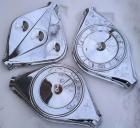
Since the pump was over 20 years old and i wasnt sure of its application, i busted her open for your review. Im not sure what i am looking at. Maybe the CO community can use this info.
Since the pump was over 20 years old and i wasnt sure of its application, i busted her open for your review. Im not sure what i am looking at. Maybe the CO community can use this info.
Unfortunately, we need a short pump to compare the diaphragm travel. I happen to have one I just replaced but it will be tomorrow before I can open it. I don't see anything obvious inside that tall cannister, however.
Originally Posted by Rocketguy
This is from the 1971 EAM:
They're calling it a "surge dome". Could it be that the larger dome aids the flow via smoothing out the surging fuel?
I was under the impression that this was the "surge dome", equivalent to the pulse damper added to the 1966 pumps.