


Oil Pump/Pressure In 215


Thread Starter
Registered User
Joined: Aug 2011
Posts: 10
Oil Pump/Pressure In 215
Hello everyone...first post of possibly many. Recently picked up a 63 F85 with an aluminum 215. I dropped at a local guy who's good with old cars. He got it running...told me that it ran well and on all 8 cylinders but had no oil pressure. He had no time to take a deeper look and I grabbed it back to poke at myself. The past owner had removed the gas tank to clean and installed an electric fuel pump to pump out of a soda bottle for the time being. My question is how does the oil pump function? My old man suggested it ran off the fuel pump? If that were the case and the fuel pump were disconnected could that be my issue? Any thoughts on the problem as well as any input on that particular engine and car would be greatly appreciated. Thanks.
Jason
Jason
'87 Delta 88 Royale
Joined: Dec 2010
Posts: 2,514
From: Margate, England
The fuel pump runs off the cam, nothing to do with the oil pump.
Over here Rover V8s (Rover made the 215 engine under licence) which you will see mostly under the hood of Range Rovers over there were notorious for oil pressure woes if regular oil changing was neglected, often needing the blocks hot tanked to shift crud from the oilways.
Be prepared to spend some time and money getting it fixed, a good site for information is "realsteel.co.uk", Rover V8s have been a hot rodding/custom car fraternities favourite for years and there are plenty of UK based tuners with lots of experience with these engines. Bear in mind in the UK it is cheaper to use smallblock Chevy and Ford motors then use our home grown 215s, lighness being the main factor when they are used.
Roger.
Over here Rover V8s (Rover made the 215 engine under licence) which you will see mostly under the hood of Range Rovers over there were notorious for oil pressure woes if regular oil changing was neglected, often needing the blocks hot tanked to shift crud from the oilways.
Be prepared to spend some time and money getting it fixed, a good site for information is "realsteel.co.uk", Rover V8s have been a hot rodding/custom car fraternities favourite for years and there are plenty of UK based tuners with lots of experience with these engines. Bear in mind in the UK it is cheaper to use smallblock Chevy and Ford motors then use our home grown 215s, lighness being the main factor when they are used.
Roger.

Old(s) Fart
Joined: Mar 2007
Posts: 50,768
From: Northern VA
Back to the lack of apparent oil pressure. How was this determined? Is this diagnosis based on the OIL idiot light being on, or was a real oil pressure gauge plumbed into the system. Note that if there's no oil pressure, you would hear loud ticking from the lifters, followed by rapping from a spun bearing and then engine failure. The best diagnostic method is to plumb a known good mechanical oil pressure gauge to the feed port then remove the distributor and turn the oil pump using an electric drill. This lets you test the pump without risk to the rest of the engine. If you are not getting any pressure, either the pump is bad or the pickup is plugged or fallen off. The pump is external to the motor, mounted on the lower passenger side of the front cover. Unbolt the oil filter adapter and the parts of the oil pump fall out into your hand.
If you DO get oil pressure on the gauge, then the pump is fine and the idiot light circuit or sender is bad.
Thread Starter
Registered User
Joined: Aug 2011
Posts: 10
Thanks for the input. The car has a pressure gauge and beyond that I believe he then used his own and also could hear that it was lacking oil by the rapping. I began this morning by draining the oil and removing the oil filter to begin the process of removing the oil pan and inspecting the oil pump and screen. My difficulty being that the steering crossmember is in the way of getting that pan off. I haven't yet finished removing that to move forward. Are you saying though that the pump is located elsewhere? I am optimistic that the pump or screen could be the issue based on my removing the oil filter and seeing quite a bit of sludge around the edge. The last time this car ran I believe was 1993. Any and all information would be great. If I'm on the wrong track to find the pump please let me know.
Thanks,
Jason
Thanks,
Jason
Old(s) Fart
Joined: Mar 2007
Posts: 50,768
From: Northern VA
Um...
You may want to get a factory Chassis Service Manual.
You may want to get a factory Chassis Service Manual.
Thread Starter
Registered User
Joined: Aug 2011
Posts: 10
Assume I'm a dumb dumb...
Sorry Joe...assume I'm completely ignorant to this all. When you say "mounted on lower passenger side of the front cover"...what "cover" are you speaking of? The oil pan? Or are you saying the pump is found by disassembling the unit that the oil filter screws into? Sorry again to need such explicit instruction.
Thanks,
J
Thanks,
J
Registered User
Joined: May 2009
Posts: 682
From: Colton Ca
The pump is external to the motor, mounted on the lower passenger side of the front cover. Unbolt the oil filter adapter and the parts of the oil pump fall out into your hand.
If you DO get oil pressure on the gauge, then the pump is fine and the idiot light circuit or sender is bad.
If you DO get oil pressure on the gauge, then the pump is fine and the idiot light circuit or sender is bad.

Old(s) Fart
Joined: Mar 2007
Posts: 50,768
From: Northern VA
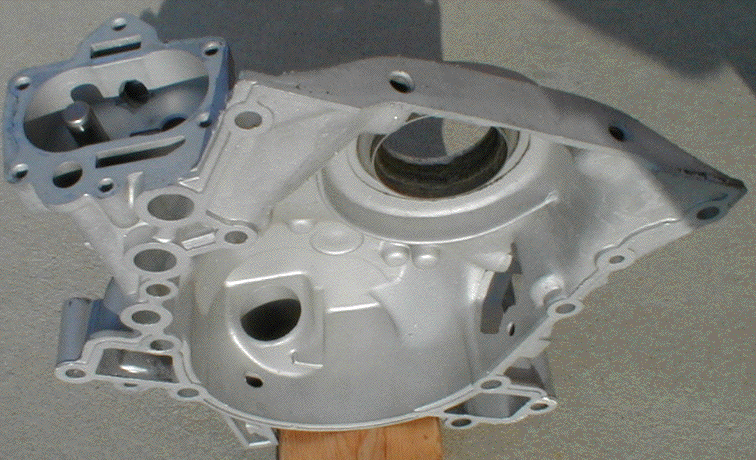
The "front cover" refers to the cover on the front of the engine, behind the water pump and balancer. It covers the timing chain. On the Buick-derived 215, the oil pump is built into this front cover. It is NOT accessible by removing the oil pan.
I'm not trying to be a smart-@$$ here, but if you are that much of a newbie, I would very strongly recommend that you get a Chassis Service Manual BEFORE disassembling the steering linkage. I'm not even sure the oil pan can come off without significantly raising the motor - and there isn't that much clearance in that car anyway with the trans attached.
More importantly, if the engine WAS run with no oil pressure, your main and rod bearings are suspect.
Thread Starter
Registered User
Joined: Aug 2011
Posts: 10
Engine Swap F85
I recently picked up a 63 f85...it's got an aluminum 215 with no oil pressure. I was going to try and track the cause down but from what I'm hearing these engines are not great to begin with. I'd like to switch it out...preferably to something bigger and ideally to a 350 Rocket which I already have, has been rebuilt and runs excellent. Of course the F85 does not have much room under the hood and I'm assuming that is not an option. Does anyone have any input on this subject...whether or not there is a way to cram that thing in there...and assuming not then what is a good option to go with that will fit and mount without major fabrication? Thanks to all.
Jason
Jason
Thread Starter
Registered User
Joined: Aug 2011
Posts: 10
I did go ahead and order the service manual. In the meantime I had already disassembled the steering linkage which was not a major job. I do believe I could have removed that pan with that linkage out of the way given that the pan is very shallow at the front. Doesn't seem to matter at this point anyway. In looking at what will need to be done to remove the front cover...to only possibly find the solution to the problem, I'm considering replacing the engine all together. My question there is what is a good fit in that car that is not a 215? I have a recently rebuilt 350 Rocket which I would love in that car but can't imagine it fitting and wonder if the mounting would include major fabrication. Do you know what would be a good fit that would mount up well. I am aware that the transmission would need to go also. The driveshaft and rear end of that car seem peanut size...would that need replacing as well? Thanks again for the input.
J
J

Old(s) Fart
Joined: Mar 2007
Posts: 50,768
From: Northern VA
I'm not sure why you think the 215 has problems, since it was in production from late 1960 through 2006 (as a Rover). Unfortunately, in our Chevy-centric world, any engine without a bowtie on the valve covers apparently has "problems".
Except for a later Rover motor, there are no different sized engines that bolt in. Yes. folks have swapped Chevy motors into these cars. This is not a trivial swap. For starters, the trans tunnel in the 61-63 cars is very small. The more common GM transmissions do not fit without cutting and welding changes to the tunnel. The stock trans only bolts to the 215/Rover block. Also, the 215 only weighs 320 lbs. Any iron motor will add about 300 lbs to the front wheels. Curb weight on that car is only about 2,600 lbs, so that's not really where you want to go.
The Rover swap is an interesting one (and one I am planning for my own F-85). The Rover block is externally identical to the GM 215, so even the trans bolts up. Later Rover motors have increased displacement (4.0 and 4.6 liters). The 215 carb intake bolts up to the Rover long block if you don't want to mess with EFI. The later Rover motors do not use a distributor, but you can swap the front cover and add a distributor drive gear to the later motors. Or, get an earlier 3.9 liter Rover that already has the distributor.
The Rover motor does use the Buick style heads, so optically it looks different from an Olds 215. I plan to adapt the Olds heads to the Rover block (not a trivial task) so it looks correct.
Except for a later Rover motor, there are no different sized engines that bolt in. Yes. folks have swapped Chevy motors into these cars. This is not a trivial swap. For starters, the trans tunnel in the 61-63 cars is very small. The more common GM transmissions do not fit without cutting and welding changes to the tunnel. The stock trans only bolts to the 215/Rover block. Also, the 215 only weighs 320 lbs. Any iron motor will add about 300 lbs to the front wheels. Curb weight on that car is only about 2,600 lbs, so that's not really where you want to go.
The Rover swap is an interesting one (and one I am planning for my own F-85). The Rover block is externally identical to the GM 215, so even the trans bolts up. Later Rover motors have increased displacement (4.0 and 4.6 liters). The 215 carb intake bolts up to the Rover long block if you don't want to mess with EFI. The later Rover motors do not use a distributor, but you can swap the front cover and add a distributor drive gear to the later motors. Or, get an earlier 3.9 liter Rover that already has the distributor.
The Rover motor does use the Buick style heads, so optically it looks different from an Olds 215. I plan to adapt the Olds heads to the Rover block (not a trivial task) so it looks correct.
Thread Starter
Registered User
Joined: Aug 2011
Posts: 10
Before I reassemble the steering linkage...even if the pump is behind the front cover wouldn't the pick up still be in the pan? Should I be unable to locate the issue and move forward with the Rover motor where do I turn to find one and at approximately what cost?
Old(s) Fart
Joined: Mar 2007
Posts: 50,768
From: Northern VA
I got my 4.6 short block from a classified ad at www.britishV8.org. Also check ebay, craigslist, etc. Note that the newer 4.0 and 4.6 motors do not have a provision for a distributor. The older 3.5 and 3.9 motors do.
Thread Starter
Registered User
Joined: Aug 2011
Posts: 10
Thanks for the help Joe. One last question regarding the pump while I await the delivery of the service manual. An earlier reply from you read...The pump is external to the motor, mounted on the lower passenger side of the front cover. Unbolt the oil filter adapter and the parts of the oil pump fall out into your hand.
Is this saying that there is no need to remove the front cover in order to inspect the pump?
Thanks again.
J
Is this saying that there is no need to remove the front cover in order to inspect the pump?
Thanks again.
J
Old(s) Fart
Joined: Mar 2007
Posts: 50,768
From: Northern VA
Note that this photo is taken from the bottom, block side of the cover, so you're looking from the timing chain's point of view.

Thread
Thread Starter
Forum
Replies
Last Post


