When you click on links to various merchants on this site and make a purchase, this can result in this site earning a commission. Affiliate programs and affiliations include, but are not limited to, the eBay Partner Network.
12A = built first week (A) of December (12), 1963
STYLE 3237 = Cutlass (32) Holiday Coupe (37)
KC = Kansas City assembly plant
1187 BODY = Fisher Body sequence number
TRIM 963 = Blue vinyl interior
HH PAINT = Bermuda Blue lower and upper body color
ACC Codes:
Group 1
S = Power trunk release
Group 2
X = Floor shifter for Jetaway automatic
P = Parking brake signal lamp (unconfirmed)
Yea the 8 and 2 are missing at the start of the vin? Otherwise there is only 8 characters
Well that's interesting. For the 1964 model year, the VIN tags for each assembly plant came pre-stamped with the last eight characters. The first two digits (the first was the engine type - six or eight cylinders, the second was the model line) were stamped on the line when the tag was assigned to a car.
Lansing cars did, but the multi-make assembly plants sometimes did their own thing on cowl tags.
Here's a Lansing tag.
Here's a Fremont tag. Note that instead of using the five group ACC codes, Fremont used the RPO codes. Fremont also added a third paint code letter for the wheels.
Of course, to throw fuel on the fire, here's a KC tag for a Pontiac.
Thanks Joe...I've NEVER seen a trim tag without the year of the make.
Now Fremont tags...I've been collecting those recently. We're trying to see how the engine casting date lines up with the Build date of the car for Fremont.
We have as quick as 3 weeks...and as long as 70 days...It's been interesting.
Another thing to note is that Fremont stopped using the RPO codes all together by the end of march...at least for Oldsmobile.
Not sure about the other brands that went down the line.
Thanks Joe...I've NEVER seen a trim tag without the year of the make.
I had not prior to this either, but I can't say that I've seen a lot of tags from KC cars either.
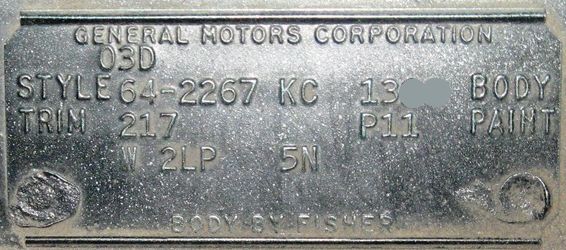
According to this Chevelle site, the Baltimore plant didn't start stamping the model year on the cowl tag until after the start of calendar 1964, in fact the whole tag blank was changed. These two tags are both from 1964 Chevelles. The first is a 12E date code, the second is 04D.
And just to add to the confusion, here's a tag from a 1964 Chevelle from the KC plant, but the body was built in the Euclid, OH body plant (as designated by the EP) but slated for assembly at KC (the K after the paint code). Note that this car is an Oct 63 assembly and does have the model year, whereas the tag in the first post is a Dec 63 assembly and does not, but it doesn't have the EP code either.
I also find it interesting that Chevy covered off on every variation imaginable with their body style #...even S.S.
Vs. Olds which had 8 styles? And zero trim levels?
I realize Chevy just had MORE body styles...but extra identification would have been nice for Olds.
I also find it interesting that Chevy covered off on every variation imaginable with their body style #...even S.S.
Vs. Olds which had 8 styles? And zero trim levels?
I realize Chevy just had MORE body styles...but extra identification would have been nice for Olds.
Not that different from Olds. For the 1965 model year Chevy really only had four A-body model lines (Chevelle, Chevelle Deluxe, Malibu, and SS) to Oldsmobile's three (F85, F85 Deluxe, and Cutlass). The second digit of the model was odd for six cylinder or even for eight cylinder.
F85 33xx, 34xx
F85 Deluxe 35xx, 36xx
Cutlass 38xx (there was no six cylinder option for the high-end Cutlass models)
Note that both Caminos and Vistas were assigned to one of the existing A-body model lines - 33xx, 34xx, 35xx, or 36xx for the ElCo and 34xx or 38xx for the Vista.
Body style numbers were common across all divisions.
Chevy offered seven unique body styles that year:
11 - two door sedan (this is a different roofline than the Olds Sport Coupe)
15 - two door wagon
35 - four door wagon
37 - two door hardtop
67 - convertible
69 - four door sedan
80 - pickup
Olds also offered seven (different) body styles that year:
27 - two door club/sport coupe
35 - four door wagon
37 - two door hardtop
55 - two row extended wagon (Vista)
66 - three row extended wagon
67 - convertible
69 - four door sedan