


Block Bypass hose from thermo housing to water pump ?

Thread Starter
Govt slave
Joined: Jun 2009
Posts: 448
From: Boca Raton , FL
Block Bypass hose from thermo housing to water pump ?
Hi guys,
I live in a hot climate (South Florida) and have been told you can internally block the bypass neck from the thermo housing back to the water pump to make the car run a little cooler.
Any truth to this and if so how do you block it ?
Thanks in advance,
Matt
I live in a hot climate (South Florida) and have been told you can internally block the bypass neck from the thermo housing back to the water pump to make the car run a little cooler.
Any truth to this and if so how do you block it ?
Thanks in advance,
Matt

Registered User
Joined: Jun 2009
Posts: 15,212
From: southeastern Michigan
Boy, this sounds like a disaster in the making. Who told you this? Dr. Phil? 
First, how hot is your car running? I don't care how hot it is in Florida, it isn't so hot that a car with a properly functioning cooling system should be overheating. I live in a hot climate, too, and I haven't changed a thing on either of my old Oldsmobiles. Neither has operating temperature issues.
Why would you want to bypass the water pump as a possible cure, anyway? It seems to me that that would only make the car run hotter and certainly lead to overheating. How will the coolant circulate through the radiator if the pump is partly blocked?
First, how hot is your car running? I don't care how hot it is in Florida, it isn't so hot that a car with a properly functioning cooling system should be overheating. I live in a hot climate, too, and I haven't changed a thing on either of my old Oldsmobiles. Neither has operating temperature issues.
Why would you want to bypass the water pump as a possible cure, anyway? It seems to me that that would only make the car run hotter and certainly lead to overheating. How will the coolant circulate through the radiator if the pump is partly blocked?

Old(s) Fart
Joined: Mar 2007
Posts: 50,841
From: Northern VA
I'm also curious as to who told you this. It makes no sense at all.

Thread Starter
Govt slave
Joined: Jun 2009
Posts: 448
From: Boca Raton , FL
That what I thought...glad you guys are here to confirm.
The engine is a 1970 455 with cam (don't know specs) performer intake with q-jet,stock maifolds.
The car ,on a hot day 90+ degrees will climb to 220 when stop and go for red lights and runs around 200 degrees cruising without stopping.
When I shut the car down after driving she will climb to 230 degrees.
This is all AFTER I backed off the timing to 8 before and installed cooler plugs (r43s)
I have all brand new :
4 core rad,fan shroud,alum flex fan,spring loaded hose,12"electric booster fan,HD water pump, 50/50 antifreeze,160 thermostat.
I just ordered a 180 stat thinking that with the 160 stat the coolant is not staying in the rad long enough to cool.
I'm hoping this will be the solutution
The engine is a 1970 455 with cam (don't know specs) performer intake with q-jet,stock maifolds.
The car ,on a hot day 90+ degrees will climb to 220 when stop and go for red lights and runs around 200 degrees cruising without stopping.
When I shut the car down after driving she will climb to 230 degrees.
This is all AFTER I backed off the timing to 8 before and installed cooler plugs (r43s)
I have all brand new :
4 core rad,fan shroud,alum flex fan,spring loaded hose,12"electric booster fan,HD water pump, 50/50 antifreeze,160 thermostat.
I just ordered a 180 stat thinking that with the 160 stat the coolant is not staying in the rad long enough to cool.
I'm hoping this will be the solutution
Registered User
Joined: Jun 2009
Posts: 15,212
From: southeastern Michigan
Don't be looking to fix what ain't broken. Just drive the car!
Registered User
Joined: Jun 2009
Posts: 15,212
From: southeastern Michigan
The choice of thermostat has no effect on how long the coolant stays is the radiator. Once it opens, it opens, and full coolant flow through the radiator is occurring. What controls the length of time the coolant is in the radiator is the design of the cooling system, size of radiator, etc. But those are fixed quantities for any given engine/radiator/etc. combination.
Again, quit trying to solve a problem that doesn't exist!
Administrator
Joined: Oct 2009
Posts: 42,521
From: Poteau, Ok
That what I thought...glad you guys are here to confirm.
The engine is a 1970 455 with cam (don't know specs) performer intake with q-jet,stock maifolds.
The car ,on a hot day 90+ degrees will climb to 220 when stop and go for red lights and runs around 200 degrees cruising without stopping.
When I shut the car down after driving she will climb to 230 degrees.
These figures are not terribly high.
This is all AFTER I backed off the timing to 8 before and installed cooler plugs (r43s)
Retarded timing can lead to higher temps.
I have all brand new :
4 core rad,fan shroud,alum flex fan,spring loaded hose,12"electric booster fan,HD water pump, 50/50 antifreeze,160 thermostat.
Which flex fan are you running? The booster fan can cut airflow and raise temps by blocking the radiator.
I just ordered a 180 stat thinking that with the 160 stat the coolant is not staying in the rad long enough to cool.
I like the Stant Superstats, the 180 degree should work fine. As the others said there is no difference in coolant flow between thermostats. You can also add a bottle of Water Wetter.
I'm hoping this will be the solutution
The engine is a 1970 455 with cam (don't know specs) performer intake with q-jet,stock maifolds.
The car ,on a hot day 90+ degrees will climb to 220 when stop and go for red lights and runs around 200 degrees cruising without stopping.
When I shut the car down after driving she will climb to 230 degrees.
These figures are not terribly high.
This is all AFTER I backed off the timing to 8 before and installed cooler plugs (r43s)
Retarded timing can lead to higher temps.
I have all brand new :
4 core rad,fan shroud,alum flex fan,spring loaded hose,12"electric booster fan,HD water pump, 50/50 antifreeze,160 thermostat.
Which flex fan are you running? The booster fan can cut airflow and raise temps by blocking the radiator.
I just ordered a 180 stat thinking that with the 160 stat the coolant is not staying in the rad long enough to cool.
I like the Stant Superstats, the 180 degree should work fine. As the others said there is no difference in coolant flow between thermostats. You can also add a bottle of Water Wetter.
I'm hoping this will be the solutution
Thread Starter
Govt slave
Joined: Jun 2009
Posts: 448
From: Boca Raton , FL
So 220 degrees is normal for a BB Olds ?
This is my first Olds engine,
My LS-6 (454/450hp) Chevelle never goes above 195 sitting at lights/traffic on the hottest day and runs 180 while cruising.
This is my first Olds engine,
My LS-6 (454/450hp) Chevelle never goes above 195 sitting at lights/traffic on the hottest day and runs 180 while cruising.
Registered User
Joined: Jun 2009
Posts: 15,212
From: southeastern Michigan
I just now was out for a drive in my '67 Delta 88 with the 425, stock everything, and I have a temperature gauge on it. The outside air temperature is 88 F. Cruising at about 40-50 mph, the temperature sits just under the 200F hashmark on the gauge. Maybe 197 or 198. When I slow to a signal light or stop sign, it drifts up to maybe 202-203. When I shut down the engine, I watched the gauge, and it crept up to about 215.
I have never calibrated this gauge, but those temperatures have always seemed right to me, and I've never worried about them. In fact, until now, I had never watched the gauge after turning off the engine. One more thing to cross off the bucket list!
Registered User
Joined: Jun 2009
Posts: 15,212
From: southeastern Michigan
The higher the temperature, within reason of course, the more efficient is the combustion of fuel. Too low a temperature, combustion is not complete, and you get accelerated build-up of carbon deposits and other unpleasantness.
Thread Starter
Govt slave
Joined: Jun 2009
Posts: 448
From: Boca Raton , FL
"When I slow to a signal light or stop sign, it drifts up to maybe 202-203. When I shut down the engine, I watched the gauge, and it crept up to about 215."
Exactly...that's why I thought 220 was hot (almost 20 degrees hotter then yours at around 200)
And on shut down I'm at least 15 degrees hotter then yours (230+).
At 220 the car runs runs like crap and pings under WOT.
At 180-200 she screams
This is why I think I'm running hot
I tried a Sunpro temp on it also and got the exact same readings
Exactly...that's why I thought 220 was hot (almost 20 degrees hotter then yours at around 200)
And on shut down I'm at least 15 degrees hotter then yours (230+).
At 220 the car runs runs like crap and pings under WOT.
At 180-200 she screams
This is why I think I'm running hot
I tried a Sunpro temp on it also and got the exact same readings
Registered User
Joined: Jun 2009
Posts: 15,212
From: southeastern Michigan
C'mon, man! Don't give us half the data and expect useful suggestions. We can't read minds here. Tell us everything that is going on.
Now, with this new information, yes, I would say you might have a problem with the engine's operating temperature. What's the condition of the radiator? Of the coolant itself? Has the cooling system been recently cleaned/flushed and new coolant installed? Has this problem just cropped up recently with the car running ok before, or is this a problem that's been around since you've owned the car or since you made some modifications?
Remember, we need the full story, not a quarter or half of it!
Thread Starter
Govt slave
Joined: Jun 2009
Posts: 448
From: Boca Raton , FL
Just installed the 455...it was recently rebuilt before I stuffed it in.
The entire cooling system is brand new.
The car has run this way since install
As I said before
ALL NEW:
4 core,
160 t-stat,
hd water pump
Hoses (bottom has a spring)
Aluminum flex fan
(had a brand new stock 7 blade with new clutch same prob)
50/50 coolant
shroud
electric fan set to come on at 190
(this helped bring things down around 10 degrees to current high of 220)
went 2 steps colder plugs (93 vs 95 heat range)
The entire cooling system is brand new.
The car has run this way since install
As I said before
ALL NEW:
4 core,
160 t-stat,
hd water pump
Hoses (bottom has a spring)
Aluminum flex fan
(had a brand new stock 7 blade with new clutch same prob)
50/50 coolant
shroud
electric fan set to come on at 190
(this helped bring things down around 10 degrees to current high of 220)
went 2 steps colder plugs (93 vs 95 heat range)
Registered User
Joined: Jun 2009
Posts: 15,212
From: southeastern Michigan
My hunch is that your temperature problem is the result of a combustion problem, not the cause of it. Trying to cure the temperature problem could be attacking the symptom, not the cause.
Pinging at high load suggests premature combustion which can lead to overheating and which might be due to using the wrong fuel or possibly having the timing set wrong as oldcutlass suggests. Are you running premium or regular fuel?
Pinging at high load suggests premature combustion which can lead to overheating and which might be due to using the wrong fuel or possibly having the timing set wrong as oldcutlass suggests. Are you running premium or regular fuel?
Thread Starter
Govt slave
Joined: Jun 2009
Posts: 448
From: Boca Raton , FL
93 octane...she won't ping when I mix it with 100 leaded,but still sputters at high revs when the car gets that hot.
I know I have a fuel starvation problem (maybe vapor lock) under WOT when hot.
Before the car gets hot (cold to 180) she's fine.
I know I have a fuel starvation problem (maybe vapor lock) under WOT when hot.
Before the car gets hot (cold to 180) she's fine.

Big Daddy No Bucks
Joined: Jul 2010
Posts: 893
From: SW Florida
Ok ...
I'll come stand in YOUR corner although a 455 will tend to run a lil' warmer.
I'd feel much better w/a peak of @ 200-210 ...
As I am of the mindset/opinion that an Olds V8 runs much better at @ 180-190.
Power begins to drop off after 200 & is definitely noticeable at 220 ... esp when you have less to start with (like say a 307). Accelerating into heavy traffic w/a 307 churning along at 230 should have had its own chapter in one of the late Dr Kevorkian book's.
Judging by your comment on the power drop ... the gauge is probably not far off ... tho confirming it wouldn't hurt.
As mentioned check out the ignition timing ... sounds like it might not be advanced enough at lower RPM's, as cruising speed temps aren't that bad (200).
You may require MORE than just bumping up the initial such as ... tweaking your springs/weights/vacuum advance etc to better compliment the unknown cam specs.
Do you know if it was bored out & how much ?.
I remember the days when I would go sit in a parking lot in the middle of the summer - the baking sun beating down & a/c on for hours ... just to see how high the gauge would climb.
(yes I'm twisted like that)
Winner :
1981 Toro w/a 1976 350 ..... 190 degrees.
And with barely a slither of a grill for hot air to escape ... go figure.
I'll come stand in YOUR corner although a 455 will tend to run a lil' warmer.
I'd feel much better w/a peak of @ 200-210 ...
As I am of the mindset/opinion that an Olds V8 runs much better at @ 180-190.
Power begins to drop off after 200 & is definitely noticeable at 220 ... esp when you have less to start with (like say a 307). Accelerating into heavy traffic w/a 307 churning along at 230 should have had its own chapter in one of the late Dr Kevorkian book's.
Judging by your comment on the power drop ... the gauge is probably not far off ... tho confirming it wouldn't hurt.
As mentioned check out the ignition timing ... sounds like it might not be advanced enough at lower RPM's, as cruising speed temps aren't that bad (200).
You may require MORE than just bumping up the initial such as ... tweaking your springs/weights/vacuum advance etc to better compliment the unknown cam specs.
Do you know if it was bored out & how much ?.
I remember the days when I would go sit in a parking lot in the middle of the summer - the baking sun beating down & a/c on for hours ... just to see how high the gauge would climb.
(yes I'm twisted like that)
Winner :
1981 Toro w/a 1976 350 ..... 190 degrees.
And with barely a slither of a grill for hot air to escape ... go figure.

Administrator
Joined: Oct 2009
Posts: 42,521
From: Poteau, Ok
What flex fan are your running?
What it sounds to me is that your engine is not completely dialed in. The advertised tune up specs do not apply to a modified engine. It's time for some tinkering.
Did you run a full 12v to your pertronix?
What it sounds to me is that your engine is not completely dialed in. The advertised tune up specs do not apply to a modified engine. It's time for some tinkering.
Did you run a full 12v to your pertronix?

Registered User
Joined: Jun 2010
Posts: 3,613
From: Rogues Island, USA
Running colder plugs isn't going to bring your engine coolant temp down. It just brings the tip of the plug temp down which may not be a good thing.
I'm leaning toward what Bill said. It may be lean across the board.
I'm leaning toward what Bill said. It may be lean across the board.
Thread Starter
Govt slave
Joined: Jun 2009
Posts: 448
From: Boca Raton , FL
yes..fan is on correctly...same one as is my Chevelle...works great
No...not completed dialed in...still need to play with carb more
Thread Starter
Govt slave
Joined: Jun 2009
Posts: 448
From: Boca Raton , FL

Administrator
Joined: Oct 2009
Posts: 42,521
From: Poteau, Ok
What is the part # of your flex fan or a picture of it? Is your fan blade centered in the shroud opening lip looking at it from the side. Are all the insulating flaps around the radiator installed and intact? Is your pusher fan rotating the correct way.
I believe you have an air flow problem at idle and slow speed since it's maintaining temp at cruise. In addition a contributing factor is a bad tune.
Registered User
Joined: Jun 2010
Posts: 3,613
From: Rogues Island, USA
You say you have a shroud and that your fan is 1 3/4 from the rad. Is the fan centered in the shroud opening, not along the sides but front to back. Distance from the radiator is irrelevant when using a shroud. It basically needs to be sunk 3/4 inch into the shroud opening.
Old(s) Fart
Joined: Mar 2007
Posts: 50,841
From: Northern VA
I will say that the flex fan is a contributor to your problem. Ditch it and get a proper six- or seven blade factory style fan with a quality clutch. The clutch fan is LESS of a HP drain on the motor than the flex fan when the clutch is not engaged. There's a reason why factories use the more expensive clutch fan rather than a cheap flex fan, especially considering that factories try to shave every penny off the production costs that they can.
Thread Starter
Govt slave
Joined: Jun 2009
Posts: 448
From: Boca Raton , FL
This is the fan I'm using.
http://www.summitracing.com/parts/hda-3567
It is centered in the shroud,
it is sucking lots of air through the radiator.(yes it's on the correct rotation)
The shroud extends over the blades fully.
I had a brand new 7 blade stock fan with new a/c delco cluch thermostat that made no difference (I even tried to unhook the clockspring to make it stiffer).
I beleive what some of you said that the car is just running too lean,because I have the fuel starvation issue under WOT.
I am going to have a friend come this week and mess with my Q-jet...I'll post the outcome as soon as I know
http://www.summitracing.com/parts/hda-3567
It is centered in the shroud,
it is sucking lots of air through the radiator.(yes it's on the correct rotation)
The shroud extends over the blades fully.
I had a brand new 7 blade stock fan with new a/c delco cluch thermostat that made no difference (I even tried to unhook the clockspring to make it stiffer).
I beleive what some of you said that the car is just running too lean,because I have the fuel starvation issue under WOT.
I am going to have a friend come this week and mess with my Q-jet...I'll post the outcome as soon as I know
Administrator
Joined: Oct 2009
Posts: 42,521
From: Poteau, Ok
You say you have a shroud and that your fan is 1 3/4 from the rad. Is the fan centered in the shroud opening, not along the sides but front to back. Distance from the radiator is irrelevant when using a shroud. It basically needs to be sunk 3/4 inch into the shroud opening.
Registered User
Joined: Oct 2010
Posts: 1,275
From: Boise ID
Actually for a fan to work at it's best it is has to be half in and half out of the shroud to produce the most air flow, I researched this extensively before I built my new shroud. To far in the fan just churns the air in the shroud and to far out and it doesn't draw enough.


Registered User
Joined: Jun 2008
Posts: 1,015
From: Near Muskegon Michigan
I ran that same flex fan for a very short time on mine. Hated the roar all of the time. With what you have I would be looking towards the engine also. It sure is a strange one.
And the answer is------
And the answer is------

Registered User
Joined: May 2009
Posts: 1,614
From: S.E. Louisiana, so far still in U.S.A.
More fuel for the fire
While I don't have a solution for your particular situation, I would like to add a bit to the thread which may re-fire the discussion. This is related to the original question posted. Many Generation II Olds V-8 engines have difficulty keeping a reasonable temperature in hotter environments. Most agree that excessive temperatures diminish performance and degrades lubricants. The original question was regarding the thermostat bypass which allows coolant to re-enter the engine without passing through the radiator. Such a device did not exist on many engines. Most assume that it is there for a reason, and I am sure that it is. A big question is what reason. I have heard many possibilities from better thermostat response, cavitation reduction, better heater response, more even temperatures within the engine preceding thermostat opening, etc. I suggest that unless someone was in the design office in the early 1960s or had access to the design notes, they probably don't know the reason(s). The bypass design used on the Olds engines are not as sophisticated as some newer designs. Here you can see one which simultaneously closes the bypass as the thermostat opens.
http://www.are.com.au/feat/techt/thermostat.htm
This seems to confirm that an open bypass, after achieving operating temperature, is undesirable.
I have a Generation I Olds V-8 which operates at the rating of the thermostat. Another non-Olds vehicle performs similarly. A Generation II Olds I have struggles to not overheat (240+F) on hot days (95-105F).
Whatever the reasons were for the bypass, many engines survived without it.
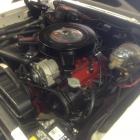
I have attached some images which show Olds Generation II V-8 engines and components which appear to be without the bypass. None of them are mine.
As an experiment, on a hot day, I removed the thermostat and plugged the bypass. It seemed to reduce the upper operating temperature by about 15-20F, and increased warm up time slightly. Warm up time has never been a problem in my part of the world. Either of these modifications is easy. You can do one without the other or both. If you don't like the results it's easy to put it back as it was. Considering all the major modifications some make, these are easy, cheap, and reversible.
http://www.are.com.au/feat/techt/thermostat.htm
This seems to confirm that an open bypass, after achieving operating temperature, is undesirable.
I have a Generation I Olds V-8 which operates at the rating of the thermostat. Another non-Olds vehicle performs similarly. A Generation II Olds I have struggles to not overheat (240+F) on hot days (95-105F).
Whatever the reasons were for the bypass, many engines survived without it.
I have attached some images which show Olds Generation II V-8 engines and components which appear to be without the bypass. None of them are mine.
As an experiment, on a hot day, I removed the thermostat and plugged the bypass. It seemed to reduce the upper operating temperature by about 15-20F, and increased warm up time slightly. Warm up time has never been a problem in my part of the world. Either of these modifications is easy. You can do one without the other or both. If you don't like the results it's easy to put it back as it was. Considering all the major modifications some make, these are easy, cheap, and reversible.
Last edited by Ozzie; Aug 25, 2013 at 05:48 PM. Reason: minor error correction


